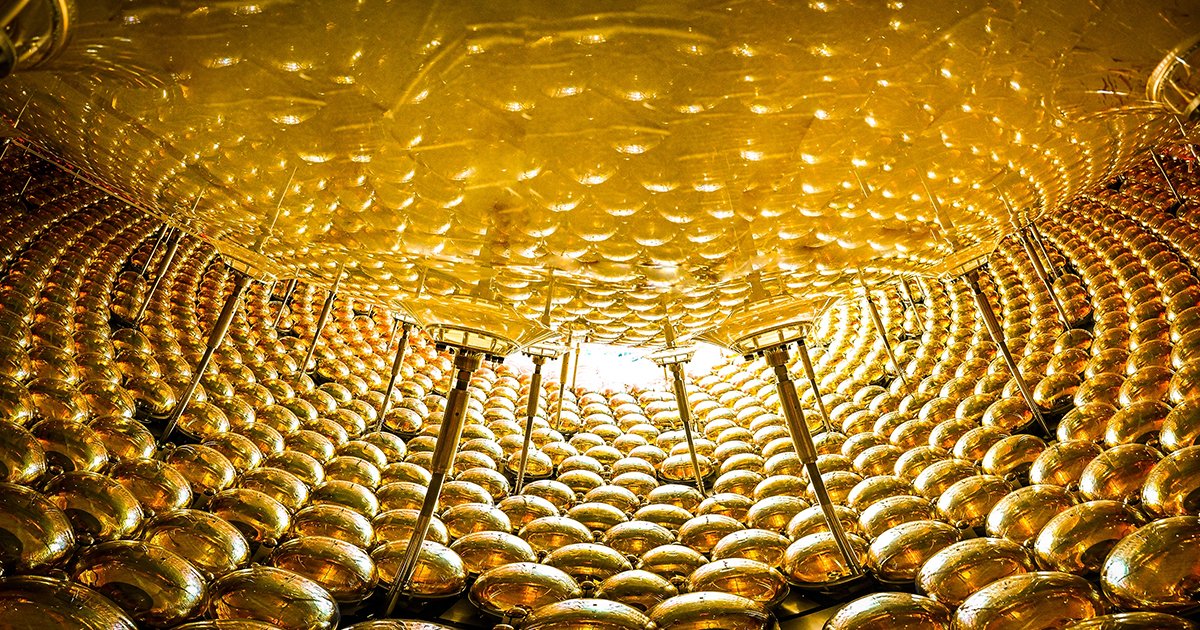
In counting geoneutrinos, physicists can get a direct measure of Earth’s vital heat-producing elements. “It’s the one thing we do that focuses on the Earth,” said Ryan Bayes, a particle astrophysicist at Queen’s University in Ontario who works on SNO+. “Everything else we do is more focused on what we receive from other places in the universe.”
The first detection of geoneutrinos, by an instrument in Japan called Kamland, was reported in 2005. In 2009, the Borexino detector in Italy reported catching several dozen more. In November 2025, SNO+ reported its first detection, bumping up the number of observed geoneutrinos by about 50.
What makes the detections at SNO+ special is the experiment’s location: These are the first geoneutrinos measured in the western hemisphere, offering a new perspective on Earth’s radioactive interior.
Major uncertainties remain in interpreting the results from these experiments, but researchers’ best estimates suggest that each site is measuring a different flux. “It could be that that’s the first hint that the mantle is not uniform,” said Mark Chen, a particle astrophysicist at Queen’s University and director of the SNO+ collaboration.
Geochemists have conventionally assumed that radioactive elements are distributed evenly throughout the mantle, because the flowing rock should mix everything together. But the measurements of geoneutrinos in different locations could hint that this is not the case.
The regions that seem to be producing the most geoneutrinos sit roughly above continent-size blobs of anomalously hot, dense material, known as large low-shear-velocity provinces, or LLSVPs, which seismologists have mapped on either side of the core. One is under Africa, the other under the Pacific Ocean. “There may be deep Earth structures in the mantle that are not understood,” Chen said. “It could be that [they] concentrate some kinds of elements.”
Neutrinos could one day offer new insight into the still mysterious origin of these deep structures and, more broadly, the patterns in the mantle that underlie many aspects of the Earth system. “It really would be a way to make a chemical map of the Earth’s interior,” said William McDonough, a geochemist at the Chinese Academy of Sciences who has long been a leading voice in the search for geoneutrinos.
Catching Geoneutrinos
The outstanding question is whether the geoneutrino measurements reveal differences between the areas of mantle below each experiment, or if the imbalance originates in the way the different experiments count their geoneutrinos. Researchers across the board say there’s still so much uncertainty that it’s impossible to say.
“If we take it at face value, we could say maybe the western hemisphere has a lot more radioactive material in it than the eastern hemisphere,” McDonough said. But there are reasons to be wary of these estimates. “Are the Italians right? Are the Japanese right? Are they both right? Or is something wrong?” he said.