
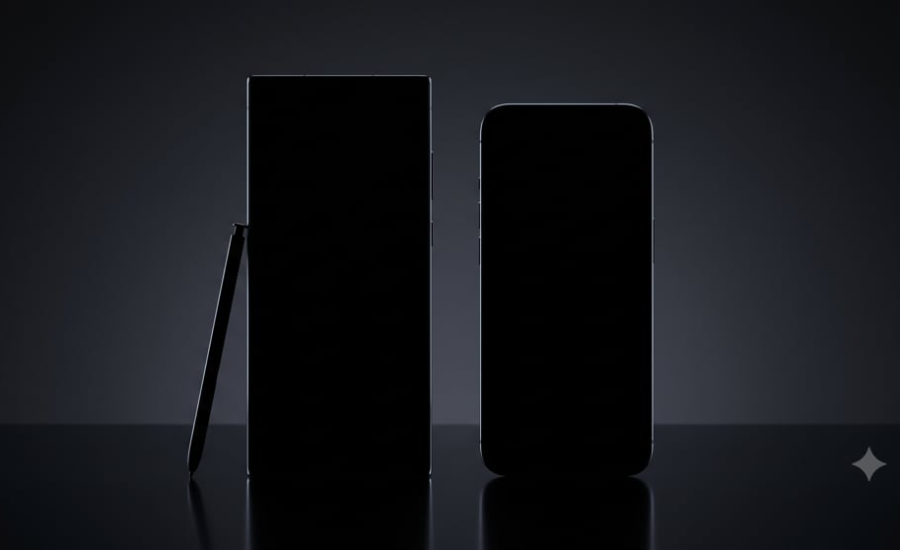
Samsung’s next flagship lineup may introduce more than a routine annual upgrade. The company is reportedly preparing a new Galaxy S27 Pro alongside the standard S27, S27+, and S27 Ultra, creating a fourth model for buyers who want premium hardware without the Ultra’s size.
The Pro may not be the smaller Ultra its name suggests. Recent supply-chain reporting indicates that Samsung could separate the models through their zoom cameras, display sizes, and S Pen support. The Ultra may lose its dedicated 3x telephoto camera but retain a higher-resolution 5x lens, while the Pro is expected to use a shorter-range zoom camera in a more compact body.
The split would leave the Pro focused on portability and shared flagship camera components, while the Ultra remains Samsung’s larger, stylus-equipped option with stronger long-range zoom. Samsung has not announced the series, and its plans could change before the expected early-2027 launch. However, WinFuture’s review of import and export records points to four models under the codenames NM1 through NM4.
Cameras, screens, and batteries separate the models
The Pro and Ultra are both rumored to use a 50MP Sony IMX855 ultrawide camera and a 16MP autofocus selfie camera. Samsung has not confirmed either specification.
A South Korean supply-chain report says the Ultra could have a 200MP main camera, 50MP ultrawide, and 50MP 5x telephoto. That arrangement would eliminate the dedicated 3x telephoto camera used on the Galaxy S26 Ultra.
The Pro would reportedly retain a lower-resolution 3x telephoto camera. Accounts differ on whether it would use a 10MP or 12MP sensor, so the precise specification remains uncertain. The ETNews report links the revised camera layouts partly to rising component costs.
That account conflicts with an earlier WinFuture-based report describing two telephoto cameras on the Ultra and a 50MP 5x lens on the Pro. The supply-chain report presents a different arrangement, but neither configuration should be treated as final.
Screen size and stylus support provide a more consistent comparison. The Pro is tipped to have a 6.47-inch OLED display and is not expected to support the S Pen. The Ultra is expected to remain the larger, stylus-equipped model.
Battery records reportedly list rated capacities of 5,087mAh for the Pro and 5,534mAh for the Ultra. Those figures could translate to marketed capacities of about 5,200mAh and 5,700mAh, respectively. Samsung has confirmed neither the capacities nor the chemistry, although it was previously reported to be testing silicon-carbon batteries for the S27 generation.
Regional hardware could complicate purchasing
The Pro appears positioned as a compact premium phone rather than a smaller copy of the Ultra. It could appeal to buyers who want advanced cameras and a large battery without the Ultra’s size, stylus, or longer optical zoom.
South Korea’s Money Today, as subsequently reported by SamMobile, says the Pro could use an Exynos chip in most markets and Snapdragon hardware in North America. The Ultra may remain Snapdragon-only worldwide. Those claims are summarized in a separate Galaxy S27 processor report, but Samsung has not confirmed either plan.
Pricing, storage tiers, carrier availability, and Enterprise Edition eligibility remain unknown. Samsung gives the Galaxy S26 series seven generations of operating system upgrades and seven years of security updates, but it has not announced support terms for the S27 lineup.
Organizations planning a 2027 refresh will need confirmed regional models, support periods, management options, and pricing before standardizing on either phone across multiple markets. Component costs could also affect the final configurations as AI demand reshapes smartphone production.
Read more: Google’s planned Pixel price increases offer an early indication of the cost pressures Samsung may face with its next flagship phone lineup.