
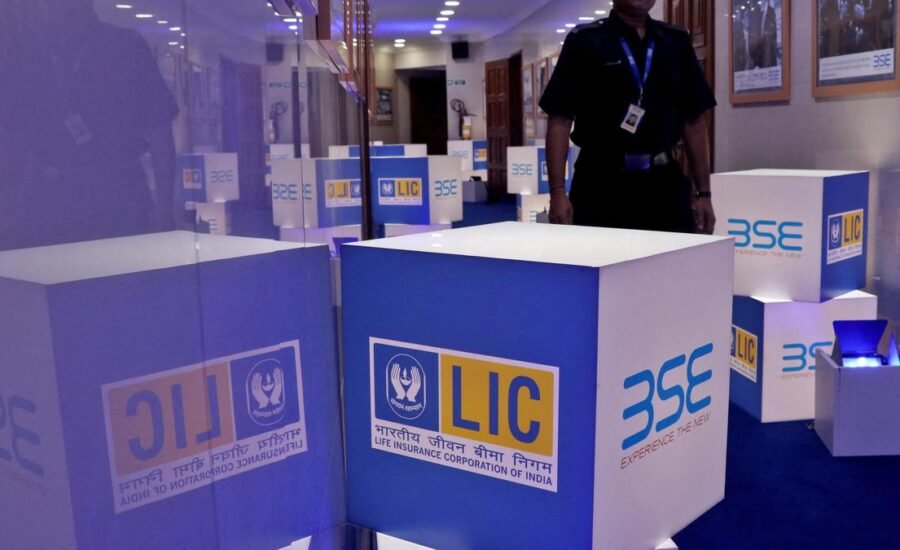

The government took the Offer for Sale route to shed 6.5% from the 96.5% stake it held in LIC.
| Photo Credit: Reuters
The story so far: The Government of India is partially offloading stake in the Life Insurance Corporation of India (LIC), one of its crown jewels. The move, while helping the insurance behemoth comply with capital market regulator Securities and Exchange Board of India’s (SEBI) shareholding norms ahead of the deadline, will actually benefit the Centre from a perspective of inching closer to its ₹80,000 crore disinvestment target for FY27.
When did the LIC’s offer for sale begin and what were its contours?
The government took the Offer for Sale (OFS) route to shed 6.5% from the 96.5% stake it held in LIC. The two-day OFS opened on August 4 for institutional or non-retail investors. August 5, the second day, was for retail investors to bid. Under the OFS, the government decided to disinvest 2.5% equity with an additional 4% as a green shoe option. It had set the floor price at ₹382 per share, which compared to August 3 closing price of ₹424.35 on the BSE translated into a discount of 10%.
What is the trigger behind the LIC OFS?
SEBI, as part of the prescribed minimum public shareholding norms, had set a revised May 16, 2027, deadline for LIC to achieve 10% public shareholding. The OFS will thus make the corporation compliant with the requirement ahead of the deadline, which SEBI had fixed in May 2024.

Besides achieving the MPS norms, the OFS is equally important for the proceeds the sale of more than 82.22 crore shares will fetch the government. On full subscription at the base price, it would translate into ₹31,000 crore accretion to the disinvestment kitty – since the government is selling stake, LIC will not get anything from the OFS.
Is the timing of OFS right and what about investor interest in LIC?
Prevailing market conditions and the shadow cast by recent geo-political developments as well as the likelihood of the response not being as desired if the OFS is pushed to a later date could have contributed to the timing. The debate on the timing can continue, but the response reflects a continued investor interest in the country’s leading life insurer. This despite LIC continuing to lose market share to private insurers over the years while maintaining the pole position and reporting growth in new business. For FY26, the market share of the corporation was a little over 56%.

The Initial Public Offering (IPO) of LIC hit the market in 2022 with the government fixing the issue price at ₹949 apiece ahead of the May 17, 2022, listing. As many as 22.13 crore shares, or 3.5% stake, were sold by the government through the IPO. The IPO was the largest in FY23 and raised ₹20,557 crore.
What does the OFS of LIC mean for the average investor?
The OFS follows bonus equity shares that were issued in the ratio of 1:1 to existing shareholders, earlier this year. Since no new shares are being issued or in other words the number of LIC shares remain the same even after the OFS, the fact that the government is shedding its stake may have a bearing on the share price, atleast temporarily. Given its size and scale of operations as well as one of the Domestic Systemically Important Insurers (D-Slls) – thus subjected to enhanced regulatory supervision – LIC will remain under the spotlight and consequently its shares will generate investor interest.

As regards the OFS, a senior official in the Department of Investment and Public Asset Management said it received an overwhelming response from the institutional investors and was over-subscribed 3.32 times of its base size. “This enthusiastic participation reflects robust investor confidence and the depth of India’s capital markets. In view of the exceptional demand, the government has decided to exercise the green shoe option. Retail investors get to bid tomorrow. Make the most of this opportunity!” he said in a social media post on August 4 evening.
How important is the LIC OFS for the government’s divestment receipts perspective?
It is possibly the most important. DIPAM data shows the disinvestment receipts, ahead of the OFS by LIC, totalled ₹21,201.13 crore in 2026-27. Coal India’s 2% OFS generating ₹5,542.36 crore was the highest. With the stake sale in LIC expected to mop up around ₹31,000 crore, the government will move closer to its disinvestment receipts target of ₹80,000 crore in FY27. Interestingly, Union Budget documents make no reference to divestment, clubbing them under Miscellaneous Capital Receipts, including receipts on account of management of equity investments and public assets through various mechanisms.
Published – August 05, 2026 04:39 pm IST