
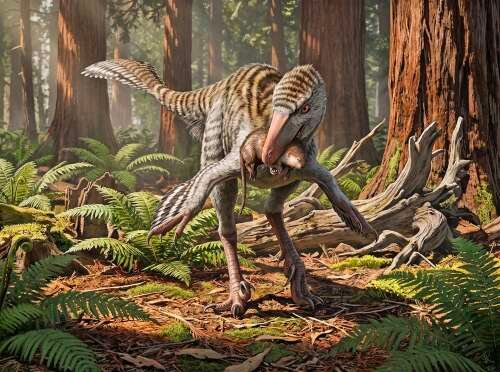
New Mexico paleontologists on Aug. 4, 2026, announced the discovery of a new dinosaur species they named Dinevenator robustus, pictured above, who lived in New Mexico more than 70 million years ago. (Courtesy New Mexico Museum of Natural History and Science)
Newly dubbed Dinevenator robustus contributes to understanding of late Cretaceous Period, scientist says
The New Mexico Museum of Natural History and Science announced Tuesday that two of its paleontologists had identified a new bird-like dinosaur species after first discovering an unusual skull fossil in San Juan County in the summer of 2005.
The shard of skull bone that research associate and paleontologist Robert Sullivan discovered south of Kirtland was initially believed to belong to a dromaeosaur, which is closely related to a velociraptor.
But Sullivan’s colleague, paleontologist Steven Jasinski, later realized that a section of the skull was thicker than a dromaesaur’s and also had other features that made him believe it was a new species.
Sullivan and Jasinski recently published a paper in the journal Fossil Studies that identified the new species as Dinevenator robustus.
Jasinski told Source NM on Tuesday that the dinosaur’s name they chose is based on “Diné,” out of gratitude for being allowed to search for fossils on land historically occupied by the Navajo people.
As for the rest of the name, “venator” is Latin for “hunter.” And “robustus” refers to the thickness of the fossil that distinguishes it from other dinosaurs in the troodontid family.
New Mexico paleontologist Robert Sullivan first discovered this skull fossil in 2005 south of Kirtland, N.M., leading to the eventual identification of Dinevenator robustus. (Courtesy New Mexico Museum of Natural History and Science)
“It’s a very robust, very thick, kind of beefy dinosaur for this group,” Jasinkski said. “This is important because we’re learning that we have different types of these dinosaurs living in different areas here in the Late Cretaceous, around 70 to 75 million years ago.”
Troodontids are two-legged, omnivorous dinosaurs that roamed the Earth between 66 million and 160 million years ago.
While the scientists have little fossil material to go on, they believe the new species in New Mexico would have measured eight to 10 feet in length and weighed 150 to 300 pounds, based on data from other species. That would make Dinevenator one of the larger known troodontids.
Jasinski said the discovery helps demonstrate the importance of New Mexico’s fossil deposits in global dinosaur research. The site where Sullivan found the skull – known as the De-na-zin Member of the Kirtland Formation – is far less researched than other well-known North American fossil sites in Montana, Canada and Wyoming, he said.
“This area of the world and New Mexico, in particular, got partially overlooked. People stopped collecting there” after early discoveries in the late 1800s, Jasinski said.
But discoveries like Dinevenator show that northwestern New Mexico may have much to offer scientists seeking to better understand the time period right before the mass-extinction event that marked the end of the Cretaceous Period roughly 66 million years ago.
“Now we’re learning that we have a lot of really, really interesting, distinct, different dinosaurs and animals from this time period,” Jasinski said.