
Researchers in Germany and the UK have discovered a material that can flip its chirality when put under physical stress. The researchers hope the phenomenon, which they have dubbed the piezochiral effect, could enable rational control over the enantioselectivity of catalysts.1
Chirality is crucial to numerous areas of chemistry, such as biochemistry and pharmacology, and its control is therefore important in determining the efficiency of chemical syntheses. David MacMillan at Princeton University, US, and Benjamin List at the Max Planck Institute for Coal Research in Germany shared the 2021 Nobel prize in chemistry for their work on asymmetric catalysis, catalysts that preferentially lead to the formation of one isomer of a product and, therefore, reduce waste.
Tuning the chirality of a pre-existing material, however, is tricky. Strain has broad applications on the electrical, magnetic and mechanical properties of materials, and strain engineering has, therefore, found applications ranging from integrated circuits to quartz watches. However, switching the chirality of a material using strain seemed impossible as strain has a direction, whereas chirality is simply left- or right-handed.
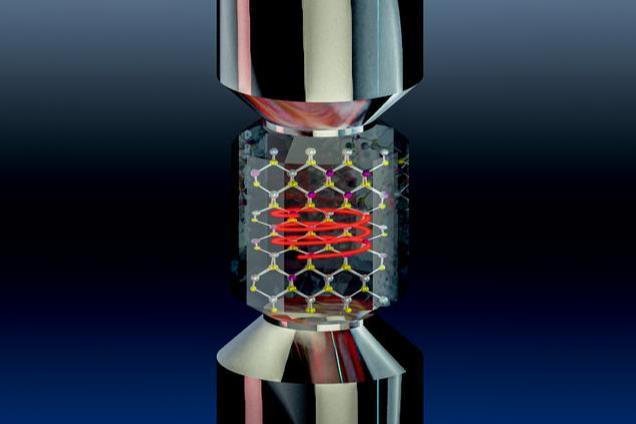
However, condensed matter physicists in the groups of Andrea Cavalleri at the Max Planck Institute for the Structure and Dynamics of Matter in Hamburg and Paolo Radaelli at the University of Oxford made an interesting discovery in 2025.2 They showed that terahertz electromagnetic pulses of opposite plane polarisation could transiently alter the chirality of the crystal boron phosphate. In the new research, they extend this to static tension or compression, demonstrating their results using polarisation rotation measurements of silver gallium sulfide in a strain cell. The key, explains Cavalleri, is that in equilibrium the structure contains regions of alternating chirality in perfect balance, and so the material appears non-chiral, much as an antiferromagnetic that contains alternate regions of each polarisation appears non-magnetic. ‘If you can do something to make one sub-lattice bigger than the other, you bought yourself a ferrimagnet, which has a magnetisation,’ he says. Similarly, pressure can disturb the balance between the two chiralities, conferring a net chirality on the crystal. The researchers identified other crystals in which they believe this phenomenon is likely to be found, including gallium(II) selenide, lithium triborate and cadmium aluminium sulfide.
He suspects their discovery might be of interest in catalysis. ‘Imagine if you come in on a Monday and you want right-handed molecules, and you come in on a Tuesday and want left-handed molecules,’ he says. ‘You can use the same substrate if by applying strain you can turn it from a right-handed to a left-handed chiral system.’
Computational materials scientist Aldo Romero at West Virginia University in the US describes the work as ‘very cool’. He believes that it could have immediate applications in strain sensors, especially as, unlike in piezoelectric materials, the force required to switch the chirality and thereby affect the light rotation detected is relatively small. Beyond this, he says, the potential of the work in fields such as catalysis is hard to predict. ‘People are not exploring that much because we do not control the chirality [of catalysts], but now with this experiment – and I guess with more research that is going to come – we are going to be able to look at the possibility of controlling catalysis in more detail using chirality,’ he says.