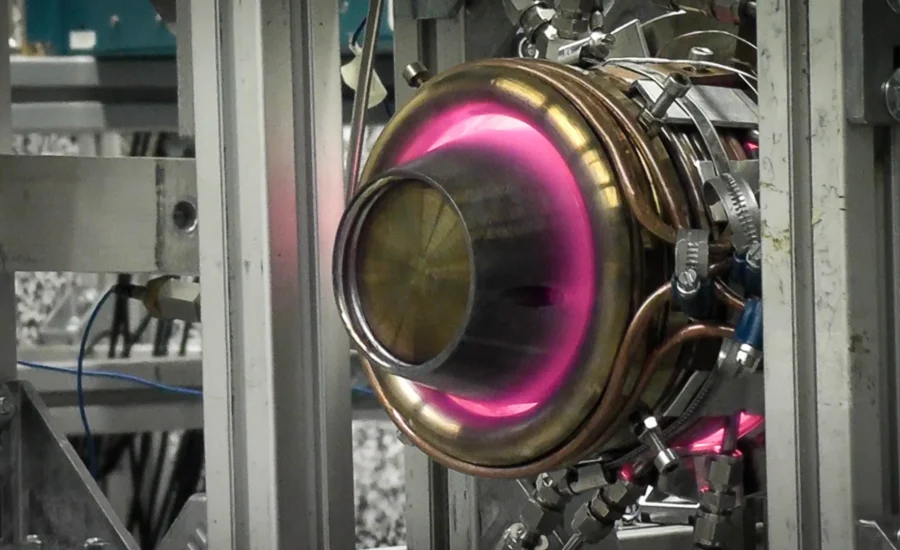
Researchers at the Karlsruhe Institute of Technology (KIT) have achieved a major milestone in hydrogen power by operating a new compressorless gas turbine for a record 303 seconds. The burner uses an advanced form of pressure-gain combustion and surpassed NASA’s previous record of 250 seconds.
The result also marks progress toward using hydrogen for cleaner energy production. Unlike natural gas, hydrogen can be produced using renewable energy sources. Earlier this year, the KIT team also became the first to generate electricity with a hydrogen gas turbine that does not rely on a mechanical compressor.
Hydrogen Turbine Runs for More Than Five Minutes
Earlier experiments could continue for only fractions of a second because longer operation would cause the combustion chambers to melt. The new test extended the operating time to more than five minutes.
“This is an important step toward highly efficient and flexible hydrogen energy for a fossil-free energy system,” explains Professor Daniel Banuti, Director of the Institute of Thermal Energy Technology and Safety (ITES).
A key benefit of the design is that it does not require energy to compress air before combustion begins.
“A conventional gas turbine, such as those used in power plants or under aircraft wings, consumes about 50 percent of its power to compress air to the high pressure needed for efficient combustion — power that is then unavailable for electricity generation,” Banuti explains.
Detonation Waves Replace the Compressor
The new turbine is built around pressure-gain combustion. Conventional gas turbines use a mechanical compressor to raise air pressure, a process that can consume roughly half of the turbine’s power output.
The KIT system creates the required pressure inside the combustion chamber instead. Detonation waves form through a fluid mechanical instability involving wave and vortex patterns in the flowing gases. This allows the turbine to operate without a mechanical compressor.
Removing the compressor could reduce energy losses, lower the number of moving components, and improve overall efficiency.
Why Hydrogen Works So Well
The technology can operate with fuels other than hydrogen, but hydrogen is especially suitable because it reacts very quickly and can produce stable increases in pressure.
Researchers say the approach could eventually support turbines that are lighter, less expensive, and highly efficient. Potential applications include electricity generation and, over the longer term, aviation.
Generating Electricity Without Mechanical Compression
Connecting the combustion chamber to a turbine and converting its intense combustion into electricity created an additional engineering challenge. The rapid and powerful reactions inside the chamber make it difficult to transfer energy to the turbine in a stable way.
“This is extremely difficult because the very fast and intense combustion processes in the chamber make stable energy transfer to the turbine challenging. We are the first to successfully operate such a turbine and generate electricity in the process,” says Banuti.