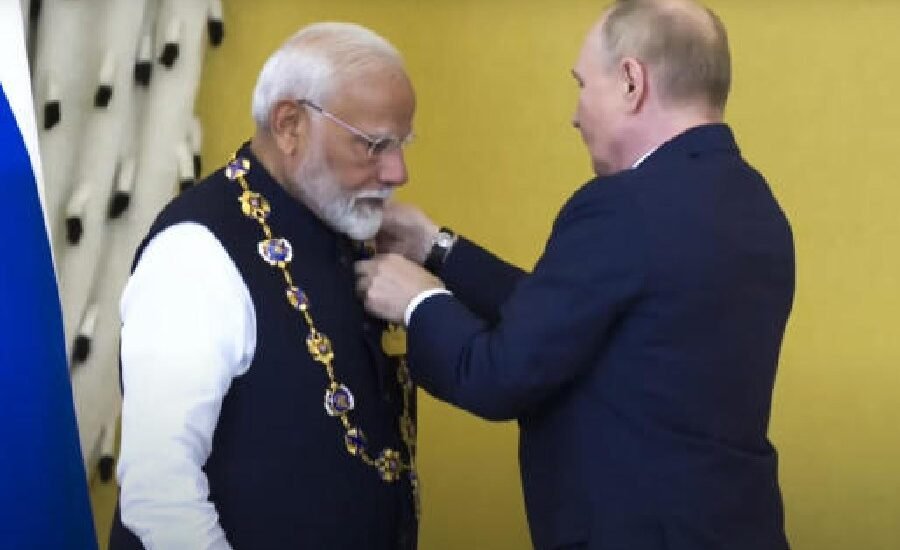
What do national awards given to a country’s head of government by foreign countries mean for foreign and strategic interests of the country of the recipient? This is a serious question for India’s foreign policy and diplomacy because Prime Minister Narendra Modi has been given national awards by 33 countries since he assumed office in 2014. No other serving head of government or head of State — executive or otherwise — appears to have received the same number of foreign national awards as Modi has in his 12 years in office.
The first award given to Modi was by Saudi Arabia in 2016 during his visit to the kingdom. In his media briefing on April 5, 2016, Amar Sinha, the then secretary (Economic Relations) in the ministry of external affairs had noted “… the Saudis saved a huge surprise… by conferring on Prime Minister the highest civilian order — King Abdulaziz Special Sash. This actually came as a surprise to all of us.” In response to a query, Sinha clarified “… this is the highest civilian order and I guess this reflects the closeness between the two leaders.” What Sinha should have added was that it was the highest civilian honour given by the Saudis to heads of governments; heads of States get awards that are higher in the pecking order.
This technicality, though, does not take away from the significance of the gesture to Modi who became the first Indian prime minister to receive the award. Manmohan Singh, who had visited the kingdom in 2010, was honoured differently — he addressed the Saudi Majlis al Shoora and was also given an honorary doctorate. The Saudi award to Modi was, in fact, more an indication of the Saudi desire to comprehensively enhance their ties with India and signalled their acceptance of the domestic political choices of the Indian people but it was nevertheless significant. All in all, the award was significant for Indo-Saudi relations. In the past decade, though, much has changed in the interstate relations in the Arabian Peninsula as well as in India’s approaches.
Beginning with Saudi Arabia, Modi received two other awards in his first term. These were from Afghanistan and Palestine which conferred on him their highest honours. India’s contributions to the Afghan republic and New Delhi’s long-standing support for the Palestinian cause could raise no eye-brows regarding these decisions. Meanwhile, the United Arab Emirates and Russia announced in April 2019 that they would honour Modi with their highest awards. While the UAE conferred its award in August 2019, the Russians did so in 2024. Thus, effectively, five awards were given or announced for Modi in his first term. They reflected the ties between India and the award-giving states.
Ten nation-states gave Modi national awards in his second term. These were the Maldives, Bahrain, the United States of America, Fiji, Papua New Guinea, Egypt, France, Greece and Bhutan. While India’s relations with most of these countries were doing well, the doubling of the number of awards in his second term was noteworthy. Answering a question in the Rajya Sabha in December 2023 on the foreign awards given to Modi since he assumed office in 2014, the former minister of state for external affairs, V. Muraleedharan, stated, “Conferring the highest awards on the Prime Minister of India is a clear recognition of his statesmanship and leadership at bilateral, regional and global levels. It also reflects a recognition of India under PM’s leadership, including in giving voice to the Global South on the world stage, and approaching issues confronted by humanity through dialogue and diplomacy”. Muraleedharan clearly emphasised that these awards reflected Modi’s achievements rather than dwelling on how they had contributed to enhancing India’s interests.
Modi places enormous importance on interpersonal ties between leaders as a path for enhancing India’s external interests. However, while good personal relations between leaders may lubricate bilateral ties, they are not the determinant factor in moving them to a higher trajectory.
In a little more than two years of his third term so far, Modi has visited 39 countries on bilateral and multilateral visits. He also went to New York to attend the United Nations in 2024 to participate in the Summit of the Future. While in the decade of his first two terms, Modi received 14 national awards in this much shorter period, 19 countries have showered him with honour. These are Nigeria, Dominica, Guyana, Kuwait, Barbados, Mauritius, Sri Lanka, Ghana, Trinidad and Tobago, Oman, Israel, Sweden, Norway, Slovakia and Indonesia. The last five nations gave him awards this year.
Of these, one, the award given by Israel, stands out. The Speaker of the Knesset conferred on Modi the ‘Medal of the Knesset’ during his visit to Israel in February this year. He became the first foreign leader to receive this honour but the medal was criticised by Israel’s Opposition parties because there is no legislation to back it. It would have been far better for Israel to confer on him a regular national award than one which has become controversial.
In addition, Seychelles gave Modi the honorary distinction of the ‘Guardian of the Blue Horizon’. The presidential citation not only noted his contribution to the development of India-Seychelles ties but also his contribution to the ‘Blue Economy’ and sustainable development of the ocean economy. It appears that the thought of the citation came to the Seychelles authorities just on the eve of the visit — at least that is what they clarified — when they realised that errors had crept into the citation document.
The spurt in Modi’s awards in the past two years has led to the question if some of the countries he now visits feel ‘obliged’ to give him an award. The basis of this query may be that Delhi-based diplomats often recommend their home country’s leadership to give these awards for the success of Modi’s visit. This may be because some, in this country, project the awards to gain domestic political dividends. Certainly, the great increase in the number of awards has given rise to a host of views which do not have a bearing on India’s interests.
The ministry of external affairs would do well to establish the perception that Modi’s focus is only on enhancing Indian interests and not on awards.
Vivek Katju is a retired Indian Foreign Service officer