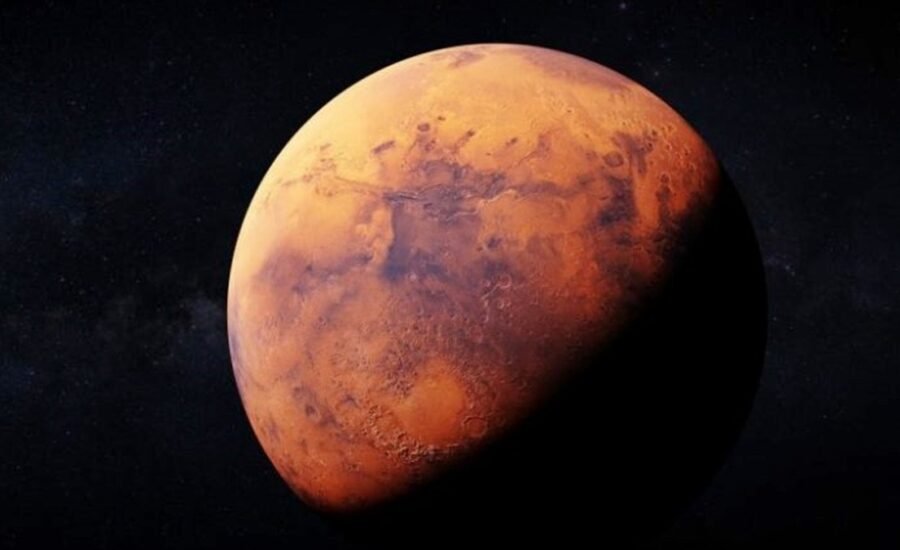
Elon Musk’s vision of making humanity a multi-planetary species by settling Mars has captivated the world. But while engineers work on rockets capable of carrying humans to the Red Planet, scientists have uncovered fresh evidence that Mars is under constant attack from an unlikely enemy, the Sun.
A new study led by Boston University and published in Science Advances has revealed how the solar wind continuously strips away Mars’ atmosphere, helping explain how a once potentially habitable world transformed into the cold, dry desert seen today.
Unlike Earth, Mars lacks a strong global magnetic field that can deflect the Sun’s stream of charged particles, known as the solar wind. Instead, these high-speed particles slam directly into the Martian atmosphere, gradually carrying it away into space.
Researchers discovered that the process resembles wind blowing across the surface of a lake. Just as strong winds create ripples and vortices in water, the solar wind generates massive Kelvin-Helmholtz waves along the boundary of Mars’ upper atmosphere.
These waves stir up giant clouds of electrically charged gas, or plasma, allowing atmospheric particles to escape into space.
Using simultaneous observations from Nasa’s MAVEN spacecraft and China’s Tianwen-1 mission, scientists were able to directly link conditions in the incoming solar wind with atmospheric particles escaping from Mars for the first time.
“We provided clear evidence that these plasma clouds are generated by Kelvin-Helmholtz waves,” said lead author Chi Zhang, a research scientist at Boston University’s Center for Space Physics.
The team also found that atmospheric loss is not uniform across Mars. Instead, it occurs primarily on one side of the planet depending on the direction of the solar wind’s electric field.
Understanding this process is crucial because scientists believe Mars once possessed a much thicker atmosphere and abundant liquid water, conditions that may have supported life billions of years ago. Over time, the relentless bombardment by the solar wind gradually eroded that protective atmosphere.
The findings also have implications beyond Mars. Similar atmospheric erosion could occur on planets without strong magnetic fields, including some potentially habitable exoplanets.
As Nasa’s MAVEN mission approaches its final phase, researchers are looking forward to the upcoming ESCAPADE mission, which will continue investigating how the Sun shapes the Martian environment.
For future human explorers, including those envisioned by Musk, the study is a reminder that Mars is not just a distant destination—it remains a planet still being reshaped every day by the power of its parent star.
– Ends