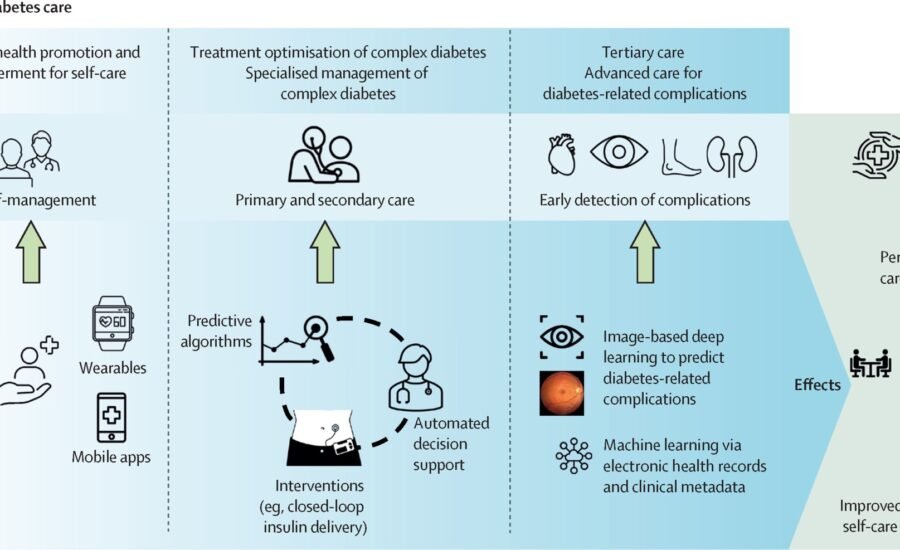
There is real AI in the world based on training on real data, especially in medicine. We are starting to see practical AI in every aspect of diabetes of all kinds, brought together in the Lancet paper below. Now I think that we can all agree here that there is too much Artificial Stupidity in the world, aka AI Slop, as though we didn’t have enough of the real thing. We can also agree that thieving data center builders need to be reined in with requirements to provide renewable electricity and industrial heat pump cooling before the computers are turned on.
I can confidently predict that the world of diabetic quackery will go all in on AI, as it has done on the bogus wristwatch blood glucose sensors that we have occasionally looked at here. I will not get started today on RFK jr. claiming that Type 2 diabetes is “curable” except to note that he is proof that Natural Stupidity continues to be more malignant than the artificial kinds.

Artificial intelligence (AI) has the potential to improve primary diabetes care in low-income and middle-income countries (LMICs), where the rising burden of disease contrasts sharply with limited health-care resources. Emerging evidence shows the promise of AI for screening, risk prediction, monitoring, and personalised management of diabetes and its complications. However, substantial barriers remain, including infrastructure deficits, data fragmentation, equity and inclusivity challenges, limited prospective validation, and concerns about the acceptability, sustainability, and regulatory oversight of AI. The effective integration of AI into primary diabetes care will depend on coordinated investment in foundational infrastructure that includes large-scale development and rigorous validation of novel AI models for use by primary care physicians and patients across diverse populations. AI initiatives are also needed to support interdisciplinary and international collaborations spanning clinical, technical, and policy domains to ensure successful implementation. By aligning technological innovation with health care needs, AI could evolve from a proof-of-concept tool to a practical enabler of equitable, scalable, and cost-effective diabetes care in LMICs. In this Personal View, we outline the major opportunities and challenges of applying AI to primary diabetes care in LMICs, and propose directions for future development and implementation.
References
The paper above gives these 80 references. Some of these papers are about the nature of the problems we diabetics face around the world, medical, social, technological, and so on, or look at existing datasets to consider what we need for effective AI training to benefit patients and societies. Some, highlighted in bold, particularly take on AI issues.
I trust that it is clear that I have not read all of them yet. This is a growth field, where what is available today will be dwarfed by developments over the next few years.
I have been an avid reader of science fiction since childhood. Nobody whom I know of foresaw the AI boom. I have seen plenty of space travel and robot science fiction, and a few tales that foretold atomic weapons or Global Warming catastrophes or communications satellites in geosynchronous orbits. There are tales of computers like Skynet or Colossus taking over the world, but not practical AI, nor, for that matter, the current wave of Artificial Stupidity polluting the InterWebz. We could talk about a few Heinlein and Asimov tales of beneficent computer-operated governments, but let’s get back to diabetes, where we currently need all the help we can get.
1.
Chan, JCN ∙ Lim, LL ∙ Wareham, NJ ∙ et al.
The Lancet Commission on diabetes: using data to transform diabetes care and patient lives
Lancet. 2021; 396:2019-2082
2.
GBD 2021 Diabetes Collaborators
Global, regional, and national burden of diabetes from 1990 to 2021, with projections of prevalence to 2050: a systematic analysis for the Global Burden of Disease Study 2021
Lancet. 2023; 402:203-234
3.
NCD Risk Factor Collaboration (NCD-RisC)
Worldwide trends in diabetes prevalence and treatment from 1990 to 2022: a pooled analysis of 1108 population-representative studies with 141 million participants
Lancet. 2024; 404:2077-2093
4.
The Lancet Diabetes & Endocrinology
Urbanisation, inequality, and non-communicable disease risk
Lancet Diabetes Endocrinol. 2017; 5:313
5.
Global Health and Population Project on Access to Care for Cardiometabolic Diseases Collaborators
Attainment of global diabetes targets in 2021: a pooled analysis of individual-level data from national surveys in 100 low-income, middle-income, and high-income countries
Lancet Glob Health. 2026; 14:e21-e32
6.
Beaglehole, R ∙ Epping-Jordan, J ∙ Patel, V ∙ et al.
Improving the prevention and management of chronic disease in low-income and middle-income countries: a priority for primary health care
Lancet. 2008; 372:940-949
7.
Global Health and Population Project on Access to Care for Cardiometabolic Diseases
Expanding access to newer medicines for people with type 2 diabetes in low-income and middle-income countries: a cost-effectiveness and price target analysis
Lancet Diabetes Endocrinol. 2021; 9:825-836
8.
Agarwal, S ∙ Wade, AN ∙ Mbanya, JC ∙ et al.
The role of structural racism and geographical inequity in diabetes outcomes
Lancet. 2023; 402:235-249
9.
Li, J ∙ Guan, Z ∙ Wang, J ∙ et al.
Integrated image-based deep learning and language models for primary diabetes care
Nat Med. 2024; 30:2886-2896
10.
Sheng, B ∙ Pushpanathan, K ∙ Guan, Z ∙ et al.
Artificial intelligence for diabetes care: current and future prospects
Lancet Diabetes Endocrinol. 2024; 12:569-595
11.
McCarthy, J ∙ Minsky, ML ∙ Shannon, CE
A proposal for the Dartmouth summer research project on artificial intelligence—August 31, 1955
AI Mag. 2006; 27:12-14
12.
García-Ulloa, AC ∙ Almeda-Valdes, P ∙ Aguilar-Salinas, CA ∙ et al.
Development and validation of a software linked to an internet portal that facilitates the medical treatment and empowerment of patients with type 2 diabetes, interaction with medical personnel, and the generation of a real-time registry
J Diabetes Sci Technol. 2021; 15:525-527
13.
Antonio-Villa, NE ∙ Palma-Moreno, BG ∙ Rodríguez-Dávila, FM ∙ et al.
Use of an electronic integral monitoring system for patients with diabetes to identify factors associated with an adequate glycemic goal and to measure quality of care
Prim Care Diabetes. 2021; 15:162-168
14.
Zhang, K ∙ Liu, X ∙ Xu, J ∙ et al.
Deep-learning models for the detection and incidence prediction of chronic kidney disease and type 2 diabetes from retinal fundus images
Nat Biomed Eng. 2021; 5:533-545
15.
Ting, DSW ∙ Cheung, CY ∙ Lim, G ∙ et al.
Development and validation of a deep learning system for diabetic retinopathy and related eye diseases using retinal images from multiethnic populations with diabetes
JAMA. 2017; 318:2211-2223
16.
Gulshan, V ∙ Peng, L ∙ Coram, M ∙ et al.
Development and validation of a deep learning algorithm for detection of diabetic retinopathy in retinal fundus photographs
JAMA. 2016; 316:2402-2410
17.
Meng, Z ∙ Guan, Z ∙ Yu, S ∙ et al.
Non-invasive biopsy diagnosis of diabetic kidney disease via deep learning applied to retinal images: a population-based study
Lancet Digit Health. 2025; 7, 100868
18.
Jiang, N ∙ Ji, H ∙ Guan, Z ∙ et al.
A deep learning system for detecting silent brain infarction and predicting stroke risk
Nat Biomed Eng. 2025; 9:1907-1919
19.
Dai, L ∙ Wu, L ∙ Li, H ∙ et al.
A deep learning system for detecting diabetic retinopathy across the disease spectrum
Nat Commun. 2021; 12, 3242
20.
Dai, L ∙ Sheng, B ∙ Chen, T ∙ et al.
A deep learning system for predicting time to progression of diabetic retinopathy
Nat Med. 2024; 30:584-594
21.
Bora, A ∙ Balasubramanian, S ∙ Babenko, B ∙ et al.
Predicting the risk of developing diabetic retinopathy using deep learning
Lancet Digit Health. 2021; 3:e10-e19
22.
Lu, Y ∙ Liu, D ∙ Liang, Z ∙ et al.
A pretrained transformer model for decoding individual glucose dynamics from continuous glucose monitoring data
Natl Sci Rev. 2025; 12, nwaf039
23.
Wang, G ∙ Liu, X ∙ Ying, Z ∙ et al.
Optimized glycemic control of type 2 diabetes with reinforcement learning: a proof-of-concept trial
Nat Med. 2023; 29:2633-2642
24.
Tyler, NS ∙ Mosquera-Lopez, CM ∙ Wilson, LM ∙ et al.
An artificial intelligence decision support system for the management of type 1 diabetes
Nat Metab. 2020; 2:612-619
25.
Bergenstal, RM ∙ Johnson, M ∙ Passi, R ∙ et al.
Automated insulin dosing guidance to optimise insulin management in patients with type 2 diabetes: a multicentre, randomised controlled trial
Lancet. 2019; 393:1138-1148
26.
Mathioudakis, N ∙ Lalani, B ∙ Abusamaan, MS ∙ et al.
An AI-powered lifestyle intervention vs human coaching in the diabetes prevention program: a randomized clinical trial
JAMA. 2025; 334:2079-2089
27.
Khasentino, J ∙ Belyaeva, A ∙ Liu, X ∙ et al.
A personal health large language model for sleep and fitness coaching
Nat Med. 2025; 31:3394-3403
28.
Ferguson, T ∙ Olds, T ∙ Curtis, R ∙ et al.
Effectiveness of wearable activity trackers to increase physical activity and improve health: a systematic review of systematic reviews and meta-analyses
Lancet Digit Health. 2022; 4:e615-e626
29.
Guan, Z ∙ Li, H ∙ Liu, R ∙ et al.
Artificial intelligence in diabetes management: advancements, opportunities, and challenges
Cell Rep Med. 2023; 4, 101213
30.
Qian, B ∙ Sheng, B ∙ Chen, H ∙ et al.
A Competition for the diagnosis of myopic maculopathy by artificial intelligence algorithms
JAMA Ophthalmol. 2024; 142:1006-1015
31.
Agrawal, A
Laying an equitable data foundation for foundation models
Lancet Reg Health Southeast Asia. 2023; 13, 100221
32.
Hong, N ∙ Whittier, DE ∙ Glüer, CC ∙ et al.
The potential role for artificial intelligence in fracture risk prediction
Lancet Diabetes Endocrinol. 2024; 12:596-600
33.
Wang, J ∙ Qin, Y ∙ Wu, Q ∙ et al.
An adaptive AI-based virtual reality sports system for adolescents with excess body weight: a randomized controlled trial
Nat Med. 2025; 31:2255-2268
34.
Aristidou, A ∙ Jena, R ∙ Topol, EJ
Bridging the chasm between AI and clinical implementation
Lancet. 2022; 399:620
35.
Young, AT ∙ Amara, D ∙ Bhattacharya, A ∙ et al.
Patient and general public attitudes towards clinical artificial intelligence: a mixed methods systematic review
Lancet Digit Health. 2021; 3:e599-e611
36.
Cohen, IG ∙ Evgeniou, T ∙ Gerke, S ∙ et al.
The European artificial intelligence strategy: implications and challenges for digital health
Lancet Digit Health. 2020; 2:e376-e379
37.
Bellemo, V ∙ Lim, ZW ∙ Lim, G ∙ et al.
Artificial intelligence using deep learning to screen for referable and vision-threatening diabetic retinopathy in Africa: a clinical validation study
Lancet Digit Health. 2019; 1:e35-e44
38.
Mathenge, WC
Artificial intelligence for diabetic retinopathy screening in Africa
Lancet Digit Health. 2019; 1:e6-e7
39.
Roberti, J ∙ Leslie, HH ∙ Doubova, SV ∙ et al.
Inequalities in health system coverage and quality: a cross-sectional survey of four Latin American countries
Lancet Glob Health. 2024; 12:e145-e155
40.
Riley, RD ∙ Ensor, J ∙ Snell, KIE ∙ et al.
Importance of sample size on the quality and utility of AI-based prediction models for healthcare
Lancet Digit Health. 2025; 7, 100857
41.
Chambers and Partners
Healthcare: medical devices—trends and developments
Date: 2025
Date accessed: December 6, 2025
42.
Liu, Y ∙ Yu, W ∙ Dillon, T
Regulatory responses and approval status of artificial intelligence medical devices with a focus on China
NPJ Digit Med. 2024; 7:255
43.
Yuan, M ∙ Yao, M-m ∙ Xu, M ∙ et al.
Large-scale local deployment of DeepSeek-R1 in pilot hospitals in china: a nationwide cross-sectional survey
medRxiv. 2025;
published on May 16. https://doi.org/10.1101/2025.05.15.25326843
44.
Chinese Government
The CPC Central Committee and the State Council issued the “Outline of the “Healthy China 2030” Plan”
https://www.gov.cn/zhengce/2016-10/25/content_5124174.htm
Date: Oct 25, 2016
Date accessed: March 11, 2026
45.
Chinese Government
Government work report
https://www.gov.cn/yaowen/liebiao/202403/content_6939153.htm
Date: March 12, 2024
Date accessed: March 11, 2026
46.
Zeng, D ∙ Li, H ∙ Car, J ∙ et al.
Transforming Chinese cohort studies through artificial intelligence: a new era of population health research
BMJ. 2025; 391, e082568
47.
National Health Commission of the People’s Republic of China
Notice from the General Office of the National Health Commission on issuing reference guidelines for artificial intelligence application scenarios in the health sector
https://www.nhc.gov.cn/guihuaxxs/c100133/202411/3dee425b8dc34f739d63483c4e5c334c.shtml
Date: Nov 14, 2024
Date accessed: March 11, 2026
48.
Chinese Government
Notice on issuing the implementation plan for the Healthy China Action – diabetes prevention and control action (2024–2030)
https://www.gov.cn/zhengce/zhengceku/202407/content_6965000.htm
Date: July 15, 2024
Date accessed: March 11, 2026
49.
Liu, Y ∙ Xiao, S ∙ Yin, X ∙ et al.
Nation-wide routinely collected health datasets in China: a scoping review
Public Health Rev. 2022; 43, 1605025
50.
Chinese Government
Building upon the initial survey, new indicators were added for hot topics such as artificial intelligence, big data models, and the low-altitude economy—a comprehensive assessment of data resources
https://www.gov.cn/lianbo/bumen/202505/content_7025580.htm
Date: 2025
Date accessed: December 6, 2025
51.
Liang, J ∙ Li, Y ∙ Zhang, Z ∙ et al.
Adoption of electronic health records (EHRs) in China during the past 10 years: consecutive survey data analysis and comparison of Sino-American challenges and experiences
J Med Internet Res. 2021; 23, e24813
52.
Xu, Y ∙ Pei, Z ∙ He, X ∙ et al.
The individuals’ awareness and adoption of electronic health records in China: a questionnaire survey of 1 337 individuals
BMC Public Health. 2024; 24:905
53.
Zeng, D ∙ Qin, Y ∙ Sheng, B ∙ et al.
DeepSeek’s “low-cost” adoption across China’s hospital systems: too fast, too soon?
JAMA. 2025; 333:1866-1869
54.
Yip, W
Improving primary healthcare with generative AI
Nat Med. 2024; 30:2727-2728
55.
Sinclair, A ∙ Saeedi, P ∙ Kaundal, A ∙ et al.
Diabetes and global ageing among 65–99-year-old adults: findings from the International Diabetes Federation Diabetes Atlas, 9th edition
Diabetes Res Clin Pract. 2020; 162, 108078
56.
Liu, S ∙ Zhao, H ∙ Fu, J ∙ et al.
Current status and influencing factors of digital health literacy among community-dwelling older adults in southwest China: a cross-sectional study
BMC Public Health. 2022; 22:996
57.
Zhang, C
Smartphones and telemedicine for older people in China: opportunities and challenges
Digit Health. 2022; 8
20552076221133695
58.
Chinese Government
Statistical bulletin on the development of China’s health sector in 2024
https://www.nhc.gov.cn/guihuaxxs/c100133/202512/f1c3a3c61748427126468afbaeee.shtml
Date accessed: December 6, 2025
59.
Li, M ∙ Tang, H ∙ Zheng, H ∙ et al.
Supporting and retaining competent primary care workforce in low-resource settings: lessons learned from a prospective cohort study
Fam Med Community Health. 2023; 11, e002421
60.
Wang, X ∙ Sun, Q ∙ Chen, L ∙ et al.
Physician turnover in China, 2011–2021: a nationwide longitudinal study
Hum Resour Health. 2025; 23:40
61.
Liu, X ∙ Li, Y ∙ Li, L ∙ et al.
Prevalence, awareness, treatment, control of type 2 diabetes mellitus and risk factors in Chinese rural population: the RuralDiab study
Sci Rep. 2016; 6, 31426
62.
Wang, L ∙ Peng, W ∙ Zhao, Z ∙ et al.
Prevalence and treatment of diabetes in China, 2013–2018
JAMA. 2021; 326:2498-2506
63.
Pi, L ∙ He, B ∙ Fei, D ∙ et al.
Diabetes knowledge, attitudes and practices among Chinese primary care physicians: a cross-sectional study
BMC Prim Care. 2024; 25:348
64.
Zhang, Z
Survey and analysis on the resource situation of primary health care institutions in rural China
Front Public Health. 2024; 12, 1394527
65.
Huang, M ∙ Rozelle, S ∙ Cao, Y ∙ et al.
Primary care quality and provider disparities in China: a standardized-patient-based study
Lancet Reg Health West Pac. 2024; 50, 101161
66.
Borges do Nascimento, IJ ∙ Abdulazeem, HM ∙ Vasanthan, LT ∙ et al.
The global effect of digital health technologies on health workers’ competencies and health workplace: an umbrella review of systematic reviews and lexical-based and sentence-based meta-analysis
Lancet Digit Health. 2023; 5:e534-e544
67.
Alderman, JE ∙ Palmer, J ∙ Laws, E ∙ et al.
Tackling algorithmic bias and promoting transparency in health datasets: the STANDING Together consensus recommendations
Lancet Digit Health. 2025; 7:e64-e88
68.
Dorsey, ER ∙ Topol, EJ
Telemedicine 2020 and the next decade
Lancet. 2020; 395:859
69.
Sheng, B ∙ Guan, Z ∙ Lim, LL ∙ et al.
Large language models for diabetes care: potentials and prospects
Sci Bull. 2024; 69:583-588
70.
Bornstein, SR ∙ Dey, AK ∙ Steenblock, C ∙ et al.
Artificial intelligence and diabetes: time for action and caution
Lancet Diabetes Endocrinol. 2025; 13:552-554
71.
Panteli, D ∙ Adib, K ∙ Buttigieg, S ∙ et al.
Artificial intelligence in public health: promises, challenges, and an agenda for policy makers and public health institutions
Lancet Public Health. 2025; 10:e428-e432
72.
WHO
WHO package of essential noncommunicable (PEN) disease interventions for primary health care
Date: Sept 7, 2020
Date accessed: March 11, 2026
73.
The Lancet Diabetes and Endocrinology
Diabetes care and AI: a looming threat or a necessary advancement?
Lancet Diabetes Endocrinol. 2023; 11:441
74.
African Union
AU data policy framework
Date: July 28, 2022
Date accessed: March 11, 2026
75.
Wu, Y ∙ Qian, B ∙ Li, T ∙ et al.
An eyecare foundation model for clinical assistance: a randomized controlled trial
Nat Med. 2025; 31:3404-3413
76.
Farzadfar, F ∙ Murray, CJ ∙ Gakidou, E ∙ et al.
Effectiveness of diabetes and hypertension management by rural primary health-care workers (Behvarz workers) in Iran: a nationally representative observational study
Lancet. 2012; 379:47-54
77.
Joshi, R ∙ Alim, M ∙ Kengne, AP ∙ et al.
Task shifting for non-communicable disease management in low and middle income countries–a systematic review
PLoS One. 2014; 9, e103754
78.
Pammi, M ∙ Shah, PS ∙ Yang, LK ∙ et al.
Digital twins, synthetic patient data, and in-silico trials: can they empower paediatric clinical trials?
Lancet Digit Health. 2025; 7, 100851
79.
Kraljevic, Z ∙ Bean, D ∙ Shek, A ∙ et al.
Foresight-a generative pretrained transformer for modelling of patient timelines using electronic health records: a retrospective modelling study
Lancet Digit Health. 2024; 6:e281-e290
80.
Guan, Z ∙ Zeng, D ∙ Li, H ∙ et al.
Can generative artificial intelligence empower target trial emulations?
Lancet Digit Health. 2026; 8, 100950