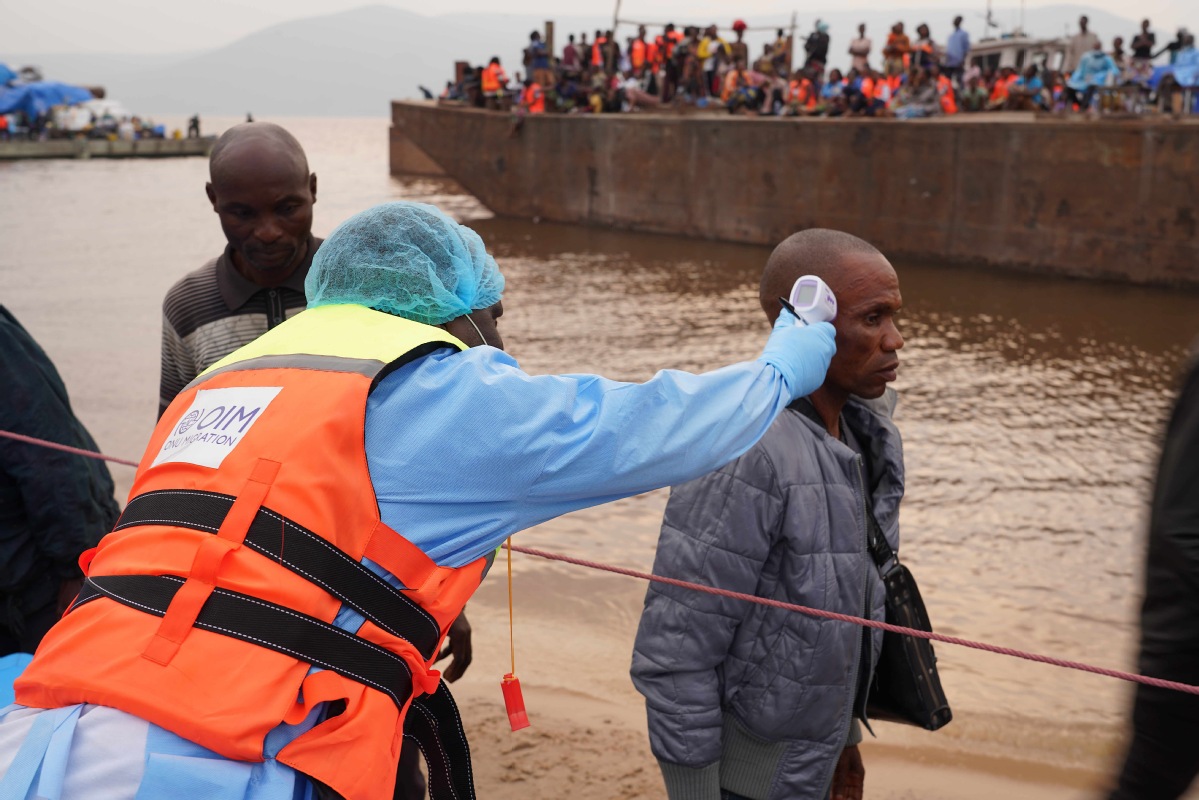
The Ebola outbreak in the Democratic Republic of Congo has entered a critical new phase, with 4,035 cases confirmed.
Jean Kaseya, director-general of the Africa Centres for Disease Control and Prevention, said on Thursday that the cases overwhelmed traditional contact tracing and forced health authorities to adopt a village-by-village response while expanding vaccination and antiviral treatment.
Kaseya announced the strategy during a joint news briefing by the Africa CDC and the World Health Organization following a high-level mission to Uganda and the DR Congo, where officials assessed the outbreak response and identified community engagement as the key to slowing transmission.
The shift comes as the outbreak, caused by the Bundibugyo strain of the Ebola virus, continues to spread rapidly across eastern DR Congo. Health authorities said the country now has 1,850 deaths, with infections reported in 51 health zones across five provinces.
“This becomes a major concern,” Kaseya said. “The level of severity of this Bundibugyo outbreak is unprecedented.”
He said the outbreak has expanded far faster than previous Ebola epidemics, recording in just 12 weeks nearly nine times more confirmed cases and six times more deaths than the 2014 West African outbreak over a comparable period.
Kaseya said traditional contact tracing is no longer keeping pace with the outbreak. On average, only 10 contacts are identified per confirmed case, far below the expected 20 to 40. With over 4,000 confirmed cases, he estimated they should be monitoring at least 160,000 people, yet only about 17,000 contacts are currently being followed.
The most immediate concern, however, is that conventional outbreak control measures are no longer keeping pace with transmission, according to Africa CDC.
Kaseya said WHO Africa has begun studies to determine whether factors including possible viral mutations could be contributing to the outbreak”s unusual severity, stressing that no evidence has yet established such a link.
To curb transmission, Africa CDC and the DR Congo’s government will shift from conventional contact tracing to active community case finding. Tens of thousands of community health workers will conduct door-to-door visits to identify suspected cases, encourage early testing and support isolation and referrals.
“We are changing the concept,” Kaseya said. “Containing and ultimately stopping this outbreak will come from communities.”
Following meetings with President Felix Tshisekedi and senior government officials in Kinshasa this week, Africa CDC and WHO agreed on a new response centered on affected communities.
Community health workers will also receive mobile phones and digital tools, while internet connectivity will be expanded to remote villages to strengthen surveillance and reporting.
Officials stressed that the vaccine has already been approved by major international regulators and the World Health Organization, with current studies focusing on its effectiveness against the circulating strain rather than its safety.
WHO Director-General Tedros Adhanom Ghebreyesus on Wednesday warned that the outbreak is outpacing the current response and called for greater international support.
sharon@chinadailyafrica.com