In brief
- A chunk of a SpaceX rocket hurtled into the moon this week, putting renewed attention on the issue of space junk.
- Experts say governments need to do more to manage what’s happening off our planet.
Experts fear space is becoming dangerously crowded, as a new era of exploration sends ever more objects into orbit and to the moon.
The recent crash of a huge chunk of SpaceX rocket debris into the moon has renewed attention on the surprisingly large collection of human-made material in space.
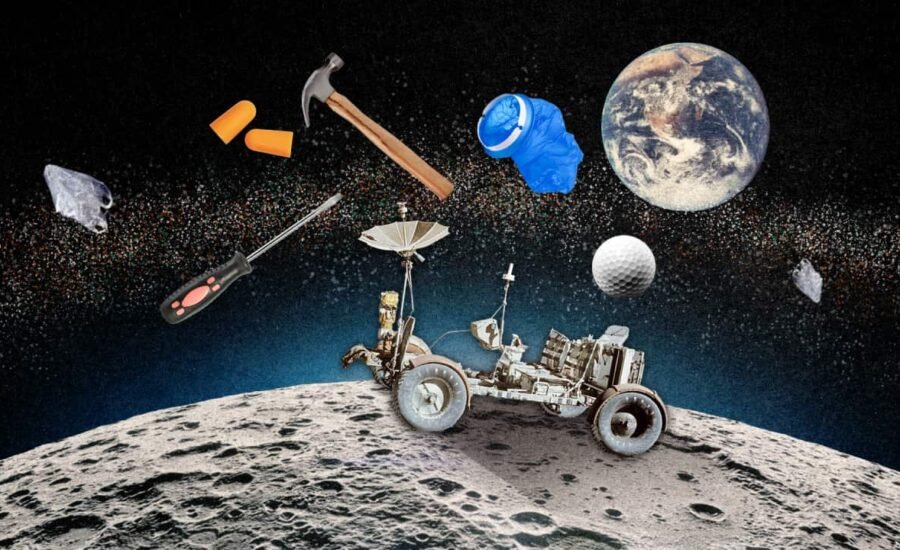
From golf balls, bags of excrement and flags on the lunar surface to rocket wreckage, abandoned tools and countless pieces of debris orbiting Earth, astronomers warn that there are consequences to treating space as a dumping ground.
The bus-sized 4000kg hunk of SpaceX debris came from a Falcon 9 rocket that launched a US and a Japanese lunar lander toward the moon in January last year.
Although no direct image of the impact has emerged, astronomers detected a plume of debris consistent with the rocket crashing into the lunar surface.
Your trusted source for staying up-to-date with the world around you. Get free daily news updates and analysis, straight to your inbox.
Just months ago, four NASA astronauts flew to the moon and back for the first time in more than 50 years. With the second race to the moon well underway — and the United States aiming to establish a base on the lunar surface — the recent SpaceX impact has renewed questions about whether humans are repeating old mistakes off-planet.
Experts say the number of objects orbiting Earth, meanwhile, is increasing the risk of collisions — and without intervention, could make some orbits too dangerous to use.
What’s on the moon?
It’s estimated the lunar surface now holds nearly 200 tonnes of human-made material across about 3,000 objects accumulated since the Soviet Union’s Luna 2 became the first spacecraft to reach the Moon in 1959.
According to a NASA catalogue, items on the moon include everything from a gold olive branch left behind by Neil Armstrong in 1969, to earplugs, urine collection devices, a hammer, moon boots, cameras, a javelin and two golf balls.
“There are fairly small things all over the moon,” associate professor Ben Montet, an astronomy researcher at the University of New South Wales, told SBS News.
“Remnants of the Apollo missions are still there. The lunar lander is there, and the rovers that came with the later missions, but also the silly things like the golf ball that the astronaut on the last mission hit. That’s still out there somewhere.”
Materials from other moon missions, including robotic probes landed by the former Soviet Union and other nations, also remain scattered across the surface.
What risk does it pose?
Scientists were not particularly concerned about the recent SpaceX collision with the moon’s surface, and a NASA spokesperson said it posed no danger to Earth.
Some saw it as an exciting moment that could create an opportunity to study, through telescopes, the lunar material kicked up by the impact.
But the out-of-control collision raised questions about future space exploration, given the rush to expand human presence and infrastructure on the moon.
Montet said the risk to the moon, at this stage, is very small, but it will likely grow as more debris accumulates in space.
And if humans are not proactive about cleaning up, the problem will get worse.
“I think about the first person who dropped a piece of trash into the ocean, thinking, ‘Oh, the ocean is very big. This won’t be an issue,'” Montet said.
“If only one person does that, that’s true. But then we ended up with a garbage patch in the ocean.”
What about the stuff orbiting Earth?
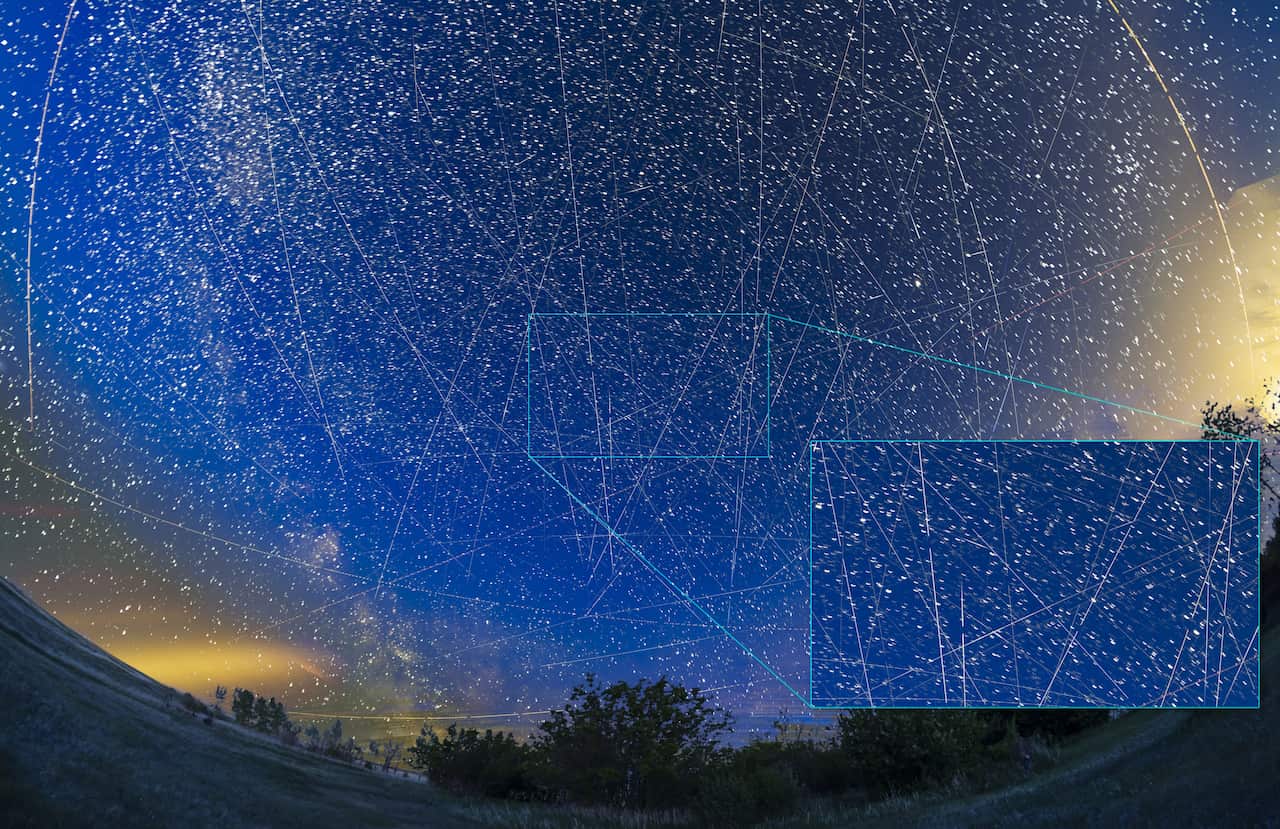
Seventy years ago, no satellites orbited the Earth. Now, there are more than 16,000.
Satellites help with telecommunications, internet, climate monitoring, research, navigation and many other important functions. The use of space is accelerating rapidly, with tens of thousands more satellites expected to launch in the next few years.
The more satellites are launched, the more space junk joins the 13,000-plus tonnes of debris already orbiting Earth.
Scientists warn that without better management, Earth’s orbit will become increasingly congested, heightening the risk of collisions that could threaten satellites and space missions.
Decades ago, a NASA scientist proposed a scenario known as the Kessler syndrome, in which Earth’s orbit became so crowded that collisions would continuously create more debris, triggering a snowball effect that would ultimately make parts of it dangerous to travel through.
Alan Duffy, an astronomer at Swinburne University of Technology, said some academics believe we’ve already reached that “tipping point”.
“Most of us expect … without us actively removing debris [like] spent rockets or defunct satellites from orbit, that it is just a matter of time. Whether it’s a few years or another decade or two, we will start to lose access to certain regions of space because it just becomes too dangerous to operate within,” he told SBS News.
What can be done to fix the issue?
While countries have agreed to broad principles for responsible behaviour in space, there is no binding international law requiring governments or companies to clean up debris they leave behind in space.
Duffy said governments and companies need to do more to remove defunct satellites and other large debris before they break apart in collisions.
He called on governments to legislate to ensure that companies are “behaving in the best possible way to preserve space”.
A range of technologies are being developed to tackle space junk, including Australian laser systems that can track debris to help avert collisions.
“The next step in that, though, is to use the same kind of laser systems to actually start to burn the junk and slow it down and encourage it to de-orbit,” he said.
Elsewhere, engineers are developing systems to capture larger debris using harpoons or nets before guiding it back into Earth’s atmosphere to burn up.
“We have all of these ideas and solutions, but the problem is: we are putting up thousands of pieces of new satellites, new infrastructure in orbit,” Duffy said.
“But at the same time, a lot of our solutions are talking about ones and twos, while the population up there grows near-exponentially.”
For the latest from SBS News, download our app and subscribe to our newsletter.