

In the present-day Universe, any large enough volume of space contains matter. On average, the matter density is diluted over time as a result of the cosmic expansion. As matter and radiation get rarefied, the question arises as to whether we will be surrounded by truly empty and dark space?
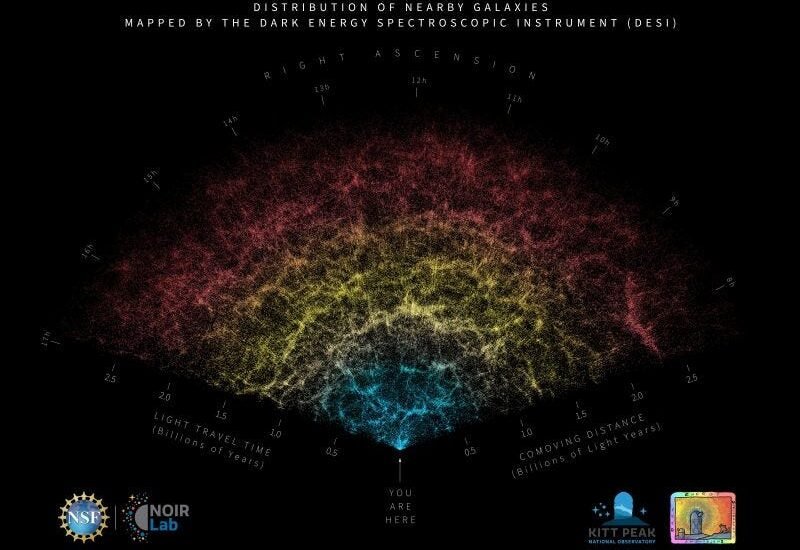
The answer is no. Any volume of space in the present-day Universe appears to be filled with a uniform substance called `dark energy’. This substance has a negative pressure that equals roughly minus its energy density — as expected for a cosmological constant — a substance that never gets diluted and ends up dominating the cosmic mass budget as matter and radiation expand. I stated `roughly’, because recent data from the Dark Energy Spectroscopic Instrument (DESI) survey (as summarized here) implies that dark energy may be evolving over cosmic time, with a slightly different pressure-to-energy density ratio than the value of -1 expected for a cosmological constant. As far as we know, the dark pressure is uniform in space and so it does not exert any net force on objects immersed in it, other than gravity.
According to Einstein’s General Relativity, a uniform cosmic substance sources gravity by its energy density plus three times the pressure. With pressure being roughly minus the energy density, this implies that dark energy induces repulsive gravity, opposite in sign to the attractive gravity sourced by matter and radiation. This repulsive gravity triggers an accelerated rather than decelerated cosmic expansion, since dark energy carries 70% of the mass budget in the present-day Universe and it will account for even more in the future as matter gets further diluted by the cosmic expansion. DESI measures the evolution in the cosmic expansion rate in an attempt to characterize the fundamental properties of dark energy.
Can we use dark energy for practical applications?
Unfortunately, the dark energy density is about 0.6 Joule per cubic kilometer. Excavating all the dark energy from the volume of a city would allow to power a 1-Watt miniature light bulb for a fraction of a second. Needless to say, the dark energy fuel — although abundant everywhere — is insufficient for powering interstellar or intergalactic propulsion.
What about spiritual implications?
Our cosmic future, the so-called `end of times’ (eschatology) in religious and philosophical texts, will likely be shaped by dark energy. Will the accelerated cosmic expansion continue as the Universe ages by a factor of ten or a hundred?
We do not know. The latest DESI results leave this question unanswered.
Whether cosmic acceleration persists will have dramatic theological consequences. Continued accelerated expansion will imply that all galaxies at cosmological distances beyond the Local Group of the Milky Way and Andromeda galaxies, will eventually be separated from us faster than light. In that case, once the Universe will age by a factor of ten, we will be left alone in a cosmic bubble of vacuum. Under such circumstances, it would be appropriate for all Milky-Way residents looking out into the surrounding cosmic void to conclude: “We are alone!”
It will not be a mark of arrogance or wishful thinking for churches throughout the galaxy to declare that the future merger of the Milky-Way and Andromeda (which I labeled Milkomeda in my paper with T.J. Cox here) is the center of the otherwise empty Universe. Hundreds of billions of years from now, the Vatican clergy might conclude that retroactively they were correct all along, despite the temporary view offered by early cosmic history when we had the illusion of not being at a unique and central cosmic location. Within this late cosmic perspective, the confusing fog eventually cleared out.
I doubt that DESI investigators fully recognize the long-term religious implications of their scientific research today.
ABOUT THE AUTHOR

Avi Loeb is chair of the UAP Science Advisory Council to the White House, Pentagon, FBI and intelligence agencies, director of the Galileo Project, founding director of Harvard University’s — Black Hole Initiative, former director of the Institute for Theory and Computation at the Harvard-Smithsonian Center for Astrophysics, and the former chair of the astronomy department at Harvard University (2011–2020). He is a former member of the President’s Council of Advisors on Science and Technology and a former chair of the Board on Physics and Astronomy of the National Academies. He is the bestselling author of “Extraterrestrial: The First Sign of Intelligent Life Beyond Earth” and a co-author of the textbook “Life in the Cosmos”, both published in 2021. The paperback edition of his new book, titled “Interstellar”, was published in August 2024.
Professional website:
https://lweb.cfa.harvard.edu/~loeb/
Social media:
https://avi-loeb.medium.com/
https://www.youtube.com/@ProfessorAviLoeb
https://open.spotify.com/show/1zhndXkvSY2b8FdjspFpCd
https://x.com/ProfAviLoeb