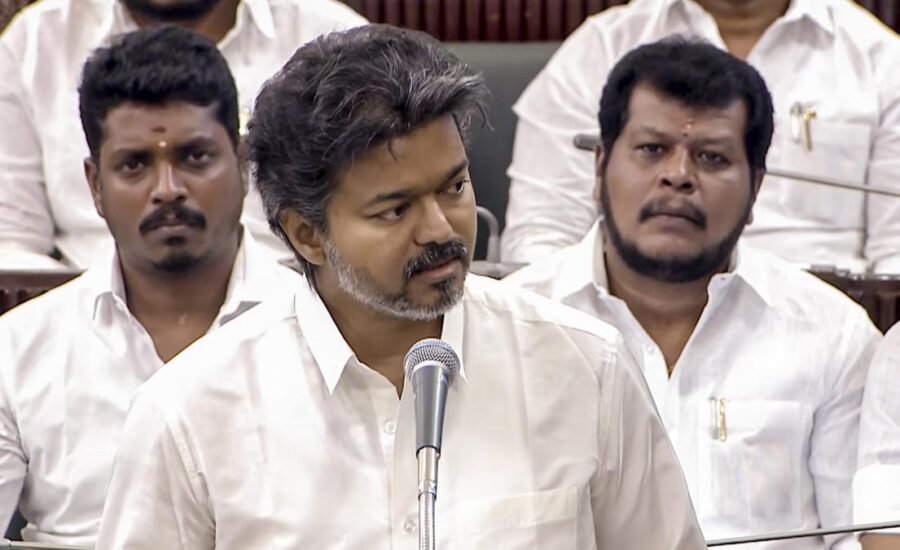

Tamil Nadu Chief Minister C. Joseph Vijay speaks during the State Legislative Assembly session, in Chennai, Tamil Nadu
| Photo Credit: PTI
Tamil Nadu Chief Minister C. Joseph Vijay on Friday (August 7, 2026) said it was his idea to visit Bengaluru to hold talks with the Karnataka government on the issue of sharing Cauvery water.
“When even enemy countries hold talks to resolve disputes, there is nothing wrong with neighbouring States holding discussions,” he said, while replying to a special calling attention motion on the Cauvery water-sharing issue and the proposed Mekedatu dam in the Legislative Assembly.

Making it clear his government remained firm on pursuing legal remedies, Mr. Vijay said he had nevertheless felt it was worth making an attempt to visit Bengaluru.
“I thought about it and sought to do it. There were many views and opinions on my proposed visit to Bengaluru. I saw it as a positive step towards resolving the problem. Even if I had to face humiliation in that attempt, I was prepared to do so for the sake of the people of Tamil Nadu. I thank everyone who expressed their affection and support,” he said.
‘Emotional issue’
Mr. Vijay said the Cauvery was the State’s lifeline and an emotional issue, and asserted his government did not have “even an iota of intention” to politicise it.
Recalling the unanimous resolution adopted by the Assembly opposing the Mekedatu project and its subsequent transmission to the Prime Minister, he said the government had not stopped with that.
“When we learnt the Union Minister of State for Jal Shakti had not presented the full facts regarding the Mekedatu issue, we wrote to the Prime Minister again, quoting the relevant portions of the final order of the Cauvery Water Disputes Tribunal and the Supreme Court judgment. We urged him not to grant administrative or any other approval to Karnataka for constructing the dam,” he said.
The Chief Minister asserted whether it was the sharing of Cauvery water or the construction of the Mekedatu dam, his government would never compromise on Tamil Nadu’s rights. “That is our stand,” he said.
‘Issue must be handled with care’
Referring to the Assembly debate in 1969 on Karnataka’s decision to construct dams across the Cauvery, Mr. Vijay asked, “Who was the Water Resources Minister then? I do not indulge in cheap politics by asking who permitted Karnataka to construct those dams. That is not our objective because the Cauvery issue must be handled with utmost care.”

He also recalled the remarks of the then Leader of the Opposition, P. G. Karuthiruman, who had said: “We should not worry about which party gets the credit. This is a problem concerning the people of Tamil Nadu.”
Mr. Vijay said the Assembly had then debated the need for the two States and the Union government to hold discussions on the issue. “The situation, however, changed completely later,” he observed.
Taking a swipe at the Leader of the Opposition, Udhayanidhi Stalin, the Chief Minister said, “Had they read newspapers regularly, they would have known what was happening in the country.”
Responding, Mr. Udhayanidhi said reading newspapers alone was not enough. “One should also interact with farmers and understand their concerns. Why is there fear or hesitation in convening an all-party meeting on this issue?” he asked
Published – August 07, 2026 11:17 am IST