
Upcycled Floral & Petal Ingredients (Marigold, Edible Flowers) Market
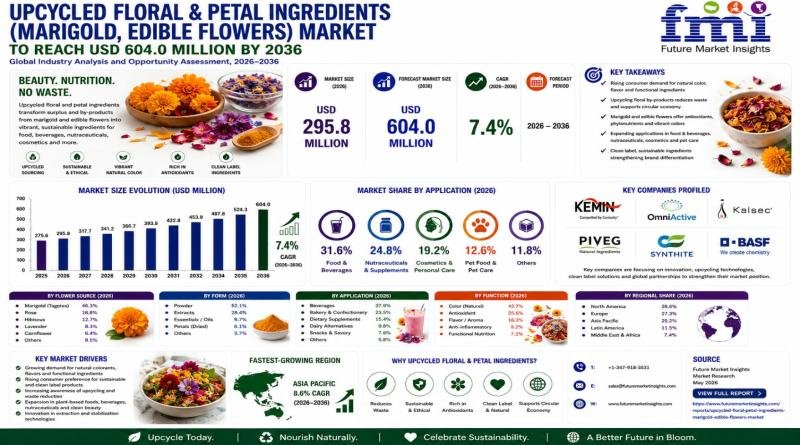
NEWARK, Del., August 01, 2026 – Sales of upcycled floral & petal ingredients (marigold, edible flowers) are projected to grow from USD 295.8 million in 2026 to USD 604.0 million by 2036, advancing at a 7.4% CAGR over the forecast period, according to Future Market Insights (FMI). Demand is driven by natural-color reformulation, clean-label food trends, and increasing carotenoid usage in supplements and functional food matrices.
Carefully handling flowers and petals during harvesting protects valuable pigments and delicate aroma compounds before drying or extraction. Food and cosmetic manufacturers are increasingly adopting upcycled botanical ingredients from suppliers that provide clear identity records, auditable origin tracking, and proven pigment/active stability over time.
Customized consulting, country-specific forecasts, and competitive intelligence assessments are available upon request: https://www.futuremarketinsights.com/reports/sample/rep-gb-34303
Key Upcycled Floral & Petal Ingredients Market Highlights at a Glance
• Market Size (2026): USD 295.8 Million
• Forecast Market Size (2036): USD 604.0 Million
• Forecast Period: 2026-2036
• CAGR (2026-2036): 7.4%
• Leading Source: Marigold (57.5% Market Share in 2026)
• Leading Product: Lutein / Color (41.2% Market Share in 2026)
• Leading Application: Color Applications (40.6% Market Share in 2026)
• Fastest-Growing Country: India (10.1% CAGR through 2036)
According to FMI, collection teams need clear species identity and food-grade handling records from harvest to ensure successful commercialization.
“Upcycled floral ingredients create commercial value depending on early specification design. Collection teams need clear species identity and food-grade handling records from harvest. Processing teams then preserve color or active content based on validated drying and protected delivery. Repeat purchasing follows consistent assay and performance inside finished food or supplement matrices,” said Nandini Roy Choudhury, Principal Analyst for Food and Beverage at Future Market Insights.
Key Takeaways for the Upcycled Floral & Petal Ingredients Market
• Demand for upcycled floral and petal ingredients is influenced by natural-color formulation and carotenoid use, requiring prompt food-grade recovery following harvest.
• Marigold is projected to account for 57.5% share of source in 2026, guided by contracted cultivation and established lutein extraction routes.
• Lutein / Color is forecast to lead product demand with 41.2% share in 2026, supported by measurable assay and color-strength specifications.
• Color applications lead application demand with a 40.6% share in 2026, as food manufacturers replace synthetic dyes with natural botanical pigments.
• India leads global country expansion with a 10.1% CAGR, followed closely by China at a 9.7% CAGR and Peru at a 9.3% CAGR.
• Key companies (Kemin, OmniActive, Kalsec, PIVEG, Synthite, BASF) differentiate through source control, NSF-GMP certified facilities, and formulation-ready delivery formats.
Access full Report in PDF Format: https://www.futuremarketinsights.com/reports/brochure/rep-gb-34303
Market Drivers, Restraints, and Opportunities
The market is being driven by natural-color reformulation and carotenoid demand. Regulatory approvals for natural food colors and growing consumer demand for clean-label, plant-derived dyes drive food and supplement developers toward traceable floral carotenoids.
Seasonal biomass supply and active degradation remain primary restraints. Seasonal flower harvesting and rapid pigment degradation during improper post-harvest drying or transport reduce usable yields and threaten lot-to-lot consistency.
The strongest opportunity lies in ultrasound-assisted extraction and regional processing hubs. Technological improvements in green extraction methods (such as ultrasound-assisted processing) enhance lutein yields by up to 10%, maximizing value from contracted floral side streams.
Segment Analysis
By Source
Marigold leads source demand, forecast to capture 57.5% share in 2026. Recognized xanthophyll profiles and organized contract farming provide predictable feedstock for lutein extraction. Edible flowers and segregated petal waste supply secondary pigment and aroma profiles.
By Product
Lutein / Color outputs dominate product share at 41.2% in 2026. Defined active assays and color-strength endpoints satisfy food and nutraceutical buyer specifications. Flavor and texture fractions provide complementary functional benefits.
By Application
Color applications represent 40.6% of market demand in 2026, providing immediate visual performance in food systems. Functional F&B and dietary supplements represent high-value secondary applications requiring strict clinical and regulatory dossier support.
Regional Outlook
South Asia and East Asia represent fast-growing regional markets, led by India (10.1% CAGR) and China (9.7% CAGR), supported by extensive flower farming acreage and established botanical extraction infrastructure. Peru (9.3% CAGR), Mexico (8.9% CAGR), and the United States (8.5% CAGR) demonstrate steady progress driven by clean-label food color demands and export channels.
Country Growth Forecast (2026-2036)
• India: 10.1%
• China: 9.7%
• Peru: 9.3%
• Mexico: 8.9%
• United States: 8.5%
India records the highest CAGR at 10.1% as extensive flower cultivation and extraction expertise expand. China follows at 9.7% CAGR, supported by vast floriculture depth and domestic processing capacity. Peru (9.3%), Mexico (8.9%), and the United States (8.5%) demonstrate steady progress driven by botanical export development and clean-label food coloring trends.
Unlock high-growth opportunities with FMI’s niche business market insights:
https://www.futuremarketinsights.com/industry-analysis
Competitive Landscape
The competitive landscape features branded carotenoid developers, botanical extraction specialists, and natural color platform leaders. Key companies profiled include Kemin, OmniActive, Kalsec, PIVEG, Synthite, and BASF.
Exclusive Discounts on Full Report: https://www.futuremarketinsights.com/reports/upcycled-floral-&-petal-ingredients-marigold,-edible-flowers-market
Frequently Asked Questions
What is the projected size of the upcycled floral & petal ingredients market by 2036?
The market is projected to reach USD 604.0 million by 2036.
What is the CAGR of the upcycled floral & petal ingredients market?
The market is expected to grow at a 7.4% CAGR between 2026 and 2036.
Which source segment leads the market?
Marigold leads source demand with a 57.5% market share in 2026.
Which product segment holds the highest share?
Lutein / Color leads product demand, holding a 41.2% share in 2026.
Which application accounts for the highest demand?
Color applications lead demand, accounting for a 40.6% share in 2026.
Explore More Related Studies Published by FMI Research
Western Europe Pea Protein Market : https://www.futuremarketinsights.com/reports/trends-growth-and-opportunity-analysis-of-pea-protein-in-western-europe
Japan Texturized Vegetable Protein Market :
https://www.futuremarketinsights.com/reports/demand-and-trend-analysis-of-texturized-vegetable-protein-in-japan
Explore In-Depth Food & Beverage Market Insights: https://www.futuremarketinsights.com/industry-analysis/food-and-beverage
FMI Custom Research: Strategic Intelligence for Confident Decision-Making
In today’s rapidly evolving business environment, leadership teams need clear, actionable intelligence tailored to their strategic objectives. FMI’s Custom Research solutions are designed around specific business questions, enabling executives to evaluate growth opportunities, validate investments, assess competitive dynamics, and reduce uncertainty before making critical decisions.
Key Executive Benefits
• Decision-Ready Insights: Research tailored to your specific business challenges, growth plans, and investment priorities.
• Reduced Strategic Risk: Validate market opportunities, customer demand, and competitive positioning before committing resources.
• Market Entry Confidence: Assess opportunity size, regulatory barriers, channel dynamics, and competitive landscapes with precision.
• Competitive Advantage: Gain proprietary intelligence unavailable through syndicated reports or internal datasets.
• Faster Growth Decisions: Accelerate expansion, product development, portfolio optimization, and investment planning.
• Primary Market Validation: Access real-world customer, buyer, and stakeholder insights that support high-confidence decision-making.
Business Impact
FMI helps organizations transform market complexity into strategic clarity, enabling leadership teams to identify growth opportunities faster, optimize resource allocation, strengthen competitive positioning, and make high-stakes business decisions with confidence.
To explore how FMI Custom Research can support your strategic priorities, connect with our team at – sales@futuremarketinsights.com
For Press & Corporate Inquiries
Rahul Singh
AVP – Marketing and Growth Strategy
Future Market Insights, Inc. +91 8600020075
For Sales – sales@futuremarketinsights.com
For Media – Rahul.singh@futuremarketinsights.com
For web – https://www.futuremarketinsights.com/
For Web – https://www.factmr.com/
About Future Market Insights (FMI)
Future Market Insights (FMI) delivers actionable, decision-focused market intelligence that goes beyond traditional research reports. The company provides:
• In-depth pricing and cost benchmarking analysis
• Demand forecasting based on real industry inputs
• Procurement and buyer behavior insights
• Supply chain and trade flow intelligence
• Technology and application trend analysis across industries
FMI follows a robust bottom-up research methodology, combining insights from industry experts, procurement leaders, manufacturers, and technical professionals to ensure accurate and practical market intelligence.
This release was published on openPR.