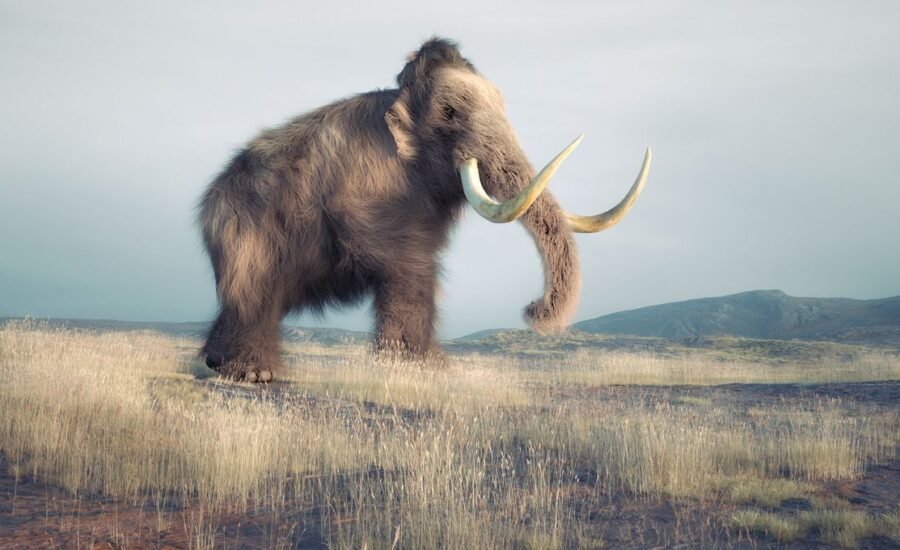
Up to around 12,000 years ago, woolly mammoths roamed widely across much of Siberia. Over time, however, their population became more fragmented, and the last living mammoths ended up stranded on an isolated island off the coast of Siberia.
Despite their isolation and tiny initial population size, the last mammoths managed to survive on the island for a long time. And while their genetics reveal inbreeding and low diversity, that doesn’t fully explain why they went extinct.
A genetic study published in 2024 concluded that eight founding individuals became stranded on Wrangel Island in Siberia 10,000 years ago. From these humble beginnings, the population increased to between 200 and 300 mammoths within 20 generations before dying out around 4,000 years ago.
“We can now confidently reject the idea that the population was simply too small and that they were doomed to go extinct for genetic reasons,” said senior author Love Dalén, an evolutionary geneticist at the Centre for Palaeogenetics, Sweden, in a statement at the time.
Wrangel Island is in the Arctic Ocean and was connected to the rest of Siberia until global sea level rise separated it from the mainland some time between 10,000 and 14,000 years ago. The climate is very cold and dry with permafrost, making for excellent fossilization conditions that preserve soft tissues, teeth, hair, and even intestine contents.
To find out more about the genetics of the population in the lead-up to the extinction of woolly mammoths, and how the Wrangel Island population managed to survive for so long, the team analyzed 21 Siberian woolly mammoth genomes; 14 from Wrangel Island, and seven from the mainland population before the animals became isolated.
One theory is that the genetically isolated population built up an accumulation of harmful genetic mutations that eventually reduced their overall fitness and led to their extinction.
However, that seems not to be what happened. The team found that while the island mammoths showed inbreeding and low genetic diversity compared with their mainland counterparts, the pace of change was very slow, suggesting the population was quite stable for around 6,000 years.
The researchers found some mutations linked with reduced male fertility and neurological defects. But the population was able to purge the most harmful genetic changes from the group, they say, so this wouldn’t have been enough to wipe out the population, which is thought to have gone abruptly extinct.
“If an individual has an extremely harmful mutation, it’s basically not viable, so those mutations gradually disappeared from the population over time,” said study author Marianne Dehasque at the Centre for Palaeogenetics. “But on the other hand, we see that the mammoths were accumulating mildly harmful mutations almost up until they went extinct.”
Like the Wrangel Island population, a population on St Paul’s Island lasted beyond the mainland mammoths, but they died around 5,600 years ago due to a combination of shrinking land area and lack of freshwater, explains a study from 2020. The Wrangel Island population extinction is more of a mystery, but we have some clues that they faced a similar situation.
“The exact cause of final extinction for the Wrangel Island mammoths remains equivocal, but we suggest it was likely caused by a short-term crisis, possibly linked to climatic anomalies or/and geochemical factors,” explain the authors of a paper from 2019.
This suggested that the mammoths weren’t killed by their own genes and isolation, but instead likely succumbed to an extreme event, either extreme weather, water quality issues, or starvation that wiped out the population for good.
“This means it was probably just some random event that killed them off, and if that random event hadn’t happened, then we would still have mammoths today,” said Dalén.
For those that wish they could have witnessed a mammoth on Earth, all is not lost, however, as American biotechnology and genetic engineering company Colossal Biosciences has plans to create genetically modified animals that resemble woolly mammoths and a host of other species.
Until we hear the pitter patter of tiny woolly mammoth feet, though, you’ll just have to enjoy their “woolly mice.”
“What happened at the end is a bit of a mystery still – we don’t know why they went extinct after having been more or less fine for 6,000 years, but we think it was something sudden,” said Dalén.
“I would say there is still hope to figure out why they went extinct, but no promises.”