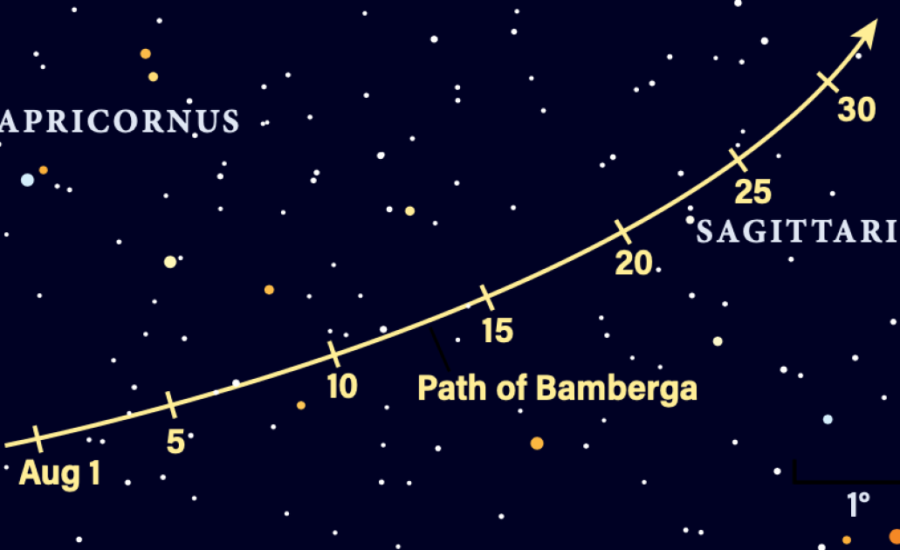
Main-belt world Bamberga shines at 9th magnitude, an easy catch with a small scope as it moves through Capricornus.
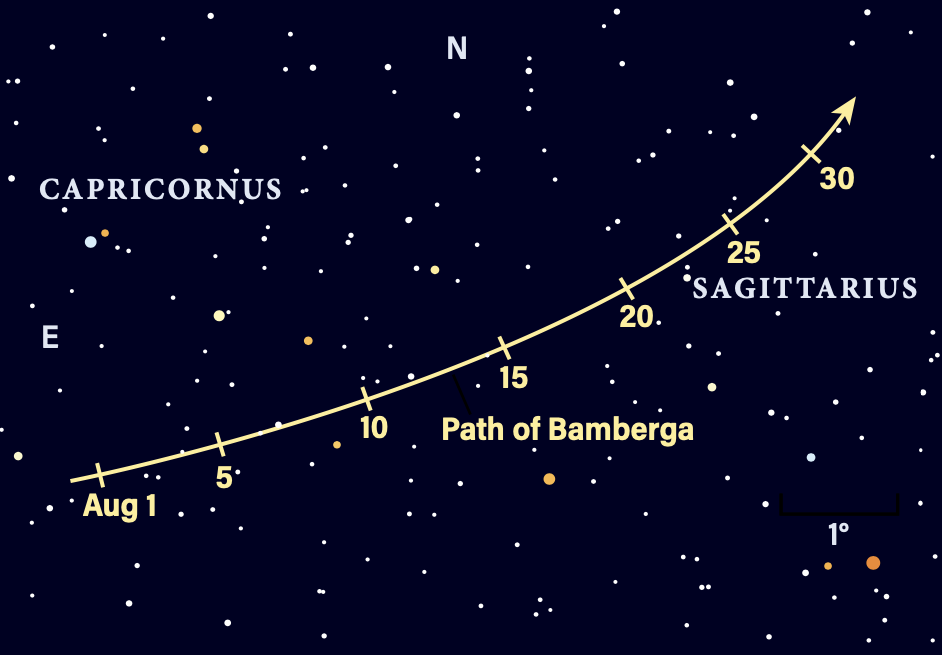
You’ll find Bamberga just southeast of globular cluster M75 (outside this field of view); the asteroid stands 2° due south of the cluster Aug. 30. Credit: Astronomy: Roen Kelly
Looking for a sky event this week? Check out our full Sky This Week column.
August 3: A solar system trio
Rising around sunset and standing highest around midnight, asteroid 324 Bamberga is visible in a small scope this evening, moving against the background stars of Capricornus. Look for it in the south around local midnight, about 5° west of 4th-magnitude Omega (ω) Capricorni, in the Sea Goat’s southwestern region. You’ll want a telescope with an aperture of 4 inches or larger, especially from the suburbs.
Check the chart above and note the position of the nearby background stars. You may spot one of the “stars” in your eyepiece subtly moving throughout the night, especially if you take a photo or make a sketch every hour or two. If you come back tomorrow night at the same time, you should definitely notice one of those points has shifted — that’s our asteroid.
Bamberga may have a high number of 324, but it’s one of the main belt’s largest worlds, cracking the top 20. It was so hard to catch because it spends a lot of time far from the Sun, and isn’t often brighter than 9th magnitude, which it glows at now.
Sunrise: 6:01 A.M.
Sunset: 8:10 P.M.
Moonrise: 10:58 P.M.
Moonset: 12:18 P.M.
Moon Phase: Waning gibbous (61%)
*Times for sunrise, sunset, moonrise, and moonset are given in local time from 40° N 90° W. The Moon’s illumination is given at 10 P.M. local time from the same location.
The morning of August 5 is a great opportunity not only to spot Saturn’s moon Titan close to its parent planet, but also the elusive moon Iapetus as well.
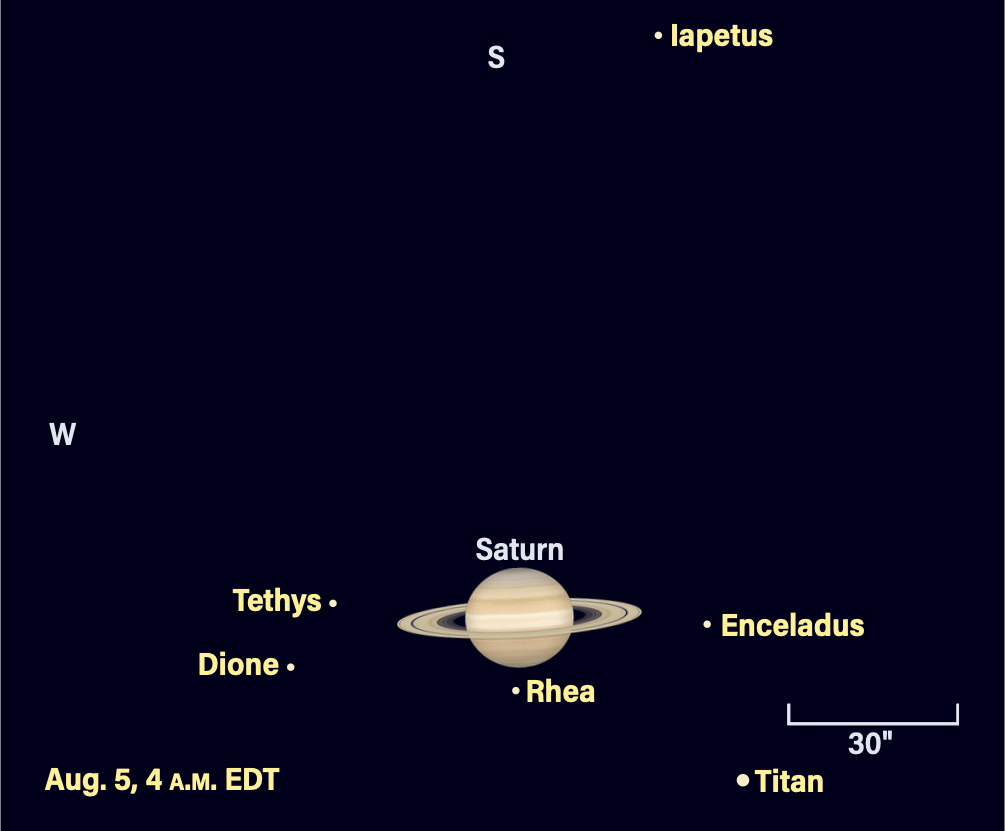
Saturn is best viewed in the early morning, around 4 A.M. At that time, turn south and look for the brightest object in this region, about 50° high — that’s the ringed planet. Through a telescope, you’ll spot several moons, starting with mid-8th-magnitude Titan just northeast of Saturn. Tenth-magnitude Rhea, Tethys, and Dione are closer to the planet; their relative positions change quickly, so they may not appear in exactly the same locations as on the chart above. You may or may not see Enceladus, which is roughly 12th magnitude, so don’t be concerned if you can’t find it, even with the chart.
The crowning achievement is Iapetus, which now sits just under 2’ south of Saturn, glowing at magnitude 11. By the time it reaches eastern elongation later this month, it will be over 9’ from Saturn and have dropped by a magnitude to roughly the same brightness as Enceladus, making it a real challenge to spot.
Alison Klesman is senior editor of Astronomy magazine. She holds a Ph.D. in astronomy and has studied a variety of topics, from minor planets to supermassive black holes.