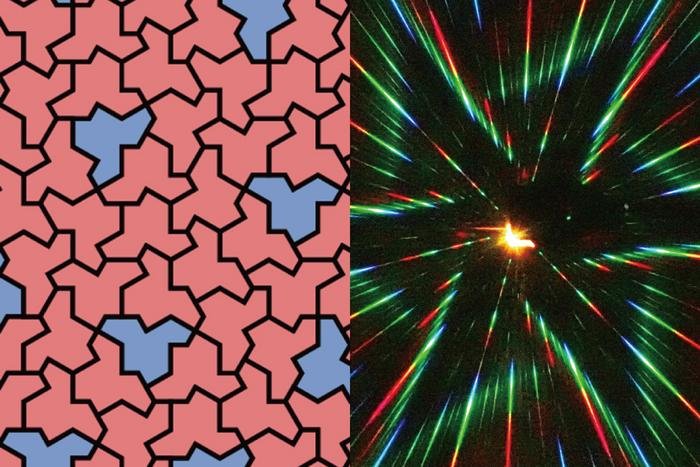
The 13-sided tile that solved a half-century-old math problem, discovered by an amateur mathematician at his kitchen table in 2022, turns out to bend light into a twisting pinwheel unlike anything produced by an ordinary crystal, according to a new study in Nature Communications.
The work, from physicists at the University of Tokyo and NTT’s Nanophotonics Center in Japan, marks the first time anyone has taken the celebrated “einstein” tile—a term derived from the German ein Stein, meaning “one stone,” and unrelated to the famous physicist—out of pure mathematics and asked what it does to light.
The answer is a form of optical handedness that even quasicrystals, the closest known relatives of this structure, do not possess.
Unlike circles or squares, which are identical when mirrored, our hands are not. They may be reflections of each other, but you can’t place one perfectly on top of the other, no matter how you rotate it. Likewise, a handed structure “notices” the difference between left- and right-circularly polarized light, while a mirror-symmetric structure—such as a circle—cannot. The flat tile pattern has no mirror image identical to itself, much like your hands, and that asymmetry becomes imprinted onto the light it diffracts.
“We found that the diffraction patterns themselves become chiral because the structure lacks mirror symmetry,” Masaya Notomi, the study’s senior author, explained in a press statement. “This kind of optical response is fundamentally different from that observed in conventional quasicrystalline materials.”
To see why that matters, it helps to go back to the shape.
The Einstein Problem
Mathematicians had pursued a particular puzzle for roughly 50 years, known as the “Einstein problem.” The question was whether a single shape could completely tile a flat plane, but only in a pattern that never repeats. Roger Penrose reduced the problem to two tiles in the 1970s. Finding a single tile remained out of reach.
Then, in November 2022, David Smith, an amateur mathematician and retired print technician from Bridlington, England, found one while tinkering with shape-tiling software. He cut copies out of cardstock, laid them across his table, and watched the pattern refuse to settle. He nicknamed it “the hat” because it looks vaguely like a fedora. Smith and three collaborators posted the proof in March 2023, and it made news around the world.

That same year, a 2023 theory paper by physicist Joshua Socolar had already predicted chiral diffraction from hat tilings, but there was one wrinkle. The hat needs its own mirror image sprinkled among the tiles to work, a hint of handedness baked into the geometry. That handedness is exactly what the new study chases into the behavior of light, so to do it, the team led by Yuto Moritake did something a mathematician would never bother with: they built the thing.
They marked the center of each hat tile with a point, producing a pattern with perfect threefold rotational symmetry (it looks identical when you turn it a third of the way around) but no mirror symmetry, meaning its reflection is a genuinely different object. Then they etched that pattern into a 350-nanometer-thick film of silicon nitride, drilling 372,100 tiny holes across a patch half a millimeter on a side.
Shine a laser through a regular grid of holes, and you get a neat, symmetric spray of dots on the far wall—a diffraction pattern, the same effect that throws rainbows off a CD. The team fired a green laser at their aperiodic version and photographed what came out.
It was a pinwheel.
A Quasicrystal Structure
The diffraction pattern was sharp and filled with bright, well-defined spots—the signature of long-range order—and evidence that the structure behaves like a true quasicrystal despite never repeating. But unlike conventional diffraction patterns, the entire arrangement twisted in one direction, with no mirror symmetry anywhere in the image. When the researchers repeated the experiment using the mirror-image version of the tile, the pinwheel twisted in the opposite direction.
So the team did what all scientists do in these situations. They just started blasting different kinds of light at it.
“Because the structure is chiral, a circular-polarization dependence should not be forbidden. But on the first trial, I couldn’t find any difference. I thought it might be very weak, so I changed the camera to a more sensitive one — and then I finally found it,” Moritake told The Debrief. “I somehow expected it, but I was still surprised when I found it.”
The strange result came with that circularly polarized light test. It’s a light whose electric field corkscrews as it travels, clockwise or counterclockwise. The pattern responded differently depending on which way the light was spinning. Feed it left-handed light and certain spots brightened; feed it right-handed light and different ones did. That behavior, the authors note, has never been seen in a conventional quasicrystal.

Underneath all of it sits a piece of elegant bookkeeping. The angle of the pinwheel’s twist, about 15.5 degrees, isn’t arbitrary. Moritake’s team showed that it falls straight out of the Fibonacci sequence and the golden ratio, the same numbers that govern the tile’s geometry. The shape’s real-world twist is written directly into how it scatters light.
The findings are a scientific first, but the paper is quick to point out that this is fundamental physics and not a product. There is no device here, and the authors are careful to call their structure a possible “platform” rather than a working component. The chirality at play is a strictly two-dimensional kind (the absence of a mirror line within the flat pattern), not the three-dimensional handedness of a molecule or, you know, your hands.
“At least, this effect is forbidden in an inversion-symmetric structure, so it reflects the chiral nature of the monotile,” Moritake said. “Of course, this effect could appear in other structures too. But I don’t know of another lattice that is both chiral and quasiperiodic like this one.”
Still, the result does something basic research quietly does all the time: it takes an object discovered for no reason beyond that it was beautiful and finds that nature had a use for it. Breaking a structure’s mirror symmetry is how physicists coax materials into nonlinear optical tricks and polarization-sensitive behavior, and aperiodic tiles offer a new and largely unexplored way in.
“Mathematical discoveries have always led to important developments in physics,” Moritake said. “The monotile is generated from a honeycomb frame, and in nanophotonics, the honeycomb lattice is used constantly because it produces interesting phenomena — graphene is the representative example. So I thought the monotile lattice might be interesting in real physics too.”
For a shape that started as a puzzle on a hobbyist’s kitchen table, that’s a long way to travel.
MJ Banias is a co-founder of The Debrief, covering science and technology news. You can email him at mj@thedebrief.org or follow him on LinkedIn.