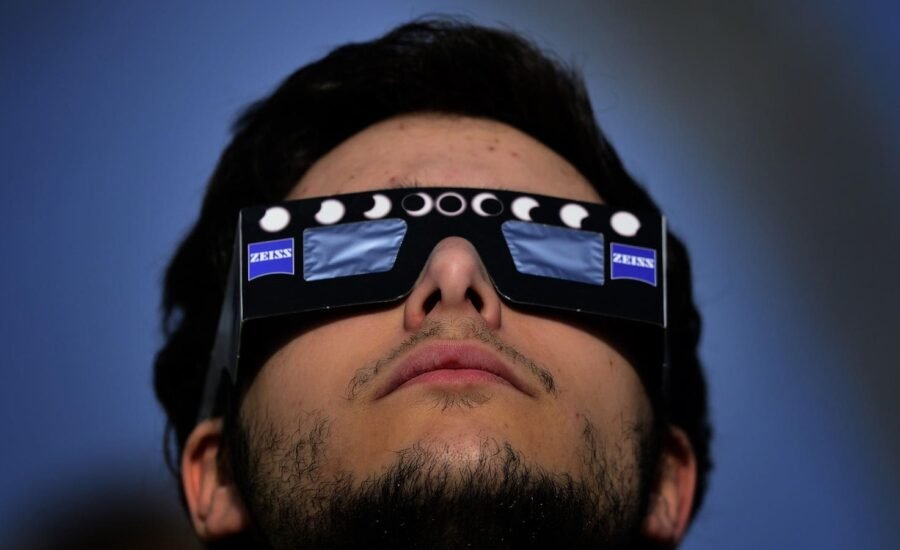

As Europe prepares for its first mainland total solar eclipse since 1999, myths persist. (MIGUEL RIOPA/AFP via Getty Images)
AFP via Getty Images
Few celestial events inspire as much excitement – or as much misinformation – as a total solar eclipse. Despite centuries of scientific understanding, myths continue to circulate online and by word of mouth. Some people believe it’s never safe to look at an eclipse; others assume a 99% eclipse is virtually the same as totality, while social media regularly revives claims about earthquakes, strange radiation and mysterious animal behavior. So what does modern astronomy say? Here are seven of the biggest eclipse myths – and why the science tells a very different story.
Myth #1: A 99% Eclipse Is Almost As Good As A Total Eclipse
No. In fact, it’s the single biggest misconception about total solar eclipses. It’s easy to assume that if 99% of the sun is covered, you’ve experienced almost everything a total eclipse has to offer. But totality isn’t something you can be “almost” inside. Either you’re standing within the moon’s narrow path of totality, or you’re not. You can’t be 99% pregnant — it’s the same with a total solar eclipse.
That’s because even if the tiniest sliver of the sun remains visible, the landscape stays surprisingly bright, the sky never falls into twilight, and the sun’s spectacular corona remains hidden. If you’re outside the path of totality, you don’t experience a total solar eclipse.
Myth #2: Total Solar Eclipses Incredibly Rare
For any one location, a total solar eclipse is genuinely unusual. On average, the same place experiences totality only once every 300 to 400 years, which explains why they’re often described as once-in-a-lifetime events. Globally, they’re common. Somewhere on Earth, one occurs roughly every 16 months, and some regions can experience multiple total eclipses within a few years. For example, the 2017 and 2024 total solar eclipses crossed paths in a “lucky quadrant” over southeastern Missouri and southern Illinois, with cities like Cape Girardeau, Perryville and Carbondale uniquely positioned within two paths of totality in less than seven years. The eclipses themselves aren’t especially rare. What’s rare is being in exactly the right place when one happens.
Myth #3: It’s Never Safe To Look At A Solar Eclipse
Looking directly at the partially eclipsed sun without certified eclipse glasses can cause permanent eye damage. That remains true throughout every partial phase, whether you’re inside or outside the path of totality. However, once the moon completely covers the sun — something that occurs only if you’re within the narrow path of totality — everything changes. During totality, it’s perfectly safe to remove your eclipse glasses and look directly at the eclipsed sun. In fact, that’s the entire point of traveling into the path of totality. Only then does the delicate white corona become visible – one of the most extraordinary sights in nature. The moment even the smallest bead of sunlight reappears, eclipse glasses must go straight back on.
Myth #4: The Eclipse Produces Dangerous ‘Eclipse Rays’
This belief is weirdly sticky despite not standing up to scrutiny. A solar eclipse doesn’t change the sun’s radiation, create harmful ultraviolet light or somehow make sunlight more dangerous. How could it? The real danger comes from human behavior rather than the eclipse itself. Because the sun appears dimmer during the partial phases, people may be tempted to stare at it for longer than they otherwise would. Without proper eye protection, that can permanently damage the retina. During totality, however, the sun’s brilliant surface is completely hidden and only the much fainter corona remains visible. It shines with roughly the brightness of the full moon and is perfectly safe to observe with the naked eye.
Myth #5: You Have To Stand Exactly On The Centerline
The centreline of the path of totality offers the longest possible totality, which is why eclipse chasers often head there, but it’s far from the only place to enjoy totality. Everyone inside the path experiences the same extraordinary event. The only difference is its duration. Someone well away from the centerline may lose only a few seconds compared with someone standing in the middle of the path, but since the moon’s shadow is round, you need to be very close to the edge before totality tumbles in duration. In practice, finding a location with the best chance of clear skies is far more important than chasing every last second of totality.
Myth #6: Animals Know Something Supernatural Is Happening
Animals often react during totality, but not because they possess mysterious eclipse instincts. As daylight suddenly disappears and temperatures fall, many species simply respond as though evening has arrived. Birds may stop singing and head for their roosts, insects begin their night-time chorus, and livestock sometimes move towards shelter. For humans, these changing sounds can be one of the most memorable parts of a total solar eclipse. For animals, they’re simply a response to an unusually rapid sunset.
Myth #7: Total Solar Eclipses Can Trigger Earthquakes
This claim resurfaces before almost every major eclipse, usually accompanied by warnings that the alignment of the sun, moon and Earth will somehow trigger earthquakes or volcanic eruptions. There’s no scientific evidence that this happens. Yes, the moon’s gravity does produce tides in both the oceans and Earth’s crust, and those forces are slightly stronger when the sun and moon are aligned during a new moon. But there is a new moon every month. This myth is really about whether a shadow can cause seismic activity. How could it? Moreover, recent research following the 2024 North American total solar eclipse uncovered an unexpected phenomenon: seismic noise caused by human activity dropped significantly during totality as people stopped driving and working to watch the eclipse. Total solar eclipses cause a seismic hush — the opposite of the myth.
Wishing you clear skies and wide eyes.