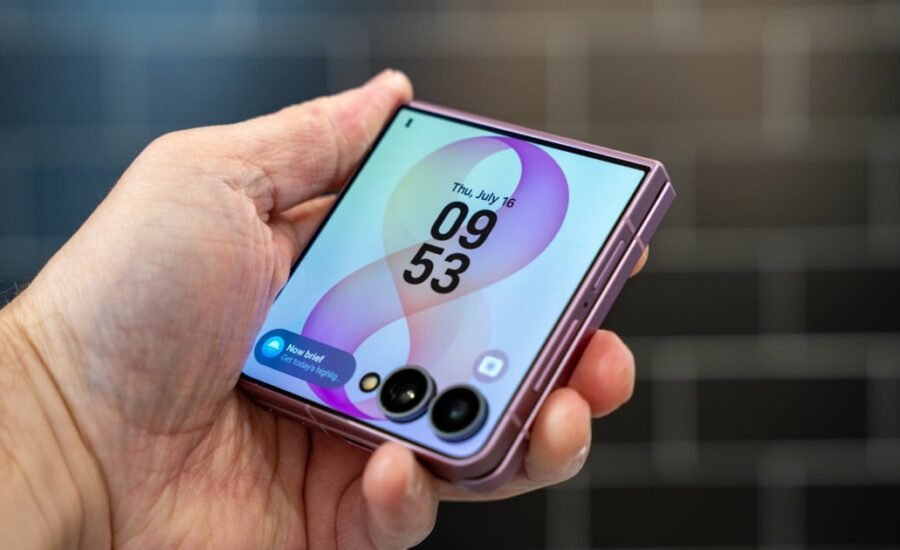
Price: A Franklin More This Year
At a starting price of $1,199.99, the Z Flip 8 hits the market $100 more expensive than its predecessor. Unfortunately, that price bump doesn’t buy you any extra headroom; you’re stuck with the same base configuration of 12GB of RAM and 256GB of storage. If you want more storage, you can snag the 512GB model for $1,399.99.

Samsung Galaxy Z Flip 8 (Credit: Eric Zeman)
Motorola pulled a similar move, tacking $100 onto the Razr Ultra to give it a steep $1,499.99 launch price. The base configuration comes with more memory and storage compared with the Z Flip 8: 16GB of RAM and 512GB of storage.
Winner: Z Flip 8
Design: Texture vs. Tradition
Both the Razr and Z Flip series are known for their clamshell-style folding designs that hark back to iconic flip phones of the early 2000s. One thing you can’t do is angrily snap them shut to end a call; their hinges are just too stiff.

Motorola Razr Ultra (Credit: Kimberly Gedeon)
The Razr Ultra family has an addictively tactile chassis. You can choose between two finishes: Alcantara and wood. I’ve tried the former, and it’s as fun to touch as it sounds—just keep in mind that it’s a bit of a dust magnet. One downside is that the Razr Ultra doesn’t have any basic options for the minimalist crowd: it’s texture or bust. Structurally, the Razr Ultra features an aluminum frame and Corning Gorilla Glass Ceramic to protect the front cover display.

Razr Ultra (Credit: Kimberly Gedeon)
The Z Flip 8, on the other hand, lets you choose between Cream, Graphite, Mint, and Pink. Instead of a textured backside, it sticks to a classic glass-and-metal build, with Samsung’s Armor Aluminum frame paired with Corning Gorilla Glass Victus 2 on both the cover screen and the rear glass panel.
The Razr Ultra has a dedicated AI button that takes you to the Moto AI experiences. Other than that, both models share a similar layout: a USB-C port on the bottom, and a volume rocker and power button on the right edge. The power button on both the Razr Ultra and Z Flip 8 doubles as a fingerprint sensor.
Both models have an IP48 rating, which means they can block debris larger than 1mm, but they’re not fully dustproof against fine substances like sand and powder. Plus, they can survive submersion in nearly five feet of water for up to 30 minutes.
Although the Razr Ultra lineup has more striking finishes, I prefer the Z Flip 8’s wider variety of colorways, but you may have your own preference.
Winner: Tie
Size: Pliable and Pocketable
Unfolded, the Z Flip 8 measures 6.57 by 2.97 by 0.24 inches, making it shorter, wider, and thinner than the 6.75-by-2.91-by-0.28-inch Razr Ultra. In fact, it’s Samsung’s thinnest clamshell foldable to date.

Z Flip 8 (Credit: Eric Zeman)
That trim profile holds true when shut, too: at 3.37 by 2.97 by 0.52 inches, the Z Flip 8 is more compact than Motorola’s bulkier 3.47-by-2.91-by-0.62-inch frame.
The Z Flip 8 is also lighter than the 7.0-ounce Razr Ultra, weighing just 6.35 ounces. As the more pocketable foldable, the Z Flip 8 wins this round.
Winner: Z Flip 8
Display: The Disappearing Crease
Both Samsung and Motorola put in some serious work to smooth out the crease on their respective foldables. Still, the Razr Ultra’s center seam can reveal itself when the light hits it just right.

Razr Ultra (Credit: Kimberly Gedeon)
The Z Flip 8’s is nearly impossible to spot; I’d call it virtually gone. Samsung has the edge here because it has a flatter-looking screen with a much harder-to-find crease.
The Z Flip 8 features a 6.9-inch, 1,080-by-2,520-pixel Dynamic LTPO AMOLED 2X display with a refresh rate of up to 120Hz. The Motorola Razr Ultra features a slightly larger 7.0-inch LTPO AMOLED display with 1,224-by-2,992-pixel resolution and a refresh rate of up to 165Hz. Keep in mind, however, that the 165Hz refresh rate only kicks in for mobile gaming (normal limit is 120Hz), so if you’re not much of a gamer, this spec is basically a non-factor.

Z Flip 8 (Credit: Eric Zeman)
As for the cover screen, the Z Flip 8 sports a 4.1-inch, 948-by-1,048-pixel Super AMOLED front panel with a 120Hz refresh rate. Compare this with the Razr Ultra’s slightly smaller 4.0-inch, 1,272-by-1,080-pixel LTPO AMOLED cover display with a refresh rate of up to 165Hz. (Again, the 165Hz refresh rate only kicks in when you’re playing a game.)
For brightness, the Razr Ultra fares better in direct sunlight, thanks to its 4,500-nit inner display and 3,000-nit cover screen. These specs are a clear step up compared with the Z Flip 8’s dimmer 2,600 nits of peak brightness across both its cover screen and inner display.
Winner: Razr Ultra
Performance and Connectivity: Elite Status
The Z Flip 8 is powered by the Qualcomm Snapdragon 8 Elite Gen 5 chip. The Razr Ultra has the standard Snapdragon 8 Elite chip.

Razr Ultra (Credit: Kimberly Gedeon)
We don’t have benchmarks for the Galaxy Z Flip 8 yet, but we do for the Z Fold 8, which has the same Gen 5 SoC. On Geekbench 6, it delivered single- and multi-core scores of 3,136 and 8,975. Surprisingly, the Razr Ultra beat these numbers, with scores of 3,027 on the single-core test and 9,139 on the multi-core test.
Both phones support 5G connectivity with sub-6GHz and C-band, but not mmWave. They also feature Wi-Fi 7 and Bluetooth 5.4.
It’s worth noting that both phones support physical nano-SIM and eSIM connectivity. The Z Flip 8 allows up to two active SIMs at once, using either a nano-SIM and eSIM or two eSIMs. Meanwhile, the Motorola Razr Ultra supports a nano-SIM and eSIM combo.
Until we have a full set of tests to compare, we’re not ready to call this one just yet.
Winner: Too Early to Tell
Battery Life: Silicon-Carbon Battle
Both the Z Flip 8 and Razr Ultra are equipped with silicon-carbon battery tech. However, the Z Flip 8 has a smaller 4,300mAh battery, while the Razr Ultra comes with a larger 5,000mAh cell.

Z Flip 8 (Credit: Eric Zeman)
We don’t have battery life results for the Z Flip 8 yet, but the Razr Ultra lasted 21 hours and 16 minutes on the PCMag battery test, which involves streaming a 1080p video over Wi-Fi at max screen brightness.
Recommended by Our Editors
The Z Flip 8 supports 25W wired charging, 15W wireless charging, and 4.5W reverse wireless charging. The Razr Ultra has faster speeds across the board: 68W wired charging, 30W wireless charging, and 5W reverse charging.
Winner: Too Early to Tell
Cameras: Triple 50 Takes the Win
The Razr Ultra, on paper, has a better camera suite: a 50MP, f/1.8 main camera, a 50MP, f/2.0 ultrawide shooter, and a 50MP, f/2.0 selfie cam. Although the Z Flip 8’s main camera matches the Razr Ultra’s, it has a 12MP f/2.2 ultrawide shooter and a 10MP f/2.2 selfie camera.

Razr Ultra (Credit: Kimberly Gedeon)
Neither the Razr Ultra nor the Z Flip 8 has a dedicated telephoto camera, but the Z Flip 8 supports up to 10x digital zoom, while the Razr Ultra has Super Zoom up to 30x.
In terms of video recording, the Z Flip 8 doesn’t go beyond 4K at 60 frames per second (fps). The Razr Ultra, on the other hand, lets you shoot up to 8K at 30 fps. On the selfie camera, the max for both foldables is 4K60.

Razr Ultra (Credit: Kimberly Gedeon)
Both cameras have fun quirks that let you take advantage of their form factor, including a camcorder mode that lets you hold the phone half-folded on its side to record video like a classic handheld camera. You can also place the foldable down, in clamshell mode (or lawn chair mode, as I like to call it), allowing you to shoot videos and selfies hands-free. With the device folded, both phones let you use the main camera rather than the front-facing camera to take higher-quality selfies.
Winner: Razr Ultra
Software and AI: Agentic Action vs. CliffNotes
The Z Flip 8 ships with Android 17 layered with One UI 9, while the Razr Ultra launched with Android 16. Samsung promises seven years of OS and security updates, besting Motorola’s commitment of three years for OS upgrades and five years for security updates.

Z Flip 8 (Credit: Kimberly Gedeon)
This year, Samsung really slammed the gas pedal on agentic capabilities for Galaxy AI. For example, Gemini can now perform more actions on your behalf without needing to jump back and forth between windows. Now Nudge, which anticipates helpful next steps (e.g., adding an event to your calendar), provides smarter, richer suggestions across more apps. The Photo app received a gaggle of AI upgrades, too, including the ability to edit photos using natural language. You can also reframe photos and videos to different aspect ratios to make them more compatible with social media platforms.

Razr Ultra (Credit: Kimberly Gedeon)
Moto AI, Motorola’s answer to Galaxy AI, is more focused on summarization. For example, the Catch Me Up perk keeps you informed about your notifications in a short and concise way. The Pay Attention feature lets you record and transcribe conversations. Remember This lets you save bits of information, from screenshots to notes, that you can ask Moto AI about later. Similar to the Z Flip 8, the Razr Ultra lets you experiment with AI-generated images in Image Studio. However, Motorola places a daily limit on how often you can use these features, while Samsung doesn’t appear to impose a quota on Galaxy AI’s image-editing tools.
Winner: Z Flip 8
Choosing the Right Folding Phone For You
The Z Flip 8 hasn’t yet been through our testing, so a final verdict will have to wait. Until then, here’s a quick breakdown of where each phone shines:
-
If your budget is tight, the Z Flip 8 is $300 cheaper and available at a discount through carrier trade-in deals.
-
The Razr Ultra offers double the base storage for the entry-level model.
-
The Z Flip 8 offers a sleeker build, a virtually invisible crease, and seven years of software support.
-
The Razr Ultra counters with a brighter display, a larger battery, and faster charging.
-
The Z Flip 8’s One UI 9 brings agentic perks and AI photo editing without daily usage caps.
Stay tuned for our full review of the Z Flip 8. Once complete, we’ll update this comparison with all the hard data so you have a definitive answer on which is best.