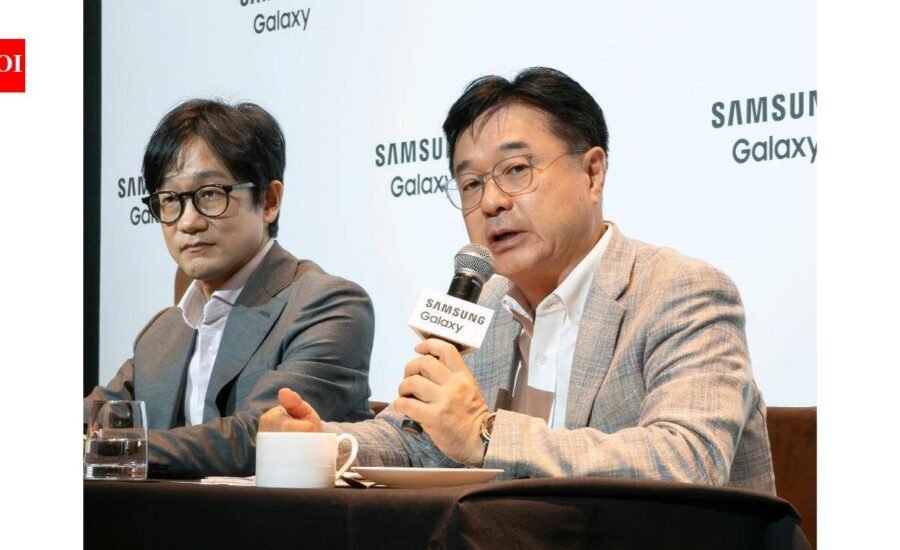
As AI features across smartphones increasingly start to look alike, Samsung is betting that its edge over the next few years won’t come from AI alone, but from how deeply that intelligence is woven into its broader hardware, software and device ecosystem. That was the central message from JB Park, CEO and President of Samsung Southwest Asia, and Jay Kim, Corporate EVP and Head of the Customer Experience Office at Samsung’s MX Division, in a roundtable discussion on the company’s AI strategy.
JB Park highlighted Samsung’s ecosystem as a defining advantage
Asked what Samsung sees as its defining competitive advantage as AI capabilities converge across the industry, Park pointed to the way AI performs differently depending on the device it runs on. He noted that creative professionals often prefer editing photos and videos on the Galaxy Fold’s larger foldable display over a standard bar-type phone, suggesting that AI features gain real value when paired with the right form factor.Beyond hardware, Park argued that Samsung’s real strength lies in its ecosystem, which stretches well past phones and watches into home appliances and displays, all linked together so a smartphone becomes the control centre for a connected home. He pointed to AI-driven energy efficiency monitoring for appliances as one example of that connected approach. Park also flagged Samsung’s commitment to seven years of OS upgrades and its focus on privacy as factors that set the company apart from rivals, framing these together as the combination that differentiates Samsung from the competition.“I think Samsung is very good in terms of ecosystem. We’re not limited to just phones and watches, but the Samsung ecosystem extends to home appliances and displays that are all linked together. You are at the centre, controlling your home appliances through a smartphone. And, you can monitor as well as make the best in terms of the energy efficiency (for appliances by using AI). We’re giving 7 years of OS upgrades and are focussed on privacy. All these factors differentiate us from competition,” Park told The Times of India.
Samsung is tailoring Galaxy AI to local needs: Jay Kim
Jay Kim traced Samsung’s AI evolution across recent flagship generations. The Galaxy S24, the company’s first AI phone, introduced AI features tied to specific services and apps. The Galaxy S25 followed with agentic AI capabilities, including Gemini integration. With the Galaxy S26, Samsung introduced what it describes as the industry’s first AI operating system, developed in collaboration with Google, representing a further step in agentic AI where the system can interpret context, automate tasks and proactively surface recommendations before users ask for them.“We’re getting a lot of feedback from local markets and we will gradually apply the learnings. But I would say that we’re in an early stage in terms of understanding how AI actually helps consumers’ lives every day,” said Kim.
India-specific partnerships
Park added that in India, Samsung has partnered with IITs and startups to improve AI usability and consumer journeys. He noted that AI usage in India is higher than the global average, with Galaxy AI features such as Photo Assist, Creative Studio, and Audio Eraser being used nearly twice as often. “In India, the usage of AI by consumers is higher than global average. Galaxy AI features such as Photo Assist, Creative Studio and Audio Eraser are used nearly twice as often as the global average. This is just the beginning of our journey for developing AI use cases in India,” added Park.