Real Madrid have completed one of the biggest transfers in their history.
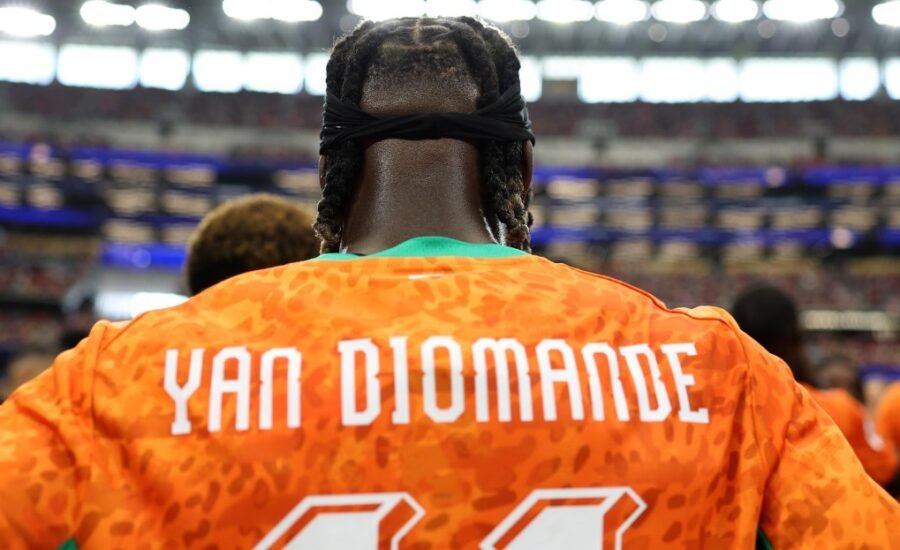
Yan Diomande is officially a Real Madrid player, signing a seven-year contract that will keep him at the club until June 30, 2033. The reported price — €125 million guaranteed to RB Leipzig with another €15 million potentially arriving through bonuses — makes the 19-year-old winger the most expensive signing Madrid have ever made in terms of fixed transfer fee.
It is an extraordinary amount of money for a player who, barely 16 months ago, had yet to start a professional football match.
But almost nothing about Diomande’s story has followed a conventional timeline.
He went from playing football in plastic sandals in Abidjan, to an academy in the United States, to repeated rejection, visa problems, almost two years without competitive football, Leganés, RB Leipzig, a breakout Bundesliga season, a World Cup and now Real Madrid.
And behind everything is the memory of his younger sister, Roxane.
Real Madrid finally get their right winger
For much of the summer, Diomande’s name was teased to fans at the Bernabéu. Interestingly, Paris Saint-Germain had advanced significantly in negotiations last month, and Diomande had been prepared to join the French champions during the World Cup.
Then Real Madrid entered the picture.
Madrid’s interest in the player was not new, but their push to sign him accelerated dramatically in late July. Club representatives travelled to Germany for talks with Leipzig, while Juni Calafat played an important role in convincing Diomande that Madrid should be his destination.
Once Diomande gave Madrid the green light, the remaining issue was reaching Leipzig’s valuation.
Madrid’s opening attempts reportedly came in below €100 million guaranteed. Leipzig resisted. Negotiations continued and eventually produced an agreement worth approximately €125 million fixed with another €15 million in possible variables.
The announcement was delayed by complications surrounding Diomande’s representation and by Leipzig’s own attempts to reorganize their squad, but the transfer itself had effectively been agreed for several days.
On August 6, Madrid finally made it official.
It completes an astonishing financial return for Leipzig.
Just one year ago, the German club paid around €20 million to sign Diomande from Leganés.
Now they have sold him for more than six times that amount.
The winger Real Madrid wanted
The price is enormous, but Madrid are buying one of the most explosive young attacking players in Europe.
Diomande is fundamentally a one-on-one winger.
He wants the ball at his feet, wants the defender isolated and wants space to attack. He has the acceleration to blow past opponents on the outside, but he is not simply a touchline sprinter. Playing predominantly from the left allows the right-footer to attack inside, combine around the box and create shooting opportunities, but he is equally as devastating on the right, which makes his fit at Madrid particularly interesting.
His former coach at DME Academy in Florida, Kioki Raul, in an interview with AS, described a player whose football intelligence stood out as much as his physical tools.
Diomande, Raul explained, was already extremely dangerous in individual situations as a teenager. He was explosive with and without the ball, understood how to control games despite his age and was almost too willing to bring teammates into play. The coaching staff occasionally wanted him to become more selfish in the final third.
That creativity survived the jump into senior football.
In his only season at Leipzig, Diomande recorded 13 goals and 10 assists across 36 competitive appearances. More impressive than the raw production was the way he generated it.
Defenders knew he wanted to run at them.
They still struggled to stop him.
Diomande became one of Europe’s most prolific dribblers, repeatedly turning static possession into defensive panic with a single acceleration.
That is a profile Madrid have lacked on the right side for years.
His arrival gives José Mourinho another attacker capable of breaking a defensive structure without needing a passing sequence to create the advantage first.
Put Diomande opposite Vinicius Junior, with Kylian Mbappé attacking centrally, and the theoretical possibilities are frightening. All three can stretch a defensive line vertically. All three can win individual duels. All three punish defenders who are left without cover.
For opponents, there may be no comfortable direction in which to force Madrid’s attack.
Diomande’s route to professional football was unconventional, and there were several points where his career could have gone in a completely different direction. He grew up in Abidjan and started playing at AFI Sud Comoé Academy before attracting more attention at an under-17 tournament in Ghana in 2022, where he scored five goals. That eventually led him into the Blue Crow network, first in Dubai and later at DME Academy in Daytona Beach, Florida.
The period in the United States is particularly interesting in retrospect because several clubs had opportunities to sign him before he became a professional. Diomande had interest or trials involving Bournemouth, Rangers, Crystal Palace and Chelsea, among others, but none ultimately resulted in a transfer. His former DME coach Kioki Raul remembers a player who immediately stood out in one-v-one situations and whose understanding of the game was unusually advanced for his age. Raul said Diomande would regularly take control of matches regardless of whether DME were facing youth clubs, universities, residential academies or professional opposition.
There were also significant complications away from the field. Diomande’s visa expired in 2023, forcing him to return to Ivory Coast, while disagreements involving the different parties handling his career created uncertainty over where he would play next. Olympiacos were one possibility, but eventually Blue Crow — which also owns Leganés — offered him a route into Spanish football.
That move proved to be the important one.
Diomande joined Leganés’ Juvenil A side in November 2024, quickly moved into the reserve team and was promoted to the senior squad within months. He made his La Liga debut on March 29, 2025, against Real Madrid at the Bernabéu. There wasn’t a huge body of work to evaluate from his first season — he played only 542 senior minutes — but there was enough for European clubs to start calling.
According to reports, Blue Crow received interest from 41 clubs after Leganés were relegated. Monaco were heavily involved, but were reluctant to meet the €20 million asking price. RB Leipzig were not.
Leipzig paid approximately €20 million for a player who had barely played 10 senior matches. That seemed like an aggressive valuation at the time, but it also tells you something about how Diomande was viewed by scouting departments before his Bundesliga breakout. The underlying talent wasn’t particularly hidden. The question was whether the flashes he had shown in Spain would scale over a larger sample and at a higher level.
Diomande’s development at Leipzig was immediate. He finished his first Bundesliga season with 12 goals and eight assists, but the more interesting part of his season was how many different areas he affected.
He created 49 chances, registered 174 progressive carries of at least 10 metres and completed more than 110 dribbles. He also won 186 duels and completed 87% of his passes despite being a high-volume dribbler who was constantly trying to advance the ball into dangerous areas.
Those numbers help explain why Madrid were willing to move so aggressively after only one Bundesliga season. There are plenty of young wingers who can dribble and plenty who can produce goals in transition. Diomande did both while also creating for teammates and retaining the ball at a surprisingly high rate.
The dribbling is the obvious starting point. Diomande ranked among the very best players in Germany for successful take-ons and progressive carries. He is extremely comfortable receiving against a set defender, and he doesn’t require much separation before attempting to beat him. That matters because Madrid face so many opponents who are happy to defend deep and concede possession. Against those teams, eventually someone has to create an advantage individually. Structure can get the ball to the final third, but structure doesn’t always get you through the final line.
Vinicius has provided that for years. Diomande gives Madrid another player capable of doing it on the opposite side.
His 12 Bundesliga goals also deserve some context. Diomande scored them from only 39 shots, an absurd conversion rate that almost certainly won’t remain that high indefinitely. He significantly outperformed his expected-goal numbers and ranked near the top of the Bundesliga in shot conversion. There is clearly real finishing ability there — particularly when shooting after carrying the ball inside — but Madrid shouldn’t expect him to score on roughly one out of every three attempts forever.
Some regression would be completely normal. The encouraging part is that even if the finishing comes down, his ability to progress the ball and create chances gives him other ways to affect games.
There are weaknesses in the profile, which is normal for a 19-year-old who has effectively had one complete season of high-level senior football.
One of the biggest areas for improvement is his movement without the ball. Diomande is much more comfortable creating an advantage after receiving possession than creating one before receiving it. His penalty-area reception numbers are relatively modest, and he can sometimes remain outside the box waiting for the ball rather than making a run behind the defensive line or attacking the back post.
That will be important at Madrid because he won’t always have the Bundesliga transition game available to him. There will be matches where Madrid have 65 or 70 percent possession and the opposition has almost everyone behind the ball. In those situations, Diomande won’t be able to solve everything by receiving wide and beating his man. He will need to develop combinations around the box, improve the timing of his runs and learn how to create scoring opportunities when he doesn’t touch the ball during the buildup.
There is also some inevitable waste in his game. Diomande lost possession around 180 times in Bundesliga play last season. That number needs context — players who attempt a lot of dribbles and progressive actions will naturally turn the ball over more often — and Madrid absolutely should not try to eliminate that risk from his game. If you sign one of Europe’s best one-v-one players and then tell him to stop taking players on, you’ve missed the point.
The development is in choosing the right moments. At 19, Diomande will occasionally attack a defender when recycling possession would have been the better option, or force an action after the second defender arrives. That is coachable. The more important thing is that the underlying ability to consistently beat the first defender is already there.
The tactical question is interesting because Diomande’s best position may not be the position where Madrid need him most.
He is right-footed and has generally looked most dangerous starting from the left, where he can isolate the full-back, cut inside and either shoot or combine centrally. Kioki Raul, his former coach in Florida, also believes the left is his strongest position and has highlighted his ability to cut inside while still being comfortable crossing or finishing with his weaker foot.
The problem, obviously, is that Vinicius Junior exists.
So the immediate assumption will be that Diomande plays primarily from the right. He has played there before and has enough variety to make it work. From that side he can stay wider, attack the outside shoulder of the full-back and create cutbacks for Mbappé, while still having the freedom to interchange with the other attackers.
That could give Madrid a much more balanced front line. One of the issues with some previous attacking configurations has been the tendency for multiple players to drift toward the left. Diomande is comfortable enough on the right to maintain width there, while also giving Madrid someone who can actually punish a full-back when isolated.
A Vinicius — Mbappé — Diomande front three is also an outrageous amount of speed. In transition, there probably isn’t a defensive line in Europe that would particularly enjoy dealing with it.
The more complicated question is what happens when Madrid have the ball against a low block. Mbappé and Vinicius both naturally want touches in particular zones, and Diomande is another player who currently does his best work with the ball at his feet. Mourinho will have to figure out how to distribute those touches while ensuring there is enough movement around them.
That is where Diomande’s off-ball development becomes important. Madrid don’t need three attackers simultaneously coming toward the ball. Someone has to stretch the defense.
What happens to the rest of the attack?
The squad implications are difficult to ignore.
Madrid now have Vinicius, Mbappé, Diomande, Rodrygo, Endrick, Brahim Díaz, Franco Mastantuono and Bernardo Silva as attacking options. There are different positional interpretations within that group, but the basic point remains: there are too many good players for everyone to receive the minutes they want.
Diomande is not arriving as a developmental signing. You don’t spend a reported €125 million guaranteed on a player and gradually introduce him over several years. He will play, and someone else’s minutes will be affected.
The signing appears to close the door on Michael Olise for this summer. Beyond that, Madrid now have even more flexibility if they receive a significant offer for one of their existing attackers. Rodrygo’s situation will naturally be discussed again. Brahim and Mastantuono face another layer of competition. Endrick’s pathway also needs to be considered carefully because sitting behind a collection of established attackers does very little for his development.
Vinicius is a separate situation because of his contract. His current deal expires in 2027, and until an extension is completed, every major attacking signing will inevitably create questions about his future. Diomande’s arrival does not necessarily mean anything specific for Vinicius — they can absolutely play together — but it does reduce Madrid’s dependence on any one winger.
There is also the question of whether the squad is actually finished. Mourinho has now received six additions: Diomande, Bernardo Silva, Ibrahima Konaté, Marc Cucurella, Denzel Dumfries and Carlos Espí. Madrid have invested heavily in reshaping the squad, and after adding another attacker, the next stage of the window should logically involve departures.
The financial side of the deal
The reported €125 million guaranteed fee is obviously enormous. If another €15 million in bonuses are triggered, Leipzig could eventually receive €140 million.
That makes the transfer particularly remarkable from Leipzig’s perspective. They paid around €20 million for Diomande last summer and are selling him one year later for a guaranteed profit of roughly €105 million before accounting for other contractual obligations.
Leganés benefit as well.
Their agreement with Leipzig reportedly entitles them to 5% of the capital gain generated by a future Diomande sale. On a €125 million fixed transfer, Leipzig’s profit over the original €20 million fee would be approximately €105 million, which would give Leganés around €5.25 million.
If the full €140 million is eventually paid, the profit rises to €120 million and Leganés’ share would increase to approximately €6 million.
There is additional money through FIFA’s solidarity mechanism because Diomande spent part of his development period at Leganés. Reports in Spain estimate another payment of roughly €400,000, potentially increasing if Madrid’s bonuses are triggered.
For a player who spent less than a year at Butarque and barely accumulated 500 senior minutes, Diomande has now generated well over €25 million for Leganés between the original Leipzig transfer and the subsequent payments attached to his Madrid move.
There is a lot that happened before Diomande became a €125 million footballer, and some of it provides useful context for understanding his career.
He grew up in a large household in Abidjan and has spoken about playing football in basic sandals before his family was able to buy him proper boots. Cristiano Ronaldo was his favourite player; one of the stories Diomande has told is that he once received a fake Manchester United shirt and wrote Ronaldo’s name and number seven on the back himself.
More importantly, Diomande has spoken extensively about his younger sister Roxane, who died at 15. She had been one of the people who continued encouraging him during the periods when his football career stalled, particularly after his visa expired and he had to return to Ivory Coast.
Diomande later wrote a letter to Roxane for The Players’ Tribune explaining the importance she had in his life and career. He has said that football became the place where he felt closest to her after her death and that he continues to dedicate what he achieves to her.
It is worth knowing because it is part of Diomande’s story, but ultimately Madrid are signing him because of what he has become on the pitch.
And that development has happened incredibly quickly.
Madrid are paying for what comes next
The central question with this transfer isn’t whether Diomande was excellent last season. He was.
The question is whether one excellent Bundesliga season provides enough evidence to justify €125 million guaranteed.
There is real risk involved. Diomande has a tiny sample of top-level football compared with most players who move for this kind of money. His finishing numbers are likely to regress. He needs to improve without the ball, and his decision-making still looks like that of a player who is learning when to use all the tools he has.
But the upside is equally obvious.
It is extremely difficult to find 19-year-old wingers who can beat defenders at this volume while also producing 20 league goals and assists. It is even harder to find one who combines that dribbling with chance creation, ball progression, physical competitiveness and an 87% passing rate.
Madrid are essentially paying superstar money before Diomande has actually become a superstar.
The encouraging thing is how quickly he has cleared every previous level. He went from Leganés’ youth team to their first team in months. He went from 542 minutes of senior football in Spain to one of the Bundesliga’s best wingers in his first season. He went from barely having a professional career to starting for Ivory Coast at a World Cup.
Now the jump is considerably bigger.
At Leipzig, Diomande could be exciting. At Real Madrid, eventually, exciting won’t be enough. The expectation attached to the fee will be that he becomes one of the best wingers in the world.
Madrid clearly believe he can.
The analytics give them plenty of reasons to think so.