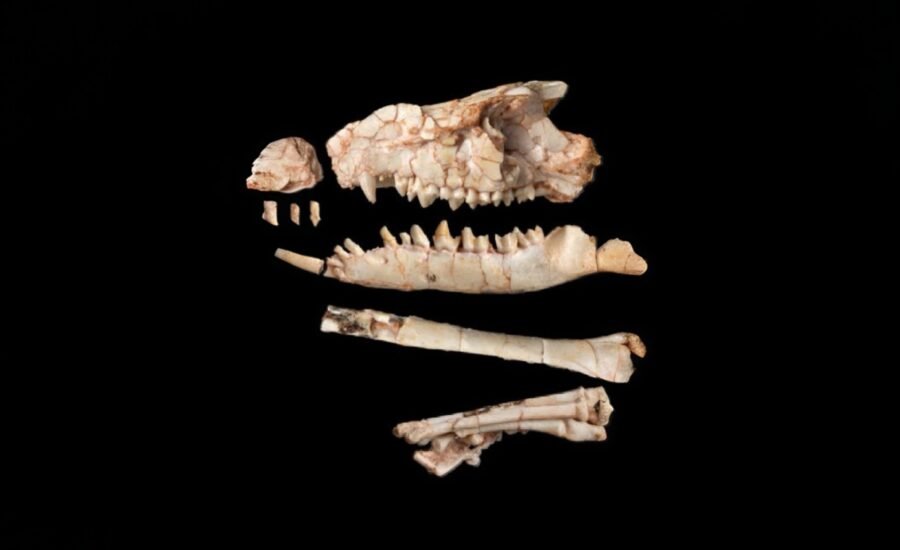
A rabbit-shaped skeleton from Mongolia just settled an old argument about a group of extinct mammals.
For decades, scientists knew this group only from its teeth, and those teeth kept pointing to the wrong branch of the mammal family tree.

A newly described fossil says otherwise.
Known only from scattered teeth
Paleontologists call the group zhelestids. For most of the last 40 years, all anyone had were scattered teeth and a few broken jaw pieces.
Those teeth were low, rounded, and built more for grinding plants than the sharp, pointed teeth found in most other mammals from the same era. That one clue was enough to start a long-running argument.
The new fossil comes from a team at the American Museum of Natural History, Stony Brook University, the University of Arizona, and Arcadia University.
Study lead author Andres Giallombardo found the specimen in Mongolia’s Gobi Desert in 2004, while he was a graduate student on a museum-sponsored expedition.
“It was the thrill of a career to find a new species so completely preserved that also solves a longstanding scientific problem, and a reminder that the Gobi Desert, which is well known for fossils, continues to change science,” said Giallombardo.
Teeth pointed to the wrong branch
The rounded teeth led some researchers to guess that zhelestids were an early branch of hoofed, plant-eating mammals.
Others went further, suggesting zhelestids were some of the earliest placental mammals, the group that today includes humans, dogs, whales, and most living animals.
Genetic studies of living animals, which estimate how far back different mammal lines split by comparing their DNA, have long suggested that placental mammals go back far enough to have lived alongside dinosaurs.
A fossil placental mammal from the Cretaceous would back that idea up with a body, not just a calculation.
Paul Velazco, a comparative biologist at Arcadia University and a co-author on the study, said the two kinds of evidence do different jobs.
“Molecular models based on living animals can predict the past, but fossils provide the evidence needed to test those predictions,” noted Velazco.
A skeleton the teeth never predicted
The new species, named Tamirkhan balcarceli, still has the low, rounded teeth that define zhelestids.
But it also has long front incisors that never stop growing, plus a set of skull features that match a very different group: small, shrew-like insect-eaters called zalambdalestoids. Its back legs settled the question.
Shawn Zack, a paleontologist at the University of Arizona and co-author of the study, said the hind limbs left no doubt.
“Tamirkhan’s hind legs are long and slender with distinctive ankles, traits that are unmistakably zalambdalestoid,” Zack noted.
Based on the whole skeleton, the team now places zhelestids inside the zalambdalestoid group rather than anywhere near placental mammals.
One tooth cannot describe a body
The rounded teeth were not evidence of a close relationship to hoofed mammals after all. They were a case of convergent evolution, where unrelated animals develop similar features because they eat similar food.
Maureen O’Leary is a paleontologist at Stony Brook University and a research associate at the museum.
“More than 200 years ago, French naturalist Georges Cuvier famously argued that a single tooth could allow scientists to predict the anatomy of an entire animal,” said O’Leary.
“While teeth remain among the most informative fossils available, this work demonstrates that teeth cannot always tell us how the whole animal looked.”
A body plan like rabbits
Tamirkhan measured 6 to 7 inches (15 to 18 centimeters) from head to tail, about the length of a new pencil.
Its long hind legs gave it a hopping, rabbit-like build, even though real rabbits would not show up for tens of millions of years.
Paleontologists have nicknamed zhelestids “Cretaceous rabbits” for exactly that reason. They copied a body plan nature had not invented yet.
Surprises from the Gobi desert
Complete zhelestid skeletons are rare. Outside Mongolia, pieces of the group have turned up only in Kazakhstan, Kyrgyzstan, and Uzbekistan.
Michael Novacek, a curator in the museum’s Division of Paleontology who has co-led expeditions to the Gobi with the Mongolian Academy of Sciences every year since 1990, said that the region keeps delivering.
“The Gobi is one of the only places where we routinely recover such remarkably complete Cretaceous mammals,” Novacek said.
“These extraordinary fossils continue to transform our understanding of mammalian evolution.”
The full study was published in the journal Nature.
Image Credit: Nicole Wong / ©AMNH
—–
Like what you read? Subscribe to our newsletter for engaging articles, exclusive content, and the latest updates.
Check us out on EarthSnap, a free app brought to you by Eric Ralls and Earth.com.
—–