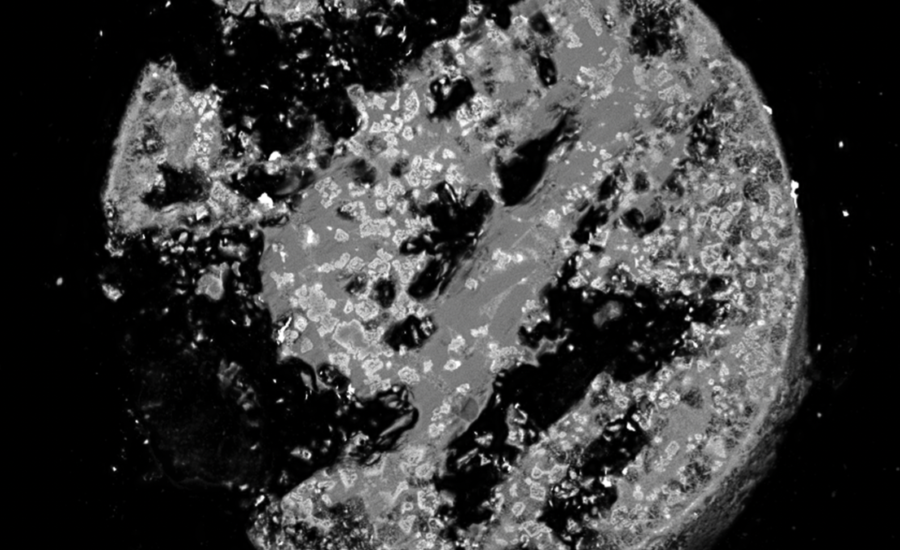

Back-scattered electron image taken with a scanning electron microscope of the spheroidal hiroshimaite sample in which the alloy was found.
| Photo Credit: Bindi et al., Sci. Adv. 12, eaeg8299 (2026)
Researchers have found a previously unknown metal alloy created by the blast of the Hiroshima atomic bomb in 1945. The material was found inside small, glass-like beads called hiroshimaites, which were recovered from the beach sands of Hiroshima Bay. These beads formed when the intense heat of the blast vaporised building materials, soil, and metals, which solidified as they fell back to the earth.
When the researchers examined the beads, they identified a micrometer-sized metallic grain embedded in the glass. It turned out to be a complex mix of iron, chromium, nickel, manganese, molybdenum, silicon, and aluminium — and it had a unique crystal structure.
The findings were published in Science Advances on July 29.
The team has expressed belief that the alloy formed by ultrafast quenching: the explosion’s fireball reached temperatures over 7,000° C, turning urban materials such as construction steel and aluminium into a mixed metallic vapour. As the fireball expanded and rapidly cooled, the elements mixed in a way that is impossible under normal conditions, stabilising into their final, complex phase.
According to the researchers, their work shows that high-energy plasma events like nuclear detonations can be natural laboratories where scientists can discover new materials that are difficult to synthesise in a scientific lab. The alloy already shares characteristics with other unusual high-entropy alloys and quasicrystals, which are of great interest among engineers for their strength and stability.
The researchers also wrote that their work shows how debris can preserve a “high-resolution record” of the chemical and physical environment during a nuclear event.
Published – August 02, 2026 12:30 pm IST