Pakistan appears to have restricted access to influential Qatari broadcaster Al Jazeera after the outlet extensively covered the ongoing protests and election-related violence and tensions in Pakistan-Occupied Kashmir (POK), according to reports and claims by activists and opposition leaders. Pakistan accused Al Jazeera of “selective reporting” and “yellow journalism”, alleging the channel was trying to “delegitimise” the POK elections through “carefully chosen timings and scripted statements from selected individuals.”
Multiple users on X reported that Al Jazeera’s website became inaccessible inside Pakistan soon after it’s reporting from the illegally-occupied region of India.
“In tandem with the blocking of local and regional digital news domains, incoming reports indicate that international broadcasters, including Al Jazeera English, have also become inaccessible to users within parts of the country. However, there has been no official confirmation from Pakistan regarding the restrictions,” reported ANI.
Activists and opposition leaders said the development has sparked fresh concerns over press freedom in a country that has increasingly tightened control over critical journalism under the hybrid regime led by Asim Murir. The intense protests in POK have reportedly left at least 80 civilians dead.
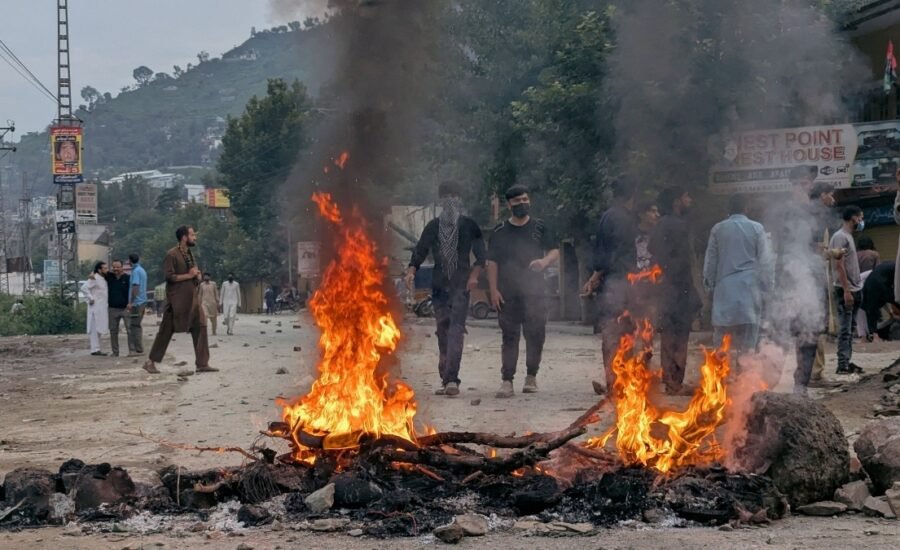
The reported move comes at a time when POK is witnessing weeks-long protests, internet shutdowns and political unrest over the ongoing disputed election of the occupied region’s so-called assembly.
Unlike several Pakistani and international outlets, Al Jazeera carried multiple on-ground reports documenting the impact of the unrest on civilians, elections and communications. For the last few days, Kamal Hyder, the Al Jazeera correspondent in Pakistan, reported from Muzaffarabad. In one of his reports, Hyder noted that the low turnout in the POK polls was a result of the people showing “solidarity with the protests in the region”.
The reported restriction has therefore raised questions about the Munir-led oppressive regime, fighting a multi-front unrest.
“Protests are going on here. People and many parties have boycotted it. Women aren’t coming out to cote. People are disgusted with the system. They got fed-up,” a Muzaffarabad local, Nadia Khitab Raja, told Al Jazeera.
India on July 31 called upon the international community to scrutinise Islamabad’s “ruthless” use of force against peaceful protesters in POK and hold it accountable for the “atrocities”.
AL JAZEERA BLOCKED IN PAKISTAN: CLAIM ACTIVISTS
The earliest claims that Al Jazeera had been blocked in Pakistan came from Sohaib Khan, former Deputy General Secretary of the terror outfit JKLF AJK-GB Zone.
In a post on X, Khan said, “Just confirmed from Islamabad: The AJEnglish website has been restricted in Pakistan following its coverage of recent events” in the POK.
“Silencing independent media will not hide the truth,” he added.
The claim was later amplified by ANI, which said Pakistan had restricted access to several digital news platforms following their coverage of the unrest in POK.
Pakistan’s Ministry of Information accused Al Jazeera of “selective reporting from handpicked polling stations in Muzaffarabad”, alleging that the channel used “carefully chosen timings and scripted statements from selected individuals” to misrepresent the POK elections and voting process.
It called the coverage “yellow journalism” and claimed it reflected “the agenda of external actors with vested interests” seeking to delegitimise the election. The ministry further alleged these actors were trying to “undermine the popular will of the people of Muzaffarabad and AJK [POK]”, which it said was demonstrated by voters’ “rejection of anarchy and coercion.”
The reported restriction on Al Jazeera was also reported by Pakistan Tehreek-e-Insaf (PTI) leader Faiza Murad, who’s now based in London. She alleged that Islamabad had simultaneously tightened reporting rules for foreign journalists.
In a post translated from Urdu, she wrote, Following Al Jazeera’s report on the elections in POK, “the Ministry of Information and Broadcasting has reminded foreign journalists that, under the Foreign Media Facilitation Guidelines, obtaining a prior NOC (No Objection Certificate) will be mandatory for reporting from any area of Pakistan other than Lahore, Islamabad, and Karachi”.
“This is proof that this hybrid regime wants to further restrict free journalism and foreign media access in Pakistan,” she said.
India Today could not independently verify the veracity of the alleged advisory referred to in her post.
WHAT DID AL JAZEERA REPORT FROM POK?
The timing of the reported restriction on the Qatari broadcaster is important because Al Jazeera has been among the few major international broadcasters to devote sustained coverage to the unrest in POK.
It has documented and reported on the prolonged internet shutdowns that residents said disrupted education, healthcare and businesses. The reports also examined how road blockades and security measures affected daily life. The network also covered the so-called elections and the political controversy surrounding them. Hyder’s reports definitely gave international visibility to a crisis in POK that has received limited global attention.
In one of his reports from Muzaffarabad, Kamal Hyder said the city was witnessing a widespread shutdown, with markets closed and roads deserted due to strike calls, which made it difficult for people to even reach polling stations. He reported that many residents and opposition groups were alleging that the electoral process lacked a level playing field. He questioned how meaningful voting could take place amid curfews, roadblocks and heavy security. His report highlighted accusations of electoral manipulation and public discontent. The reports gave voice to criticism directed at Pakistan’s establishment and Munir’s hybrid regime.
Al Jazeera’s reporting highlighted the allegations made by protesters, the security establishment’s brutal response and the wider political tensions surrounding the sham polls in the disputed region.
WHY PROTESTS ARE RAGING IN POK
The protests in POK, led by the outlawed Joint Awami Action Committee (JAAC), erupted in June over reserved seats in the region’s so-called assembly, and decades-long ill-treatment of the people at the hands of the Pakistani establishment. Other demands include Islamabad’s prolonged interference in local governance, greater political autonomy, the release of detained JAAC activists, accountability for civilian deaths during the crackdown, equitable distrubution of resources, and regulation of prices of wheat and other food items.
India in July said that the ongoing protests in POK were a direct result of Pakistan’s decades-long “systemic exploitation, denial of fundamental rights and administrative oppression” and called on the international community to hold Islamabad accountable for the human rights abuses in the region.
According to multiple reports, the protests have also featured slogans sharply critical of Pakistan’s establishment and political leadership, with some demonstrators reportedly raising chants such as “Open the road to India”.
POK is the part of the former princely state of Jammu and Kashmir that has been under Pakistan’s illegal control since the 1947-48 India-Pakistan war and is an integral part of India.
As protests intensified, clashes with security forces, internet shutdowns and road blockades followed, with rights groups raising concerns over civilian casualties and restrictions on communication. The unrest has since evolved into a broader movement against the region’s political system, with protesters demanding transparency, accountability and greater democratic rights, even as the establishment led by Munir shows no signs of backing off.
– Ends