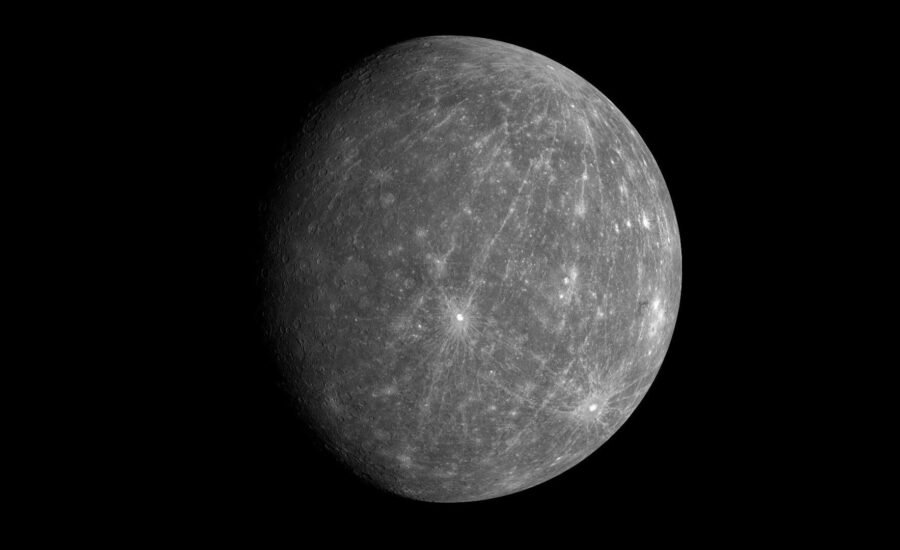
On Aug. 3, 2004, NASA launched the MESSENGER spacecraft on a historic first mission to orbit the planet Mercury. The spacecraft’s name stands for the MErcury Surface, Space ENvironment, GEochemistry and Ranging mission.
It blasted off on a Delta II rocket that launched from Cape Canaveral Space Force Station in Florida at 6:15 a.m. Eastern Time and spent the next six and a half years making its way to Mercury’s orbit. Because Mercury is so close to the sun, a spacecraft travelling toward the planet speeds up as the sun’s gravity pulls it in.
In order to slow down enough to avoid falling into the sun, MESSENGER utilized the gravitational pull of Venus and Mercury with multiple flybys along the way. It made 15 trips around the sun before it finally arrived in Mercury’s orbit in 2011.

(Image credit: NASA/ Johns Hopkins APL)


Why it mattered
Mercury is an odd planet. It is close to the sun, yet holds the promise of water ice on its surface. It completes one orbit every 88 days. But it can be a devil of a planet to reach with a spacecraft.
The launch of NASA’s MESSENGER spacecraft was the first step to bring the rocky, craggy Mercury within tantalizing reach of scientists hoping for an upclose look at the planet. The spacecraft made some surprising discoveries, revealing that Mercury’s core is huge — roughly 85% of its radius (Earth’s core is only 50% of its own radius). The planet is also very flat, with less elevation changes than those found on Earth’s moon and Mars. MESSENGER’s greatest finds may have been extremely “radar-bright” deposits in craters at Mercury’s poles, which are in permanent darkness and may hold pockets of water ice.
MESSENGER’s primary mission at Mercury ended in 2012 and its mission was extended twice. In 2015, NASA ended the MESSENGER mission by crashing the probe into Mercury.
A new spacecraft is now headed for Mercury. The BepiColombo mission, a joint project by Japan and the European Space Agency, launched two different orbiters to Mercury in 2018 and is due to arrive at the planet in November.