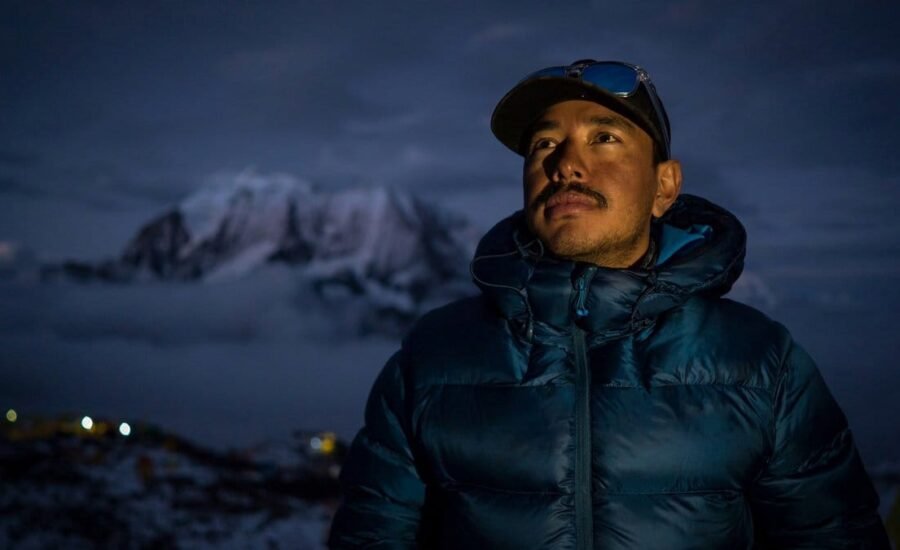
Four days later, the mountain had the final word.
An avalanche struck the expedition on Broad Peak in Pakistan’s Karakoram, killing Purja and nine other climbers. Purja was 43.
Tributes poured in from Nepal, Britain and the international climbing community. Fellow climbers recalled not just an extraordinary mountaineer but a leader who constantly challenged the limits of what was considered possible.
To the wider world, Nirmal Purja was the man who climbed all 14 of the world’s 8,000-metre peaks in just 189 days in 2019, breaking a record that had stood for years. To many, he was “Nims”, the climber from 14 Peaks: Nothing Is Impossible, the documentary that introduced millions to Himalayan mountaineering.
But to Nepal, he represented something larger: a generation of climbers determined to move Nepalese mountaineers from the margins of climbing history to its centre.
His achievements made him famous. His methods, personality and controversies made him one of the most debated figures in modern mountaineering.
Also Read: Union Budget 2026 pushes mountain trails for tourism. It will be a challenge for state govts
From Myagdi to Special Forces
Nirmal Purja was born on 25 July, 1983, in Dana, a village in Nepal’s Myagdi district, beneath the shadow of the Himalayas that would later define his life. With limited educational opportunities in the village, the family eventually moved to Chitwan so that Purja and his siblings could study.
Looking back at his childhood, Purja once recalled: “We used to live in this little house where the whole of the upper floor was used for chickens. It was four days’ walk to the nearest road.”
Like many young Nepalese men, Purja saw the Brigade of Gurkhas as a route towards opportunity. Three of his elder brothers had already enlisted. In 2003, he joined the British Army. But the military was not just a career choice for him. “When I joined the Special Forces, it was never for the money. It was for pure desire to serve in an elite unit,” he said.
In 2009, Purja became the first Gurkha to pass selection for the United Kingdom’s elite Special Boat Service (SBS), one of the world’s most demanding special forces units. His years in the military shaped his approach to extreme environments.
As part of the SBS, he worked in cold-weather warfare, studying how humans operate in some of the harshest conditions on Earth. The discipline, preparation and teamwork he learned there would later define his climbing career.
‘Project Possible’
Unlike many famous mountaineers, Nirmal Purja did not grow up dreaming of Everest.
His journey into climbing began much later, during a military break when he visited Everest Base Camp. The experience stayed with him. “When you say you are from Nepal, people always ask you if you’ve seen Everest. And I had to say no,” he once said. “I felt like I had to go and do this, just for my sanity.”
Within a few years, he was climbing some of the world’s highest mountains. Then came the biggest gamble of his life. In 2018, after 16 years in the British military, Purja hung up his boots, remortgaged his house, and announced Project Possible.
It sounded almost impossible at first: Climbing all 14 mountains above 8,000 metres in less than seven months. The existing record at the time, held by South Korean climber Kim Chang-ho, stood at seven years, 10 months and six days.
Six months and six days later, Pujra had bested it.
The achievement instantly transformed him into one of the world’s most recognisable mountaineers. But Project Possible was never just about speed. For Purja, it was about changing how the world viewed Nepalese climbers.
For decades, Nepali high-altitude workers had played a crucial role in Himalayan expeditions. They fixed ropes, carried equipment and guided foreign climbers towards summits. Yet global recognition often went elsewhere. Purja wanted to challenge that hierarchy. He wanted Nepalese climbers to be seen not merely as support staff, but as expedition leaders, athletes and record-breakers. Unlike traditional mountaineers who often avoided publicity, Purja embraced documentaries and social media.
He understood that storytelling could be as powerful as scaling the summit itself.
During Project Possible, Purja captured one of the most recognisable images in modern mountaineering. In May 2019, during a brief weather window on Everest, he photographed a long queue of climbers waiting near the summit. The image travelled worldwide and reignited debates about overcrowding on the world’s highest mountain.
Also Read: Six years of failure & a near-death experience—How 2 Indian mountaineers conquered Everest
A climber’s influence beyond the summit
Indian mountaineer Amit Negi, a Himachal Pradesh-based climber attempting to summit all 14 peaks above 8,000 metres, first met Purja during an Everest expedition in 2021, high above Camp 3 at around 25,500 feet.
They met again during Kanchenjunga and Annapurna expeditions.
At Annapurna in 2023, Negi saw a more personal side of Purja. “Despite everything he had achieved, he was very down to Earth and friendly,” Negi told ThePrint. During their conversation, Purja spoke emotionally about his daughter, who was born a year earlier.
What stayed with Negi was Purja’s philosophy towards mountains and life. “He always said, ‘sponsorship mile na mile, sab mountain par chhod do. The day the mountain accepts you and calls you, you will reach it’.”
Inspired by him, Negi began his own journey towards scaling all 14 peaks. “He was like family to me,” Negi said. “I want to dedicate my future 8,000-metre peaks in Nepal to him.”
K2 winter: A victory for Nepal
After Project Possible, Nirmal Purja turned towards another historic challenge, K2 in winter.
Known as the “Savage Mountain”, K2 has long been considered one of the most dangerous and technically demanding peaks in the world. For decades, a winter ascent remained one of mountaineering’s last great challenges.
In January 2021, Purja was part of an all-Nepali expedition that achieved the first successful winter ascent of K2. The moment carried significance beyond the summit. The climbers reached the top together, singing Nepal’s national anthem.
For Purja, the achievement represented something bigger than a personal victory.
“K2 in winter is something people had thought about for a long time, but had never accomplished,” he said. “For me, more satisfaction came from winter K2 because it was done in a different manner and style, a message of team unification rather than just me climbing for myself.”
Purja also challenged traditional ideas about mountaineering. For much of its history, climbing was associated with isolation, patience and the image of an individual battling nature. Purja represented something different.
His expeditions relied on extensive planning, advanced technology, satellite communication, helicopters where possible and large support teams.
His argument was that the mountains evolve and so do the people attempting them.
“You don’t need to be extraordinary to achieve extraordinary things,” became one of the ideas most associated with his public message. Then came allegations that further complicated his legacy. In 2024, two women climbers accused Purja of sexual misconduct. He denied the allegations through his legal representatives.
His supporters continued to highlight his achievements and his contribution to Nepalese climbing. Critics argued that extraordinary accomplishments cannot place anyone beyond scrutiny. Both realities became part of the story of Nirmal Purja.
(Edited by Amrtansh Arora)
Also Read: ‘9-10 could have died’—Abandoned by firms, Himachal trekkers escape Sahastra Tal-like tragedy