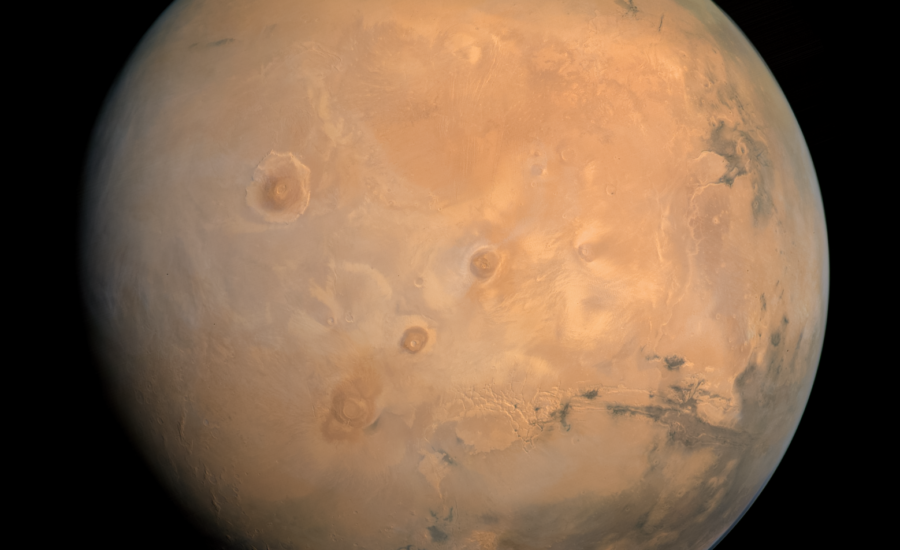
What new methods can be developed to identify water ice deposits on Mars? This is what a recent study published in The Planetary Science Journal hopes to address as a team of researchers led by the Planetary Science Institute investigated new methods for identifying water ice deposits on Mars. This study has the potential to help scientists, engineers, mission planners, and future astronauts better understand new methods for finding water ice deposits on Mars, which could benefit human exploration and Mars climate analyses.
For the study, the researchers used a combination of computer models and statistical analysis to examine the global distribution of subsurface water ice on Mars. This study continues the efforts of the Mars Subsurface Water Ice Mapping project, which is dedicated to identifying subsurface water ice on Mars for future exploration. There were several motivations behind the study, including human exploration since water ice deposits would substantially reduce the financial and logistical costs of shipping it from Earth.
Additional motivations include improving water ice identification methods without relying on one instrument and moving from an observational to statistical approach in identifying water ice deposits. In the end, the researchers found a greater chance of finding subsurface water ice poleward of 45° latitude in both hemispheres while noting that subsurface water ice near the equator is hard to identify.
The study notes in its conclusion, “Our work is a step toward resource quantification, and it supports previous studies demonstrating that subsurface water ice exists in the Martian midlatitudes. We find that subsurface ice in excess of pore space exists at latitudes higher than ∼45°. Pore-filling ice may extend to lower latitudes in select locations, but there is high uncertainty. The data are not sufficient to confirm or deny the presence of ice in these locations.”
What new insights into identifying water ice deposits on Mars will researchers make in the coming years and decades? Only time will tell, and this is why we science!
As always, keep doing science & keep looking up!
Sources: The Planetary Science Journal
Featured Image Credit: Kevin Gill