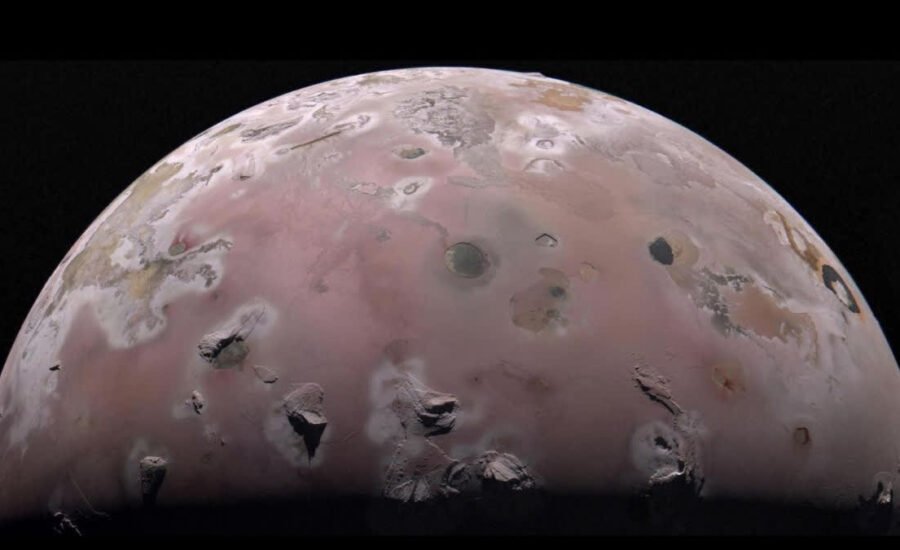
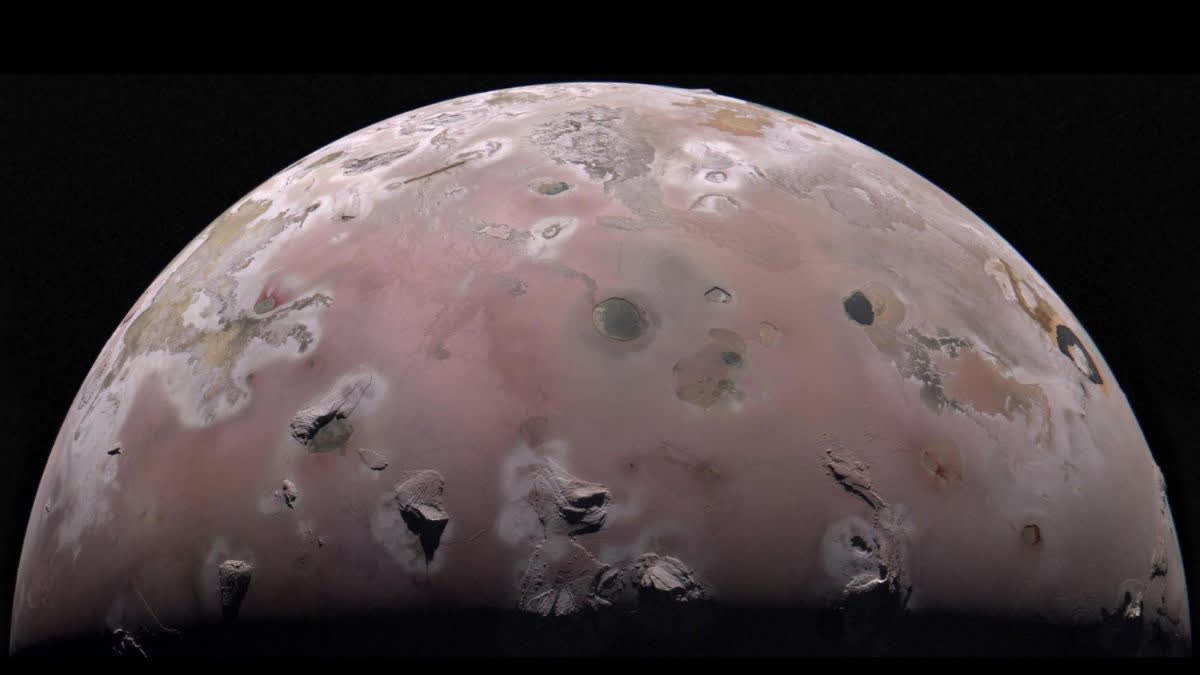
The north polar region of Jupiter’s volcanic moon Io was captured by NASA’s Juno during the spacecraft’s 57th close pass of the gas giant on Dec. 30, 2023. Data from that flyby and one on Feb. 3, 2024, is helping scientists understand Io’s interior. (Image Credit: NASA/JPL-Caltech/SwRI/MSSS Image processing by Gerald Eichstädt)
Hyderabad: The National Aeronautical and Space Administration’s (NASA) Juno spacecraft has provided the first measurements of temperatures beneath the surface of Jupiter’s moon Io, revealing significant heating within its shallow subsurface.
According to a study titled “Io Sub-Surface Temperature Profile Observed by the Juno Microwave Radiometer” in the Journal of Geophysical Research: Planets, the data gathered during two close flybys shows that most of Io’s surface is incredibly smooth and made of unusually low-density material.
How is Io’s internal heat generated?
Io is the most volcanically active body in the solar system. It is powered by tidal heating, which occurs as Jupiter’s immense gravity constantly stretches and squeezes the moon along its slightly elliptical orbit. This process generates an internal heat output many times greater than Earth’s. Until now, virtually everything known about this heat came from infrared observations, which can only detect surface temperatures. The latest findings were derived from data collected by Juno’s Microwave Radiometer (MWR) instrument.
Scott Bolton, the study’s coauthor explained that the MWR directly observed Io’s heat output by looking beneath its surface. “The surprising discovery that we could see below a rocky moon’s surface has important implications for studying Earth’s volcanoes. Juno has taught us that if we look with an MWR-type instrument near a volcano on Earth, we might see a similar signature in the subsurface temperature gradient, providing new information on how terrestrial volcanoes work,” he added.
The MWR was originally designed to peer beneath Jupiter’s cloud tops and study the dynamics of its deep atmosphere. Its six microwave antennas detect wavelengths ranging from roughly half an inch to 20 inches, with each wavelength capable of probing different depths. During Juno’s extended mission, the instrument also observed two other Galilean moons, Ganymede and Europa, though Bolton noted that probing Io’s volcanic rock was an unexpected addition to that work.
This map represents data captured by the Microwave Radiometer instrument aboard NASA’s Juno, indicating heat rising from just beneath the surface of Jupiter’s moon Io. The colors illustrate a distinct temperature gradient across the moon, with the most extreme, localized heat output in red. (Image Credit: NASA/JPL-Caltech/SwRI/USGS)
During flybys on December 30, 2023 and February 3, 2024, Juno came within around 930 miles of Io’s surface. Shannon Brown, the paper’s lead author at NASA’s Jet Propulsion Laboratory, said the instrument measured thermal emissions at depths ranging from a few inches to tens of feet. The team found that temperatures rose by more than 40 degrees Fahrenheit (4.4-degree Celsius) within just a few feet of the surface, a gradient far steeper than solar heating alone could explain.
Two possible explanations
Researchers have proposed two explanations for the heat signal. One is that heat could be rising steadily through a conductive crust; this background heat flow measured at 1 to 3 watts per square metre. While this energy release is gentle on a local scale, it represents a total output across the entire moon of up to 30 times Earth’s average. The alternative explanation points to cooling lava flows, capped by roughly 30 to 35 feet of solidified crust, which cover around 10 per cent of Io’s surface at any given time.
This graphic illustrates the areas of Io sampled by the Microwave Radiometer instrument aboard NASA’s Juno spacecraft during two close flybys of the Jovian moon. (Image Credit: NASA/JPL-Caltech/SwRI/USGS)
Bolton said Io offers a unique window into how tidal heating works throughout the cosmos, a fundamental process that not only provides energy and heat to the worlds far away from its parent star, but also fuels subsurface oceans on moons such as Europa and Ganymede.
Io’s incredibly smooth terrain
The flybys also revealed that Io is far smoother than previously thought. While the moon is known for its tall mountains, the MWR data showed expansive smooth patches stretching 60 miles or more. By observing overlapping regions of Io from different angles, researchers were able to map how its surface reflects microwaves. Brown said that away from its mountains, Io’s surface resembles the Great Plains of North America, with low-density material that are “more like pumice or a fluffy volcanic ash than solid rock.”
What is NASA’s Juno mission?
Juno is a space mission managed by NASA’s Science Mission Directorate in Washington and overseen by the Marshall Space Flight Center in Huntsville, Alabama. The Jet Propulsion Laboratory (JPL), a division of Caltech in Pasadena, California, handles mission operations. Scott Bolton, the Assistant Vice President of the Southwest Research Institute, serves as the principal investigator. Notably, the Juno spacecraft was built and is operated by Lockheed Martin Space in Denver.