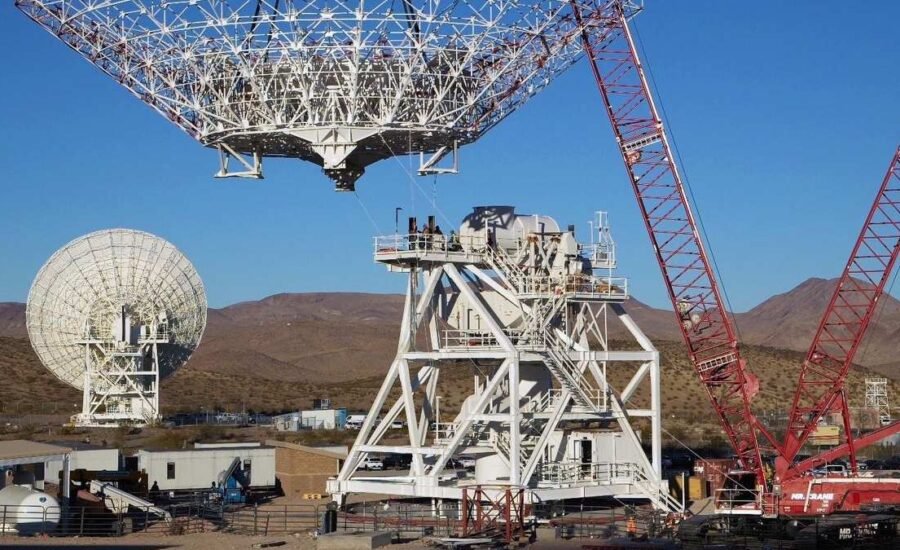
NASA’s Jet Propulsion Laboratory announced that Deep Space Station 23, the newest addition to the agency’s Deep Space Network, officially began operations on Wednesday at the Goldstone Deep Space Communications Complex in California’s Mojave Desert. The announcement came via a post on JPL’s official X account. The activation marks the culmination of four years of rigorous efforts to establish the infrastructure.
DSS-23: Construction & Activation
Construction on DSS-23 broke ground back in February 2020, with representatives from NASA headquarters, JPL, and Peraton, the antenna’s builder, gathered at the Goldstone site. On December 18, 2024, the reflector’s 133-ton steel framework was lowered into place by crane. This was followed by the installation of a four-legged support structure called a quadripod, weighing roughly 16.5 tons. That quadripod carries a curved subreflector, which bounces radio frequency signals from deep space onto the main dish and down into the antenna’s pedestal, where its receivers sit.
Deep Space Station 23 – the newest antenna in NASA’s Deep Space Network – began operations today at the Goldstone complex in California. See all of the DSN stations and which spacecraft they’re talking to at https://t.co/kZRImN1vvY pic.twitter.com/sB4WqoMxIL
— NASA JPL (@NASAJPL) August 4, 2026
DSS-23 is a multifrequency beam waveguide antenna measuring 34 meters, or 112 feet, wide, and its addition brings the total number of antennas in NASA’s global Deep Space Network to 15. The Goldstone complex, located near Barstow, now houses four such antennas of its own, namely DSS-14, DSS-24, and DSS-16. DSS-25 is offline as of now. DSS-23 is the fifth of six new beam waveguide antennas planned for the network, following DSS-53, which came online at the DSN’s Madrid complex in 2022.
See Also: Artemis II: How Is NASA Communicating With The Orion Crew Millions Of Miles Away In Deep Space?
Cover: NASA