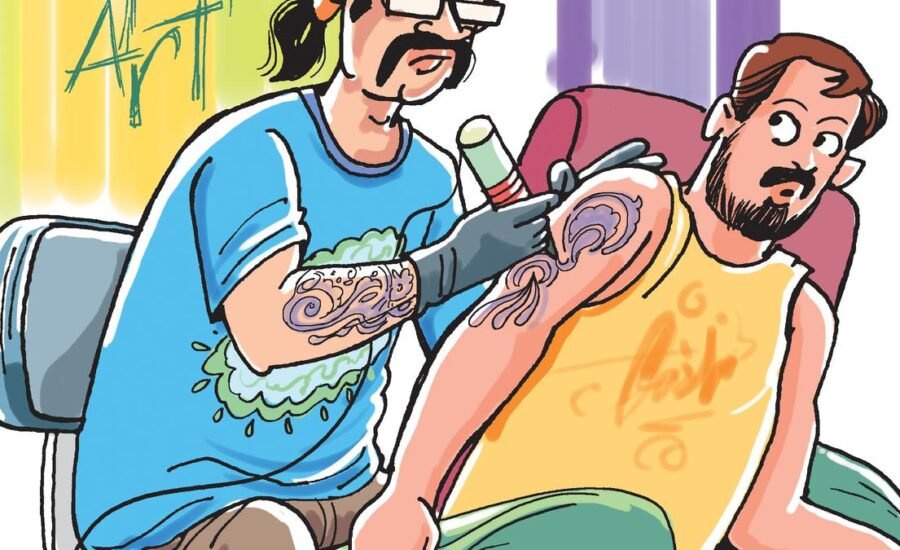

Illustration by Satheesh Vellinezhi
The mushrooming of tattoo studios and tattooing in public places such as streets and festival grounds have prompted health authorities to sound a note of caution about the potential health risks and the need to adopt safe practices.
In an effort to curb the spread of infectious diseases such as Hepatitis B and C, the Health Department has come up with a set of safety guidelines that tattoo studios are required to follow. The seven-point advisory focuses on maintaining personal hygiene, cleanliness of the establishment, licensing, sterilisation of equipment, the use of single-use items, towels and aprons, and proper waste disposal.
The framework was released a few days ago as part of the World Hepatitis Day (July 28) observance. Besides tattoo studios, other establishments covered by the guidelines in Ernakulam include salons and barber shops.
Dr. Deepa Augustine, Associate Professor, Department of Dermatology, Government Medical College, Ernakulam, said several people visit the hospital seeking tattoo removal.
“People need to realise that removing a tattoo is not an easy process. It requires several sittings and is expensive. More people are coming to get their tattoos removed nowadays, mostly for employment purposes,” said Ms. Augustine. She pointed out that several tattoo studios are mushrooming in the city. “The government should frame a policy to regulate these studios,” she said.
Reusing needles can lead to the transmission of diseases such as Hepatitis B, HIV, and syphilis, said Dr. Augustine. She added that people should always choose a safe place to get their tattoos done and ensure that proper sterilisation procedures are followed.
Dr. Manitha Kumari, a consultant dermatologist, said it is always good to consult a dermatologist before getting a tattoo done. “Newer professional tattoo methods have fewer issues if done at the right place with the right technique and precaution. Tattoo allergy has been observed more with coloured tattoos, rarely with black ink. Any infection that can spread through a needle prick, such as HIV, Hepatitis B, and Hepatitis C, can spread unless the procedure is done professionally,” said Ms. Kumari.
She added that there are also concerns about tattoo ink causing lymphoma several years after the procedure. She pointed out that there are chances of developing skin conditions such as keloid, psoriasis, and lichen planus at the tattoo site if the person already has these skin conditions.
Meanwhile, tattoo artists maintained that strict safety standards are followed at studios by adhering to sterilisation procedures and using disposable materials for each client.
Syama Devi, a tattoo artist who owns a studio in Kochi, said people should always check whether the artist is certified. “We often see tattooing being done near Marine Drive in the city or during festivals. One should never get a tattoo from such places and should always go to a certified professional and studio. Ensuring proper care after the procedure until the tattoo heals is very important,” said Ms. Devi.
Rolvin Devassy, a tattoo artist and owner of a studio in the city, said most of the safety measures in the guidelines were already in place in the advisories released earlier by the government.
“There is a general lack of knowledge about this industry. Although there is a mention of sterilisation procedures in the safety guidelines, they need to make autoclave machines mandatory in tattoo studios. Some of the metal parts of tattoo machines need to be sterilised, and this is possible only by using an autoclave machine,” said Mr. Devassy.
He added that customers should not shy away from asking tattoo artists about the safety precautions followed.
Published – August 06, 2026 09:00 am IST