The intention was clear. Protests happened repeatedly. Governments changed. Some people became leaders, others became ministers. Coaching institutes also flourished—their courses kept selling, so they remained secure. But who got trapped? Students from poor families.
I realised that every time there was a protest, the issues weren’t resolved; they only became more complicated. This time, we wanted to protest in a way that would force the entire system to change. Our main demand is reform. After taking an exam, we should at least know whether we failed because we needed to work harder or because someone else cheated. Today, you can’t even tell whether you missed out because of merit or because of malpractice.
Just like people get trapped in poverty, students get trapped in unemployment. We think, “I missed it by just 10 marks. I’ll prepare again.” Then we prepare again, the paper leaks again, answers are fed to candidates, we miss the cut-off by two or four marks, and once again we tell ourselves, “I’ll work harder next time.” But that next time never comes.
Instead, the top two ranks are sold. How can meritorious students ever make it to the merit list? Just look at the history of the JSSC CGL. If you check its record, there have been around 15 to 20 protests just to get the examination conducted. Then there are protests to get the results declared. When irregularities come to light, there are protests demanding cancellation. It’s an endless cycle.
Take this very JSSC CGL. Abhay Tiwari, an accused candidate, secured Rank 2 for the Block Supply Officer post. Then there is Anshuman Tiwari. His wife is involved. His brother-in-law is involved. It almost seems as though every topper belongs to the same family. Later, his name also appeared at the top of the PGT merit list, where he secured Rank 1.
That’s when the issue escalated. If the same agency is repeatedly under scrutiny, the same candidate keeps getting selected, and members of the same family continue to clear examinations, then the problem is clearly systemic. In the JSSC CGL alone, five members of a single family cleared the examination.
Go and look at the libraries. Very few ordinary students ever get selected. My pocket money used to be ₹3,500, but there are students who don’t receive any pocket money at all. Some have lost their mothers; some have lost their fathers. We have to fight for all of them. We have to fight for the future.
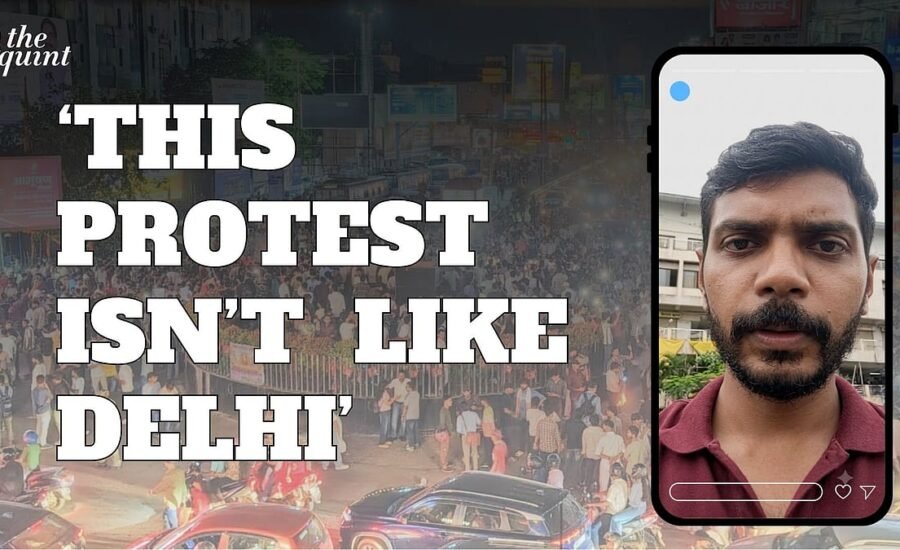
It isn’t possible to keep protesting again and again. This isn’t Delhi. This isn’t a metro city. Here, our reality is different. You’ll see people carrying tea or coffee in steel mugs. You’ll see them bringing bags of roasted gram, puffed rice, or sattu. How long can someone survive like that? How many times can we keep protesting? There is pressure from home as well. Parents tell us, “Son, don’t go. It’s the farming season.”
Even now, many students spend the first half of the day ploughing fields and the second half protesting. I may not personally do that, but many people standing beside me come directly from farming families. They spend the morning digging fields with mattocks and the afternoon protesting. That is our reality.
Our first demand concerns the JPSC examinations conducted by TDPL. Since the agency is tainted, every examination conducted by TDPL—including FARO and several others—should be cancelled immediately.
Our second demand is that every examination in which Abhay Tiwari, who served as a manager at TDPL, had any role should also be cancelled.
Our third demand is for systemic reforms. Examinations must be conducted on time, at regular intervals, and their cut-offs must be published. At present, we don’t even get to know the cut-off marks.
I can bring thousands of students before you whose slippers are completely worn out from travelling for examinations. You’ll find people eating rice with their hands because they have nothing else. For them, Pizza Hut, Domino’s, or burgers are just names of shops. Among thousands of aspirants, many have never stepped inside a Domino’s. That’s not something I’m saying for the sake of this interview; it’s the reality.
We’ve cried so much that there are no tears left. That is the condition we are living in.
The situation has become unbearable. Either shoot us or bring reforms, so that the next generation can say that those before them fought for their future.