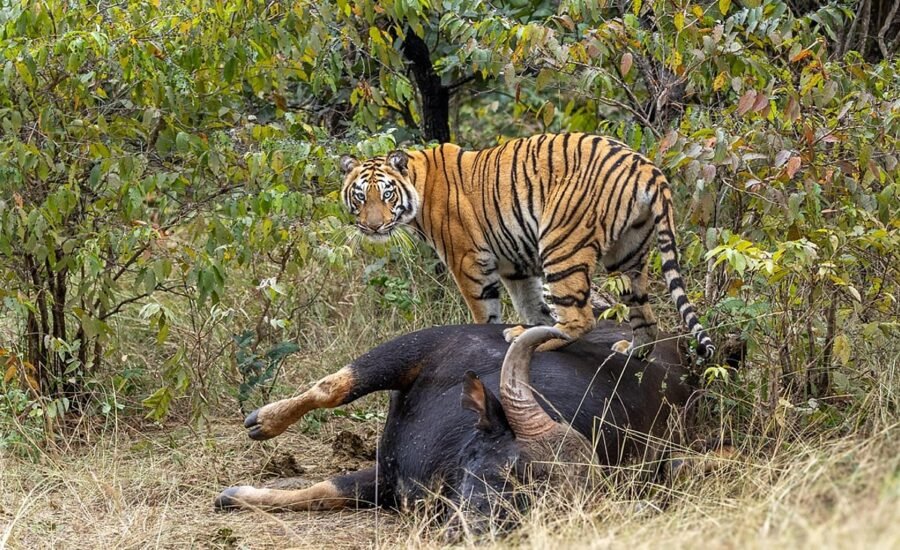
“Critically low presence (1 or fewer tigers)” was documented in Jharkhand’s Palamu and in West Bengal’s Buxa. In the former, camera traps captured a single individual while a single photo confirmed presence in the latter. Most wildlife experts claimed that the tiger photographed in Buxa actually came from Bhutan. Moreover, Indravati, Udanti Sitanadi and Guru Ghasidas-Tamor Pingla reserve — all from Chhattisgarh — are believed to have extremely less or no tigers at all.
Recognise and improve tiger corridors
“Tiger recovery happened in many reserves and states which implemented the NTCA-WII (Wildlife Institute of India) road map,” pointed out tiger scientist and WII professor Qamar Qureshi. He added that “states and areas like Madhya Pradesh, Karnataka, Maharashtra, Tamil Nadu, Kerala, Uttarakhand, Bihar, Assam and West Bengal’s Sundarbans have done well”.
“All the rest need to ensure better management. The funding of reserves needs to be enhanced and science-based solutions need to be prioritised. There is a need to improve almost 50 per cent reserves with removal of invasive species and habitat improvement, ungulate recovery and augmentation and better protection,” he added.
“Recognising all possible corridors is of utmost importance as they connect not only tiger reserves but other protected areas too. Improvement of existing corridors must be ensured as well,” Qureshi further added.
Pradeep Vyas, retired chief wildlife warden of West Bengal and widely known as the state’s ‘tiger man’ for his long exposure and experience in the Sundarbans, said problems in several reserves were existent from the beginning. “Many of these reserves had habitat quality issues from the start, and had only been created by states for optics,” he claimed.
Vyas pointed out that more than a decade is required to improve habitat and prey base to the optimum threshold, once anthropogenic activities get controlled.