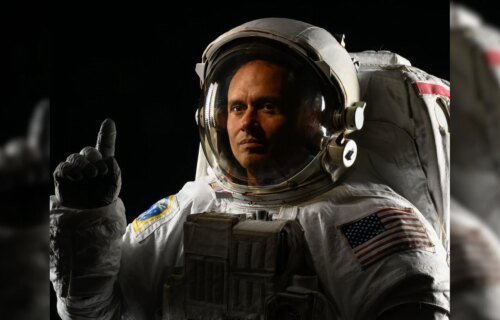
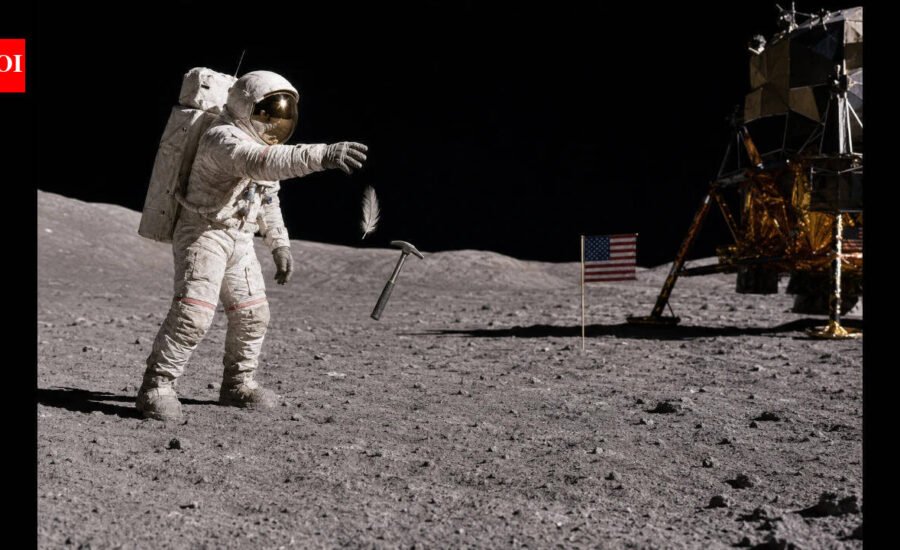
When Apollo 15 commander David Scott released the hammer and feather on the Moon, both objects fell together and struck the lunar surface at essentially the same time. The simple demonstration offered a striking illustration of a fundamental principle of physics: without air resistance, objects fall at the same rate regardless of their mass.The experiment took place during the final minutes of Apollo 15’s third lunar surface excursion, when Scott held a geological hammer and a falcon feather at the same height and released them together. NASA’s account, drawing on the Apollo 15 Preliminary Science Report, records the aluminium hammer had a mass of 1.32 kilograms, the feather 0.03 kilograms, and the objects were released from about 1.6 metres above the lunar surface. They were observed to undergo the same acceleration and hit the ground simultaneously, within the accuracy possible when releasing them by hand.The question Galileo tried to answerThe experiment carried an idea associated with Galileo Galilei from Earth to another world. Galileo challenged the traditional belief that heavier bodies fall faster than lighter ones, using experiments and mathematical reasoning to investigate how objects move as they fall. According to research published in the British Journal for the History of Science, his studies of falling bodies and inclined planes played a central role in the development of his understanding of accelerated motion.The famous story that Galileo stood atop the Leaning Tower of Pisa and dropped objects of different weights is much less certain. It has become one of the most familiar stories in the history of science, but historians have long debated whether the experiment actually happened. What is much better documented is Galileo’s experimental and theoretical work on falling bodies, including his use of inclined planes.Galileo was working toward a crucial distinction between gravity and the resistance of the medium through which an object falls. On Earth, a feather does not fall slowly simply because it has little mass. It falls slowly because its broad, light structure is strongly affected by air resistance. A hammer also encounters air resistance, but its greater mass makes the effect far less noticeable.Why the hammer and feather behaved alikeThe Moon provided the perfect setting for Scott’s demonstration because its surface is essentially an airless environment. There was no atmosphere surrounding the falling objects to produce the drag that normally makes a feather descend more slowly than a hammer on Earth. NASA notes that the absence of air resistance allowed the feather to fall at the same rate as the hammer.This does not mean that gravity pulls equally hard on the hammer and feather. A more massive object experiences a greater gravitational force. But mass also determines how strongly an object responds to a given force. In free fall, those effects balance in such a way that the resulting acceleration does not depend on the object’s mass.On Earth, dropping a hammer and feather together appears to show that weight determines how quickly something falls. On the Moon, the absence of an atmosphere strips away the factor responsible for most of that difference, allowing the underlying gravitational behaviour to emerge.Scott’s demonstration did not discover a new law. By the time Apollo 15 reached the Moon, the principle had been part of established physics for centuries. NASA’s own description calls the result one predicted by well-established theory. What made the experiment memorable was that it offered a direct, almost theatrical demonstration of that theory on another world.
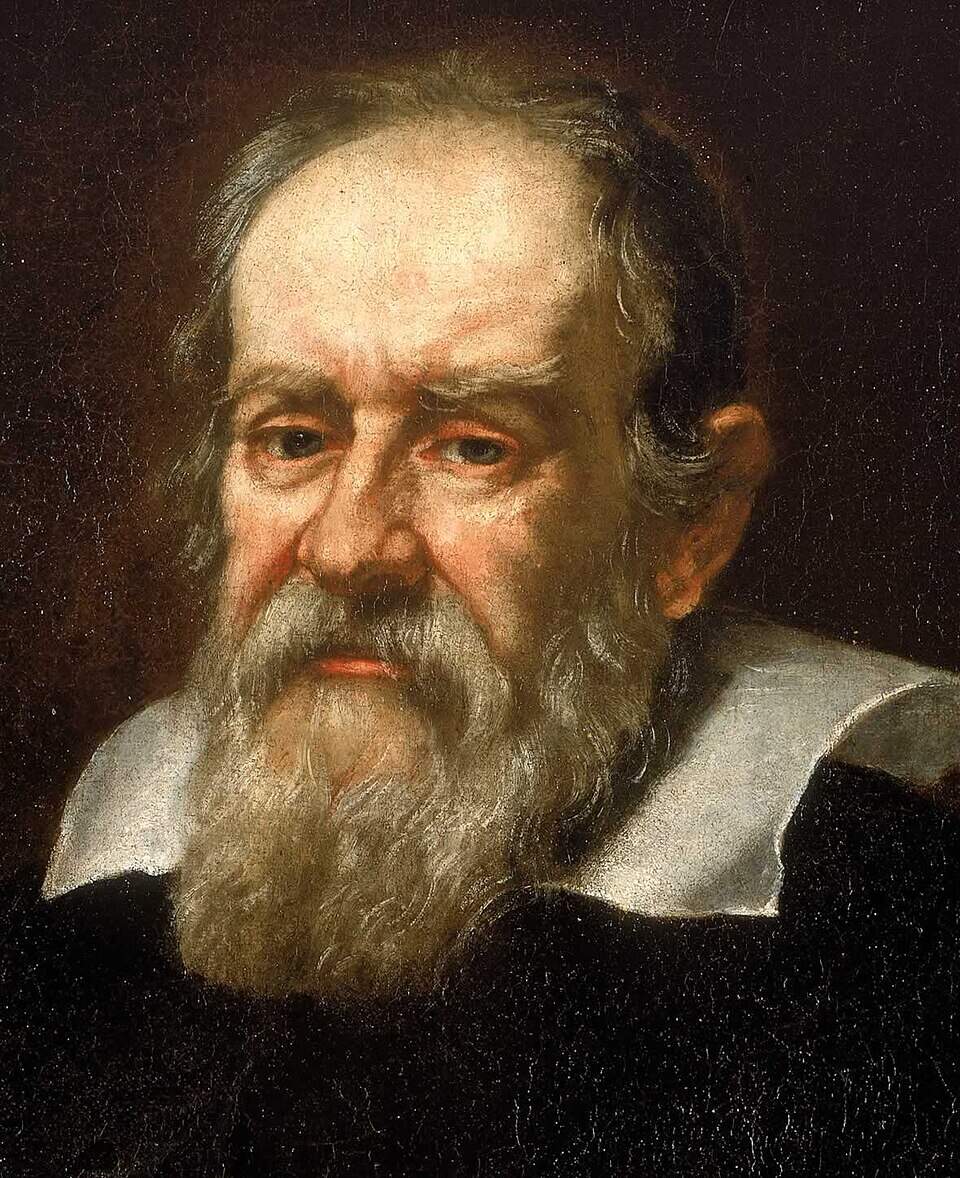
Galileo Galilei, whose studies of falling bodies and accelerated motion laid the groundwork for the principle later demonstrated by Apollo 15 on the Moon. Image Credits: Wikimedia Commons.
A centuries-old question, answered on the MoonSomething was fitting about taking Galileo’s question to the Moon. Galileo had used the tools available to him to investigate falling motion, working with experiments that made the process easier to observe. Apollo 15 had something he could never have imagined: a natural vacuum in which the interference of Earth’s atmosphere was almost completely absent.The experiment also showed why the environment matters so much in science. A feather and a hammer dropped on Earth give a misleading impression because air resistance changes their motion. Put the same basic experiment somewhere without an atmosphere, and their behaviour becomes dramatically different. The release lasted only a few moments, but it linked Galileo’s centuries-old question to a space mission far from Earth. This was not a discovery or a final test of Galileo’s theories. Instead, it was simply a demonstration.