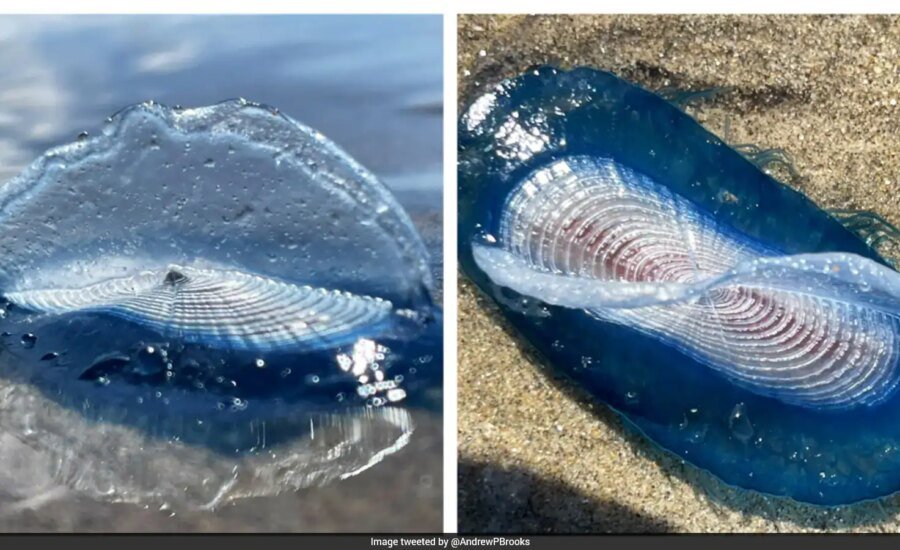
Beachgoers across parts of the UK have been greeted by an unusual sight this summer. Hundreds of bright electric blue marine creatures washed up along the shoreline after strong westerly winds and warm weather carried them ashore. Large numbers of the creatures, identified as Velella velella, or by-the-wind sailors, have recently appeared on St Bees beach in Cumbria, BBC reported. Similar sightings were also reported earlier this summer along the Welsh coast, marking one of the largest strandings of the species in more than a decade.
Visitors at St Bees described the spectacle as both surprising and beautiful, with many stopping to photograph the vivid blue organisms scattered across the sand.
Speaking to the BBC, Louise Nicholson said, “There were hundreds of them, and there were lots of visitors to the area taking photos. They are absolutely beautiful, only about 2 inches in size. It was a great find on a beautiful day.”
I spotted lots of these unusual creatures on Borth Beach in Wales, these are By-the-wind Sailors or Velella velella & are a colony of individual animals & not true jellyfish.
There’s a video here which shows more & gives a sense of their scale https://t.co/uVd0EmY5t6 pic.twitter.com/BHH2DhMB4m
— Andrew Brooks (@AndrewPBrooks) August 3, 2026
Despite their jellyfish-like appearance, Velella velella are not true jellyfish. They are colonial hydroids – colonies of tiny organisms that work together as a single animal. Measuring around two inches (five centimetres) long, each has a small translucent sail that catches the wind, allowing it to drift across the surface of the ocean while its tentacles trail below to feed on plankton.
The species is commonly found in the Atlantic, Pacific and Indian oceans. Strong westerly winds, often following storms, can push vast numbers of them onto beaches. Marine experts believe the recent spell of unusually warm weather may also have contributed to this year’s sightings and say more strandings could occur over the summer.
Although Velella velella are closely related to the Portuguese man o’ war, their sting is far less potent. Experts say they can still cause mild irritation, particularly if someone touches their face, lips or eyes after handling them. As a precaution, beachgoers are advised to admire the creatures from a distance and avoid touching them.
Cumbria Wildlife Trust said, “Despite appearances, this weird and wonderful creature is not a jellyfish! They’re sometimes found washed up on our shores after westerly winds. “Look, but don’t touch – they give a very nasty sting.”
The sightings come as the UK continues to experience above-average temperatures. The Met Office has forecast highs of up to 35°C in parts of southeast England, while the UK Health Security Agency has issued amber heat-health alerts for several regions, warning of the potential health impacts of the prolonged hot weather.