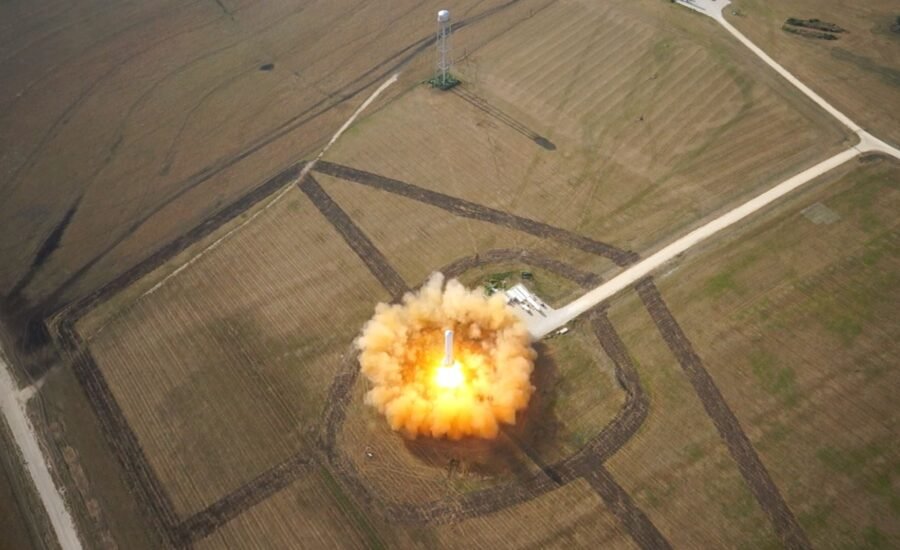
A rocket leaves the pad vertically because the ground is beneath it and the thickest part of the atmosphere is directly ahead. Watch a little longer, though, and the path begins to lean. The vehicle that appeared to be climbing towards space starts turning towards the horizon.
That turn is not a correction or a shortcut. It is the heart of the flight.
Flying into space and entering orbit are different achievements. Height gets a spacecraft out of the dense atmosphere, but speed keeps it there. For a typical low Earth orbit, the required speed is roughly 7.8 kilometres per second, or about 28,000 kilometres per hour. Most of that motion is sideways.
Crossing into space is not the same as reaching orbit
A vehicle can climb beyond the atmosphere, coast for a while and still fall back to Earth. That is a suborbital trajectory. It has gone into space in an ordinary sense, but it has not acquired enough horizontal speed to continue circling the planet.
The distinction matters because gravity does not abruptly disappear above the atmosphere. In a NASA engineering exercise based on the Space Launch System, gravitational acceleration at an injection altitude of 148 kilometres is calculated at about 96 per cent of its surface value. A spacecraft at that height is still being pulled firmly towards Earth.
The same NASA calculation makes the balance unusually clear. At orbital injection, it gives the vehicle and payload roughly 20 times as much kinetic energy from their speed as gravitational potential energy from their height. The difficult part is not simply lifting the mass. It is accelerating that mass until its path curves around Earth rather than intersecting it.
The spacecraft stays up because it keeps falling
The cleanest explanation remains Isaac Newton’s old cannonball thought experiment. Fire a cannonball horizontally and gravity bends its path towards the ground. Fire it faster and it travels farther before landing. At a high enough speed, Earth curves away beneath it at the same rate that the object falls.
The object never stops falling. It simply keeps missing the ground.
NASA’s guide to orbital mechanics describes a spacecraft in low Earth orbit as moving in the neighbourhood of 30,000 kilometres per hour. The European Space Agency’s explanation of launch to orbit makes the same central point: a launcher must first pass through the atmosphere and then provide the horizontal push needed for orbit.
This is also why astronauts in orbit appear weightless even though gravity remains strong. The spacecraft, the crew and everything loose inside are falling together. There is no floor pushing back against their bodies in the familiar way a floor does on Earth.
Why rockets rise first and turn later
A rocket cannot build all that sideways speed near the surface. Dense air produces drag and severe aerodynamic loads, while mountains, buildings and the ground make a horizontal departure impractical for an orbital launcher. The first part of the flight therefore gains altitude and clears the launch site. The vehicle then pitches over progressively as the atmosphere thins.
By the later stages of ascent, the rocket may be gaining far more speed than height. From the ground, the exhaust trail can make the turn look gentle. For the guidance computer, it is a continuous calculation involving position, velocity, remaining propellant and the exact orbit the payload needs to enter.
Staging is part of the same logic. A rocket begins with tanks, engines and structures needed for the first minutes of flight. Once a stage has spent its propellant, carrying its empty mass would make the remaining acceleration harder. Dropping it allows the next stage to continue with less dead weight. ESA’s plain-language account of rocket flight notes that modern launchers commonly use two or three stages for this reason.
Launch location can help at the margin. Earth itself rotates eastward, so a rocket launched towards the east from near the equator begins with some useful speed already in hand. NASA puts that equatorial contribution at more than 1,650 kilometres per hour. It is valuable, but still only a fraction of the roughly 28,000 kilometres per hour needed for low Earth orbit.
Orbit is a precise direction as well as a speed
Reaching the right number on a speedometer is not enough. Velocity includes direction, and the direction determines the shape and tilt of the resulting orbit. A small error can leave a payload in an orbit whose lowest point dips too far into the atmosphere, where drag will slow it and bring it down.
Different missions also require different trajectories. A satellite bound for geostationary orbit is often released into a long elliptical transfer orbit first. It later fires an engine near the high point of that ellipse to circularise its path. A lunar or planetary spacecraft needs another carefully timed change in velocity to leave its Earth orbit and enter a transfer path towards its destination.
The engines do not normally keep firing merely to hold a satellite up. Once the spacecraft has the right velocity in the right place, gravity shapes the orbit. Engines or smaller thrusters are used later for corrections, orbit changes, collision avoidance and countering the slow effects of atmospheric drag in lower orbits.
The speed is enormous, but nowhere near science fiction
Twenty-eight thousand kilometres per hour is hard to picture. It is fast enough to cross Australia in minutes and circle Earth in roughly an hour and a half, depending on the orbit. Yet it is still less than one ten-thousandth of the speed of light.
I wrote recently about why reaching light speed is not merely an engineering problem. Orbital speed is modest beside that limit, but achieving it from the surface remains punishing because a rocket must lift its own propellant while fighting gravity and the atmosphere.
That is the useful way to watch a launch. The early vertical climb clears the ground. The long turn builds the motion that matters. When the engines finally cut off at orbital speed, the spacecraft has not escaped Earth’s gravity. It has entered a carefully arranged fall that can continue around the planet.