Last Updated:
Asif Nazrul claimed he convinced the army chief that both the labour law conviction and the money laundering allegations against Yunus stemmed from political vendetta




According to Nazrul, it was only after he persuaded the Army Chief that General Waker-Uz-Zaman agreed to back Yunus’s name for the top post. (X)
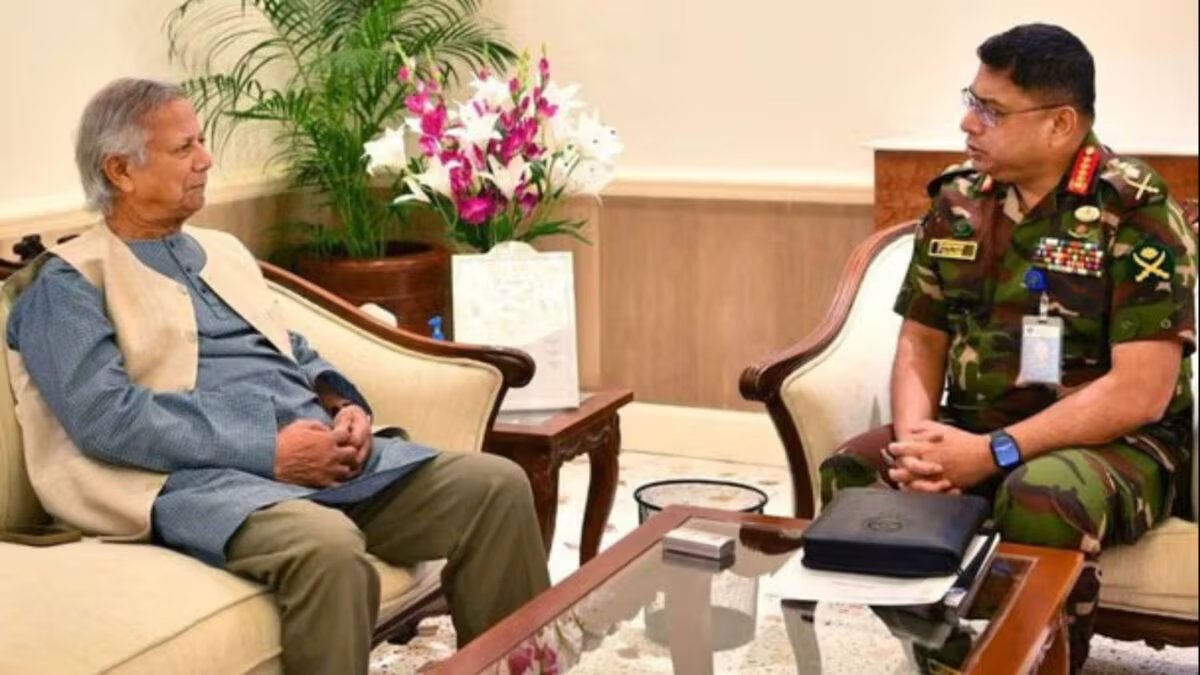
Bangladesh Army Chief General Waker-Uz-Zaman had initially opposed the appointment of Professor Muhammad Yunus as the head of Bangladesh’s interim government citing two major concerns, former Bangladesh law adviser Asif Nazrul has revealed.
Nazrul, who was also a professor at Dhaka University, had mentored students protesting against Sheikh Hasina in 2024. Following the fall of the Hasina government, he went on to serve as the Adviser for Law, Justice and Parliamentary Affairs in the interim administration led by Yunus.
Recounting his meeting with the army chief at the Army headquarters, Nazrul said: “I had gone there at their invitation. General Waker praised the role of the students and strongly spoke in favour of reforms. Then, quite frankly, he said he wanted to discuss who should head the interim government. I informed him that the students had decided that Professor Muhammad Yunus should be the chief, and that I believed he was the best choice.
“He raised two objections. First, Professor Yunus had already been convicted in a labour law case. Second, there were allegations of money laundering against him.”
Yunus was convicted in January 2024 and sentenced to six months in prison for violating Bangladesh’s labour laws by failing to establish a legally mandated workers’ welfare fund and other statutory benefits at Grameen Telecom. However, the conviction was later overturned after he became the head of the interim government. In June 2024, a court in Bangladesh indicted the Nobel laureate and 13 others on charges in an over $2 million embezzlement case.
According to Nazrul, it was only after he persuaded the Army Chief that General Waker-Uz-Zaman agreed to back Yunus’s name for the top post.
Nazrul claimed he argued that both the labour law conviction and the money laundering allegations stemmed from political vendetta, eventually convincing the army chief to accept the students’ choice.
The former law adviser made the revelations during an interview with the Bangladeshi newspaper Prothom Alo.
Nazrul was among the most influential civilian voices during the 2024 anti-Hasina movement. Besides enjoying significant influence among the student leadership spearheading the protests, he was also considered an important interlocutor with sections of Bangladesh’s military establishment during the political transition that followed Hasina’s ouster.
The remarks provide a rare glimpse into the behind-the-scenes discussions that preceded the formation of Bangladesh’s interim government, and suggest that Muhammad Yunus’s appointment was not initially backed by the country’s military leadership before objections were addressed.
About the Author

Anindya Banerjee, Associate Editor brings over fifteen years of journalistic courage to the forefront. With a keen focus on politics and policy, Anindya has garnered a wealth of experience, with deep …Read More
Dhaka, Bangladesh
August 06, 2026, 13:19 IST
Read More