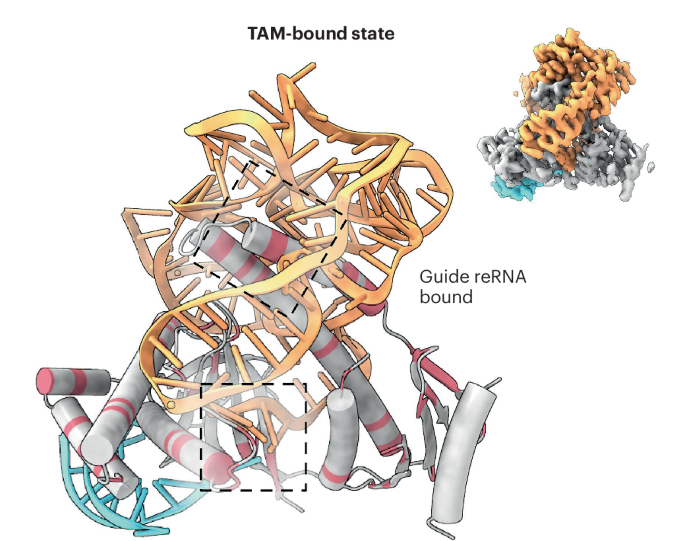
Protein design is especially problematic for multidomain enzymes reminiscent of RNA-guided nucleases, whose features rely on coordinated interactions with information RNAs, goal DNAs and a number of conformational states. Protein sequence-based language fashions have opened new prospects for enzyme engineering, however the lively nucleases they produce typically stay intently associated to the reference sequences they’re skilled on. The authors addressed this problem by combining the inverse protein-folding mannequin ESM-IF1 with evolutionary data derived from pure TnpB homologs. TnpB is a small transposon-associated protein that features as a genome-editing nuclease and is taken into account an evolutionary ancestor of Cas12 enzymes. This enzyme served as a wonderful template as a result of it combines programmable DNA focusing on with various pure features in a compact structure. Preliminary computational experiments confirmed that ESM-IF1 might redesign the minimal RNA-guided nuclease ISDra2 TnpB. It preserved the DED catalytic triad, the catalytic residues, of the RuvC area in TnpB.
From an evolutionary perspective, phylogenetic evaluation confirmed that the ESM-IF1-generated sequences shared solely 50–60% amino acid id with ISDra2 TnpB. Nonetheless, the sequences contained nonsynonymous modifications at residues in a area analogous to the protospacer-adjacent motif (PAM) acknowledged by CRISPR–Cas9. To beat this limitation, the researchers integrated a masking technique primarily based on positional conservation and evolutionary coupling analyses. The coupling indicators had been derived from a Potts mannequin (GREMLIN) skilled on both paired TnpB–RNA or TnpB–DNA sequences obtained from genomic databases. Residues exceeding the positional conservation and evolutionary coupling thresholds served as sequence masks for conditional ESM-IF1 technology. This technique successfully balanced structural enter with practical conservation, permitting the manufacturing of extremely divergent sequences whereas preserving key organic contacts.