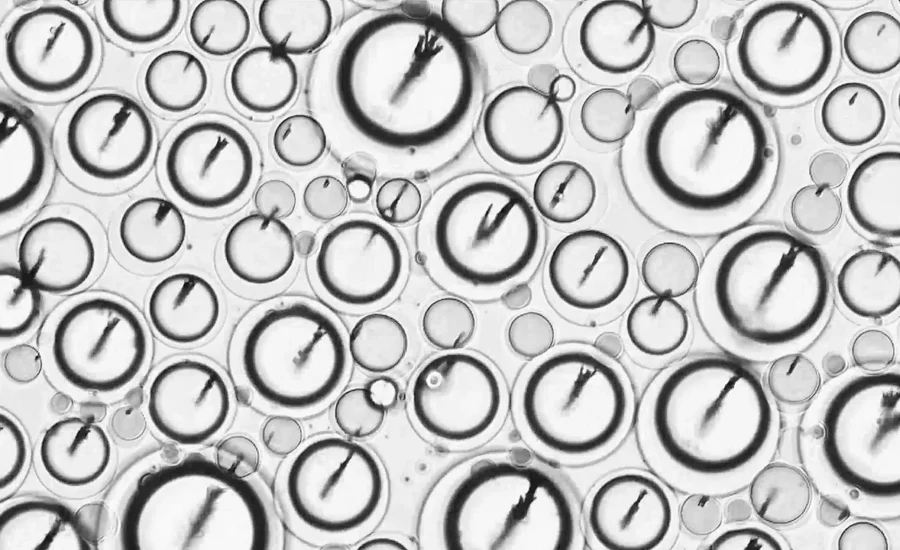
Chemists make all sorts of marvelous materials, drugs, and solutions, but at the end of the day, these inventions just sit there. That’s not the case with these dancing droplets created by Rakesh Narani, a postdoctoral researcher in the lab of Che-Jen Lin at National Tsing Hua University.
The two-phase droplets—named Janus droplets after the two-faced Roman god—are made mainly of a hydrocarbon on one side and fluorinated liquid on the other. Narani was able to get magnetic iron oxide nanoparticles to sit on the boundary between the two halves, thus creating the black lines that divide them. When Narani changes the direction of a magnetic field, the nanoparticles swing and swerve inside their containers, allowing him to drive the droplets around.
He says this kind of control could be useful in applications like sensing, catalysis, and drug delivery.
Submitted by Rakesh Narani and Che-Jen Lin. Follow Narani on Instagram at @rakeynarani.
Do science. Take pictures. Win money. Enter our photo contest.
See more Chemistry in Pictures.