

India’s aerospace and defence industry is entering a new phase of growth, supported by strong policy measures, rising aircraft demand, and a gradual shift in global supply chains toward India. According to industry estimates, the Indian aerospace and defence market is projected to reach nearly US$ 54 billion (around ₹5 lakh crore) by 2033, growing at a CAGR of around 8.1%.
The growth is being driven by higher defence indigenisation, increasing sourcing by global aerospace aircraft manufacturers, expanding commercial aviation, and government initiatives such as Make in India. Expansion of domestic aerospace supply chains, rising aircraft demand, and increased air passenger traffic could also be key growth drivers.
As these trends gather pace, a handful of Indian companies are expanding their capabilities across precision engineering, aerospace components, aircraft systems, and defence electronics. Let’s see how three of them performed in Q1FY27 and what lies ahead.
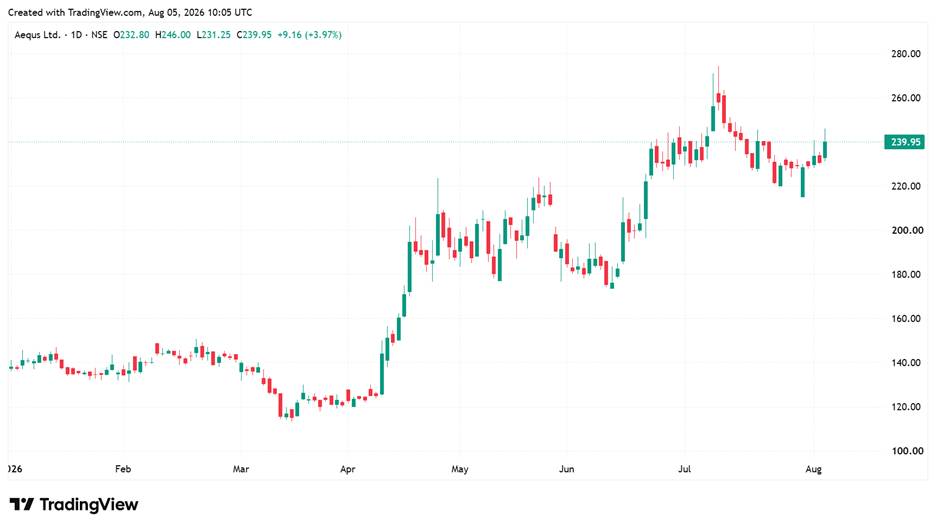
#1 Aequs: An Export-Led Aerospace Manufacturer Moving Up the Value Chain
Aequs Limited is a vertically integrated precision manufacturer. The company has two primary business verticals: Aerospace and Consumer. It also has a presence in the defence industry. Aequs operates a manufacturing infrastructure in India, Paris (Texas, US) and France (Cholet).
Within the Aerospace business, the company manufactures highly complex parts for long-cycle, recurring aviation programs. This is the core growth engine. With 5,740 parts, it holds one of the most extensive aerospace product portfolios in India. The portfolio spans aerostructures (core business), engine systems, actuation systems, landing systems, and interior.
For select products, the company achieves 100% in-country value addition. Its clients include Airbus, Boeing, Safran, Collins Aerospace, and SAAB. Customer retention is also high, with the top 3 customers having an average relationship tenure of 15 years. The aerospace business is highly export-driven.
Accounting Shifts Masking High-Margin Aerospace Gains
Aequs delivered robust revenue growth in Q1FY27. Revenue grew by 55% year-on-year to ₹395.5 crore. However, EBITDA (Earnings Before Interest, Taxes, Depreciation, and Amortisation) declined by 46% to ₹21.5 crore due to a 67% increase in direct costs. As a result, margin declined from 16% to 5%.
As a result, it reported a loss of ₹53.2 crore as against a profit of ₹3.9 crore in Q1FY26. This decline is primarily due to a change in accounting treatment for the Consumer Electronics business. Since the plant commenced commercial operations, costs that were earlier capitalised in Q1FY26 are now fully expensed, leading to a higher cost base.
Of the total revenue, the Aerospace business contributed 81% and the Consumer segment 19%.
Exports accounted for 88% of total revenue and 12% of domestic revenue. In the segment mix,
the Aerospace business revenue increased 40% year-over-year to ₹322.2 crore. Segment EBITDA increased 35% to ₹73.1 crore, with margins of 22.7%.
Management expects the segment EBITDA margins to be above 20%. It has guided for 25-30% aerospace revenue growth in FY27. Consolidated EBITDA margins are also expected to hover in the 18-22% range over the long term (under Vision 2031).
However, Aequs expects to break even by H1FY28 as losses in the consumer business narrow. EBITDA losses in the consumer business narrowed by 24% sequentially to ₹36.1 crore in Q1FY27 and are expected to break even by Q4FY27 as capacity utilisation approaches 40-50% (up from 22% in Q1FY27). However, net profit breakeven is expected only by FY30.
The ₹9,500 Crore Order Book and the Push for High-Margin Capabilities
Aequs has multi-year plans to grow its aerospace segment, supported by a strong demand pipeline. The order book for this segment stands at approximately US$1 billion (around ₹9,500 crore). This provides revenue visibility of approximately 8x the division’s FY26 revenue.
Further, Aequs is strategically moving up the value chain to manufacture higher-margin landing gear and engine components. Revenue contribution from these engine components is expected to only begin in FY29. To do so, it plans to invest ₹1,900 crore over 10 years to create India’s first vertically integrated aero-engine and landing-gear manufacturing plant in Tamil Nadu (Hosur).
#2 Data Patterns: Moving Beyond Subsystems to Complete Aerospace Solutions
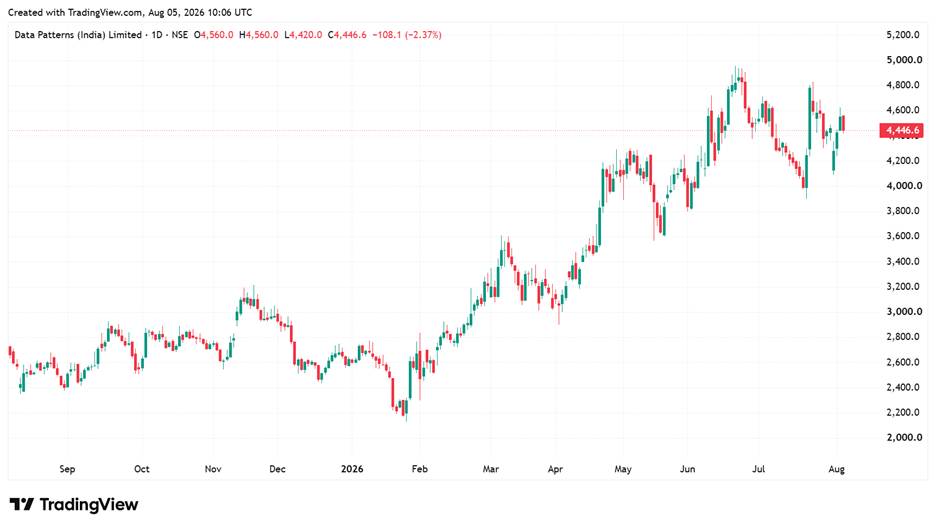
Data Patterns is a fully integrated aerospace electronics solutions provider with in-house design, prototyping and testing facilities for production and vertical integration. Data Patterns has established deep domain expertise across several high-reliability flight and defence electronics domains.
Aerospace & Avionics Portfolio
The aerospace and avionics segments are key businesses. This spans advanced cockpit displays, radars, electronic warfare suites, unmanned aerial vehicles, and satellite technologies. It designs and manufactures glass cockpit displays, airborne software-defined radios, and airborne programmable radio hardware.
These subsystems are designed for Indian defence aviation platforms including light combat aircraft, intermediate jet trainers, and light utility helicopters. Its radar portfolio includes the Advanced Light Helicopter radar and dedicated fire control radars for Su-30 and MiG-29 fighter aircraft.
Converting a ₹2,654 Crore Order Book Into Revenue
Aerospace orders form a large part of its order book of ₹927.7 crore as of Q1FY27. If the order inflow and negotiated contracts in July are included, the order book grows to ₹2,654 crore, providing high revenue visibility for the next few fiscal years. Currently, Data Patterns earns 12.8% of its revenue from exports.
Financially, revenue grew by 16.8% year-on-year to ₹116 crore in Q1FY27. However, EBITDA fell by 2.2% to ₹31.4 crore with margins at 27%. As a result, net profit fell by 13.5% to ₹22.1 crore. Long-term capability investments and seasonality in operations impacted margins. This includes higher employee expenses, restructuring costs and a provision of ₹2 crore for receivables.
As the business revenue is skewed toward Q3 and Q4, these higher costs impacted profitability. Going ahead, management expects to report revenue growth of 20-25% over the next two to three years. EBITDA margins are expected to be in the range of 35-40%. The order pipeline is strong at ₹2,000 to ₹4,000 crore.
Future Guidance and Su-30 Upgrades
For growth, the company is successfully shifting from delivering individual electronic boxes or subsystems to designing and manufacturing complete system solutions. Also, Data Patterns is executing a major developmental board suite (referred to as Java boards) for the Su-30 fighter aircraft platform.
The product is entering the qualification stage, with trials scheduled to begin before December 2026. This programme represents a pipeline of several thousand crores over the next two years.
#3 Unimech Aerospace: Expanding from Tooling to Recurring Aerospace Components
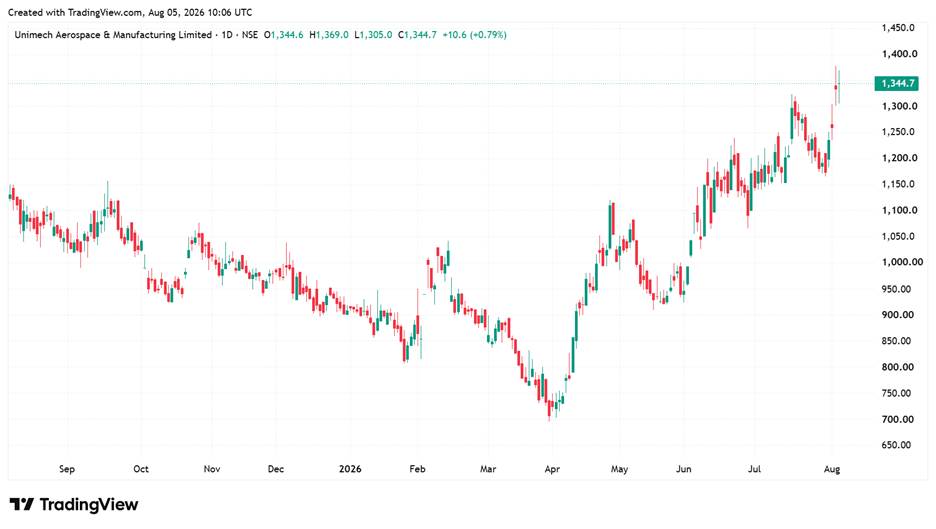
Unimech Aerospace is a global precision engineering company. It delivers tooling, precision components, assemblies, and engineered systems for mission-critical applications. The company is a trusted partner to leading global OEMs and Tier-1 suppliers.
Operational Scale and Global Footprint
The company’s operations are divided into three main business divisions: Aero Tooling, MRO Tooling and Ground Support Equipment (76% of Q1FY27 revenue), Precision Components and Assemblies and others (24%). In Aero Tooling, Key engine tooling programs include LEAP, Pratt & Whitney, and Rolls-Royce engines, alongside airframe tooling for Airbus and Boeing.
Unimech serves 41 customers across 8 countries. Exports represent approximately 96% of its total business. The firm manages over 6,300 qualified SKUs. The company is growing fast and has delivered a revenue CAGR of 60.4% between FY22 and FY26.
As of Q1FY27, it operates five advanced manufacturing facilities and one Free Trade Warehouse. The plants operate at approximately 58% capacity utilisation. An additional 10% of available capacity is strategically dedicated to new products and qualification programs to support future pipeline growth.
The ₹450 Crore Hobel Bellows Catalyst
Unimech’s next phase of growth is driven by strategic acquisitions, joint ventures, and technology partnerships. On April 27, 2026, Unimech completed the 100% acquisition of Hobel Bellows (a leading manufacturer of metallic bellows and exhaust manifolds) for ₹450 crore. It is targeting to qualify its bellows technologies for aerospace applications by Q4FY27.
Q1FY27 Financials and Margin Expansion
Financially, the company’s revenue grew 71% year-on-year to ₹107.6 crore, driven by robust demand and early contributions from Hobel Bellows. Operating EBITDA increased 98% to ₹39.3 crore, while margins expanded 510 bps to 36.5%. Net profit surged by 46% to ₹27.9 crore. With an order book of ₹280.3 crore, it expects to report meaningful revenue growth in FY27.
Looking ahead, Unimech is expanding its share in high-value, regular flying parts and precision components to drive growth. This includes entering commercial aerostructures, semiconductor equipment, nuclear utilities, and the metallic bellows sector. Its entry into commercial aviation is another growth driver.
It entered the commercial aviation recurring flying parts market through a 5-year, US$7.5 million long-term supply contract with Fischer Advanced Composite Components, Austria. This provides a stable base for recurring revenue for the coming years. Advanced negotiations are underway for similar contracts with other key global engine and airframe Tier-1 suppliers.
Key Financial Metrics as of Q1FY27 (In ₹ Crore)
| Particulars | Exports (%) | Order Book | Revenue | Profit / (Loss) |
| Aequs | 88.0 | ₹9,500 crore | 395.5 | (53.2) |
| Unimech | 96.0 | 280.3 | 107.6 | 27.9 |
| Data Patterns | 12.8 | 927.7 | 116 | 22.1 |
Aequs is significantly larger than the other two companies, with Q1FY27 revenue of ₹395.5 crore and an order book of around ₹9,500 crore. While Unimech and Data Patterns are currently emerging players in the aerospace and defence value chain.
Aerospace Valuations: Analysing the Sector Premia and Returns
Data Patterns’ Return on Equity (ROE) and Return on Capital Employed (ROCE) are the strongest of the three. Meanwhile, Unimech’s return ratios are weaker. Aequs’s aerospace segment has a strong ROCE of around 20%, but losses in the consumer business have dragged down profitability.
For valuation, we have used the EV/EBITDA multiple and have not used the historical median (except in the case of Data Patterns) due to insufficient data. Accordingly, all three are trading at a premium to the industry median. Data Patterns is also trading at a premium to its 3-year historical EV/EBITDA multiple of 48x.
| Peer Comparison (X) | ||||
| Particulars | EV/EBITDA Multiple | Return Ratios | ||
| Company | Industry | ROE (%) | ROCE (%) | |
| Data Patterns | 62.8 | 40.3 | 15.2 | 21.9 |
| Unimech | 49.4 | 40.3 | 9.0 | 11.8 |
| Aequs | 108.0 | 40.3 | – | 1.6 |
| Source: Screener.in (As of 04th August 2026) | ||||
To conclude, the aerospace opportunity is no longer just about rising defence spending.
Now, it is increasingly about India’s ability to become a global manufacturing hub for complex, high-precision components. Companies that are moving beyond contract manufacturing, expanding into higher-value products, and securing long-term global programmes could be better positioned to capture this structural opportunity.
Thus, the focus should remain on execution, order conversion, margin sustainability, and the ability to deepen relationships with global OEMs. As strong contenders, these stocks are worth keeping on your watchlist.
Disclaimer
Note: Throughout this article, we have relied on data from http://www.Screener.in and the company’s investor presentation. Only in cases where the data was unavailable have we used an alternative, widely used and accepted source of information.
The purpose of this article is only to share interesting charts, data points, and thought-provoking opinions. It is NOT a recommendation. If you wish to consider an investment, you are strongly advised to consult your advisor. This article is strictly for educational purposes only.
About the Author: Madhvendra has been deeply immersed in the equity markets for over seven years, combining his passion for investing with his expertise in financial writing. With a knack for simplifying complex concepts, he enjoys sharing his honest perspectives on startups, listed Indian companies, and macroeconomic trends.
A dedicated reader and storyteller, Madhvendra thrives on uncovering insights that inspire his audience to deepen their understanding of the financial world.
Disclosure: The writer and his dependents do not hold the stocks discussed in this article.
The website managers, its employee(s), and contributors/writers/authors of articles have or may have an outstanding buy or sell position or holding in the securities, options on securities or other related investments of issuers and/or companies discussed therein. The articles’ content and data interpretation are solely the personal views of the contributors/ writers/authors. Investors must make their own investment decisions based on their specific objectives, resources, and only after consulting such independent advisors as may be necessary.