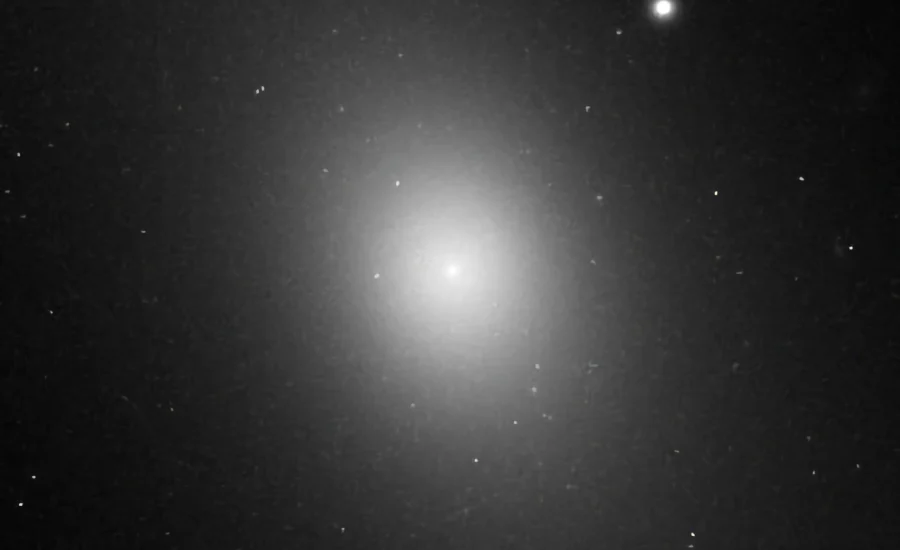
When you look up at the night sky, the stars you see are part of our own galaxy, the Milky Way. But out there in the universe, galaxies come in all shapes and sizes, and some are truly enormous. A galaxy’s size is closely tied to how many stars it contains. One of them, IC 1101, has just been confirmed as the largest galaxy ever measured.
IC 1101 stretches an incredible 520,000 light-years across. To put that in perspective: In contrast to the Milky Way, which is about 100,000 light-years wide, IC 1101 is more than five times larger.
If you placed it where the Milky Way is, it would swallow up not just our galaxy but also many of our closest neighbors.
Scientists estimate that there are 3.4 trillion stars inside this galaxy, compared to a mere 200–400 billion in the Milky Way.
Hubble captures a cosmic interaction
The largest current generation galaxies are known as brightest cluster galaxies (BCGs). They grow through what is called hierarchical galaxy growth, primarily by merging with smaller galaxies, the process often referred to colloquially as “galaxy cannibalism.” This works best in dense clusters of galaxies.
Among the brightest cluster galaxies, IC 1101 is especially massive and extended. It sits at the center of the huge galaxy cluster Abell 2029. IC 1101 was observed using the WFC mounted on the 2.5 m INT, located at the Roque de los Muchachos Observatory.
Astronomers used ultra-deep images to study IC 1101’s faint outer regions. They pushed their instruments to detect light so dim it’s like spotting a candle from thousands of kilometers away.
What they found was that IC 1101 doesn’t have a sharp “edge.” Instead, its stars fade gradually into space, stretching farther than anyone had measured before.
Hubble captures the ghost of Cassiopeia
More surprisingly, the very outskirts of the galaxy indicate that it is still growing. Astronomers detected subtle, mottled regions surrounding IC 1101 that are consistent with the wobbles in the hot gas of its parent galaxy cluster. That means IC 1101 is still actively accreting material and growing, even if it has already earned the title of largest known galaxy.
Studying IC 1101 helps scientists answer big questions like: Is there a maximum size for galaxies? How do galaxies grow in crowded environments like clusters? And what does this mean for the future of galaxies like our own?
Right now, IC 1101 sits at the extreme upper end of the galaxy size scale. It shows us that even the universe’s giants are still works in progress.
Journal Reference:
- Carlos Marrero-de la Rosa et al, How large can galaxies be? Ultra-deep imaging of IC 1101, the most extended known galaxy, arXiv (2026). DOI: 10.48550/arxiv.2607.15340