
While most media are focusing on the financial windfall due to the geopolitical turmoil (Iran war), Saudi Aramco’s second-quarter 2026 results hide risks facing the Kingdom. The world’s largest oil producer’s adjusted net income has reached $33.4 billion, taking first-half adjusted earnings to $67.2 billion. Its Q2 reported net income stands at $32.7 billion, an impressive one-third higher than a year earlier. The pure financials are extraordinary results, again without any doubt reinforcing Aramco’s position as the most profitable energy company in the world. However, analysis should resist focusing on the earnings headline, as the most strategically important number in Aramco’s results is not its profit but its free cash flow. The latter has clearly deteriorated sharply despite a dramatic increase in realized crude prices. The last report suggests that Aramco remains exceptionally profitable. Still, when looking at its position to maintain Saudi Arabia’s fiscal model, ambitious investment agenda, and shareholder distributions, all of this has become materially more difficult.
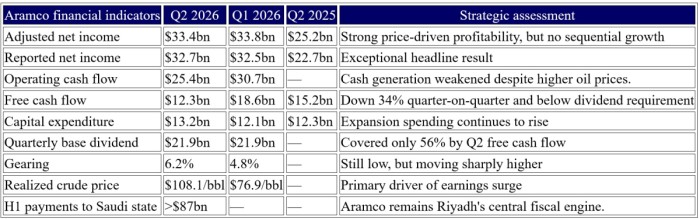
Without any doubt, the main focus should be on $12.3 billion, which represents Aramco’s second-quarter free cash flow. When taking this and relating it to a quarterly base dividend commitment of $21.9 billion, it is staggering to see that cash covered only around 56% of shareholder distributions. When now looking at the total period reported, the first six months of 2026, we see that cumulative free cash flow totaled $30.9 billion, but that the two quarterly base dividends amounted to $43.8 billion. This means there is a clearly underlying financing gap of around $13 billion, even before acquisitions, share buybacks, or any additional strategic investments are considered. No, there is not a direct and imminent liquidity crisis, as the company still has one of the strongest balance sheets in the global energy industry. It also provides very strong, easy access to debt markets if required. Still, what should raise eyebrows is that accounting profits and available cash have begun to diverge in a way investors should not ignore.
Related: Hormuz Draft Agreement Reportedly Awaits Khamenei Approval
This is even more striking when assessing the operational environment. The national oil’s realized crude price increased from $76.90 per barrel in the first quarter to $108.10 per barrel in the second quarter. What should be noted is that geopolitics were the main driver of higher oil prices in H1 2026. Downstream operations are also doing very well, as evidenced by EBIT doubling to approximately $6.2 billion, driven by improved refining margins. Taking all of this in, under normal market conditions, there should be a corresponding surge in operating cash flow. Looking at Aramco’s report, the reality is that operating cash flow declined from $30.7 billion to $25.4 billion, while, in my opinion, looking at current markets, capital expenditure increased further to $13.2 billion. A combination of rising investment requirements, working-capital movements, taxation, and payment timing within the Saudi fiscal system primarily causes the latter. In Aramco’s statements, the company has already highlighted unfavorable movements in amounts due from the Saudi government as a factor affecting cash conversion. While most are forgetting to address this, it shows, in my opinion, that Aramco is increasingly functioning as the Kingdom’s financial backbone. It is no longer the Kingdom’s national oil company. In the last period(s), it has become clear that cash generated is immediately recycled through taxes, royalties and dividends: all to support government spending, Vision 2030 investments and wider economic diversification.
Looking at the financial reports, during H1 2026 alone, the NOC has transferred approximately $25.3 billion in income taxes, $26.7 billion in royalties and $35.7 billion in dividends to the Saudi state. This means that the Saudi government has received more than $87 billion from Aramco. These are very exceptional figures and conditions. There are almost no listed companies anywhere in the world known to operate under comparable fiscal obligations. The brutal truth at present is that Aramco has effectively become the financial transmission mechanism linking international oil markets directly to Saudi public finances. Taken all into account, this situation also explains the apparent contradiction that Saudi Arabia’s hydrocarbon economy contracted during the period due to lower production, even as Aramco simultaneously reported record profitability. It should be understood that reduced production will lower national output, but at the same time, every exported barrel generates substantially higher margins due to elevated oil prices.
Investors should definitely avoid interpreting today’s earnings as the new normal. The Saudi oil giant is currently reaping the rewards of an unusually favorable combination of constrained global supply, elevated geopolitical risk premiums and resilient export capability. Investors, analysts and policymakers should realize that these conditions are unlikely to remain permanently aligned. In the event of easing regional tensions, oil prices could retreat significantly. At the same time, further escalation around the Gulf or the Red Sea could sustain high prices but threaten the physical ability to export crude. Aramco’s future position lies between two opposite risk scenarios: lower prices if stability returns, and lower export volumes if conflict intensifies.
It should also be recognized that, even though Aramco’s extensive infrastructure investments have partially reduced this exposure, the total risk remains, as it has not been eliminated. The East-West Pipeline, linking the Eastern Province to Yanbu on the Red Sea, is now regarded as one of Saudi Arabia’s most strategically valuable assets, as it enables exports to bypass the Strait of Hormuz. Reality, however, is that the overall risk profile of this infrastructure is clear, and it already has multiple vulnerabilities. Yanbu, the Red Sea, Bab el-Mandeb, the SUMED pipeline and the Suez Canal, which are an interconnected export chain, are now facing Houthi attacks, drone incidents, maritime insurance costs and broader regional instability. In reality, the risks have not been removed, but geopolitical (and military) risk has only been redistributed across multiple maritime chokepoints.
From a strategic perspective, this changes how Aramco should be valued right now. The giant is not only exposed to oil prices, but increasingly to the resilience of global shipping corridors. For total financial performance, production costs are not the only defining factors; insurance premiums, freight rates, tanker availability, and regional naval security are also important. Any disruption to these routes has a direct cash-generation effect.
Still, when taking into account all these pressures, Aramco’s balance sheet remains remarkably robust. Yes, gearing has increased to 6.2%, compared to 3.8% at the end of 2025 or 4.8% at the end of Q1 2026. Still, it is exceptionally conservative by international standards. Solvency is not an issue; the direction, however, is. The main risk is that free cash flow continues to undershoot dividend obligations. This is critical, as major projects including Jafurah, Zuluf, Fadhili, downstream petrochemicals, and international acquisitions continue to absorb capital. The result will be increased leverage unless there are changes to dividend policy or additional portfolio optimization measures. Keep in mind, the recent divestments, such as Aramco’s PRefChem interest to Petronas, need to be viewed not only as strategic portfolio management but also as prudent capital recycling.

When comparing Aramco with its regional peers, the company is exceptionally well positioned. However, when looking at the comparative picture, it is becoming increasingly nuanced.
The broader lesson extends beyond individual balance sheets. The financial performance of Arab national oil companies, both now and in the future, will increasingly depend not only on commodity prices but also on geopolitical resilience, maritime security, and government fiscal demands. It is to be expected that strong profits can coexist with weakening cash generation. The latter is when governments continue extracting growing dividends while companies simultaneously fund ambitious expansion programs. It becomes increasingly clear that global and regional investors should distinguish between earnings quality and cash quality. The former currently remains exceptional; the latter is beginning to deteriorate.
Returning to Saudi Arabia, this distinction has broader implications. Vision 2030, industrial diversification, downstream expansion, hydrogen development, petrochemicals, and international acquisitions all rely, directly or indirectly, on Aramco’s ability to maintain its capacity to generate excess cash. However, if oil prices hover between $75-85 per barrel over the next two years, the current dividend levels and rising capital expenditure will be challenging. It is to be expected that the Kingdom’s powers will need to face difficult choices between borrowing more aggressively, moderating investment ambitions, or eventually reconsidering shareholder distributions.
The Q2 results of Aramco therefore should not be interpreted simply as another record earnings announcement. They are merely a snapshot of a company operating at the intersection of geopolitics, national fiscal policy and global energy security. Profits are extraordinary, but cash flow tells a more cautious story. Aramco is ultimately facing the situation where, even if it is the world’s most profitable oil company, exceptional earnings cannot indefinitely satisfy expansion of capital expenditure, rise state extraction, and growing geopolitical uncertainty simultaneously. The warning signs now indicate that profits are not weakening, but converting those profits into sustainable, distributable cash is becoming progressively more difficult.
By Cyril Widdershoven for Oilprice.com