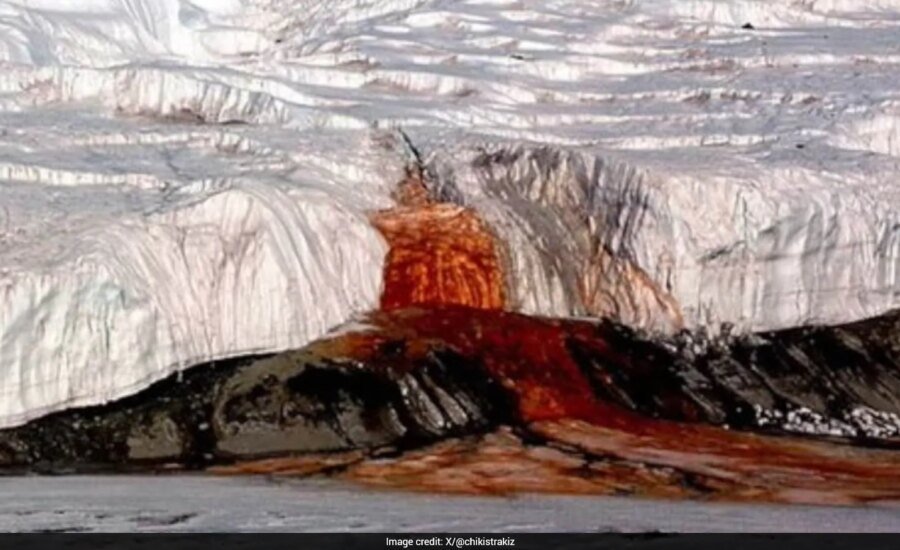
In Antarctica, there’s a glacier that bleeds a crimson-red waterfall into a frozen lake deep within McMurdo Dry Valleys. Known as ‘Blood Falls’, this eerie natural waterfall has fascinated scientists for over a century. In a study published on August 3 in Nature Geoscience, scientists found that apart from appearing to bleed out, the waters are actually home to many microscopic life forms.
“Here, across 167 aquatic, sediment and aeolian samples from the McMurdo Dry Valleys and marine reference sites, we identified a distinct marine micro-eukaryotic assemblage restricted to red-hued ice, mud and sediment at the Taylor Glacier terminus,” the researchers wrote in the published study. “Marine indicator species were identified across several phylogenetic groups including diatoms, haptophytes, dinoflagellates and ciliates.”
Also read | Stray SpaceX Rocket Piece Will Crash Into Moon On August 5. Is There Any Danger?
Millions of years ago, changing sea levels and encroaching glaciers sealed off a body of seawater beneath Taylor Glacier. Cut off from sunlight, oxygen, and fresh water, this subglacial lake became hyper-saline and rich in dissolved iron. Hence, the colour.
The researchers said that specialised marine microbes have adapted to survive in absolute darkness and freezing temperatures for years.
“The whole landscape is just a level of pristine that you’re not used to seeing,” Andrew Allen, a marine biologist at the Scripps Institution of Oceanography, said as quoted by Scientific American. “When you look out at that landscape, life doesn’t come to mind right away. You know, it’s not like the Arctic, where there are vertebrates running around. And there’s no plant life, so it feels almost abiotic at times.”
But from where did they come?
“We think that this periodic outflow of brine water creates a habitat where marine microbes could persist,” Allen said. “But the origin of these particular marine microbes is probably most consistent with the idea of ancient flooding than wind dispersal.”
Also read | “Decided To Build Robotic Arm”: Man Shares How Claude Helped With Son’s School Project
“These findings indicate that the subglacial brine-fed system at the Taylor Glacier terminus retains marine-derived biological signatures long after physical separation from the ocean, linking contemporary Antarctic microbial assemblages to past climatic transitions,” the researchers wrote.
The discovery proves that life can flourish in extreme, lightless environments previously thought to be completely uninhabitable. Astrobiologists believe this subglacial ecosystem serves as a direct model for potential life elsewhere in the Solar System, particularly in the sub-surface oceans of icy moons like Jupiter’s Europa and Saturn’s Enceladus.