
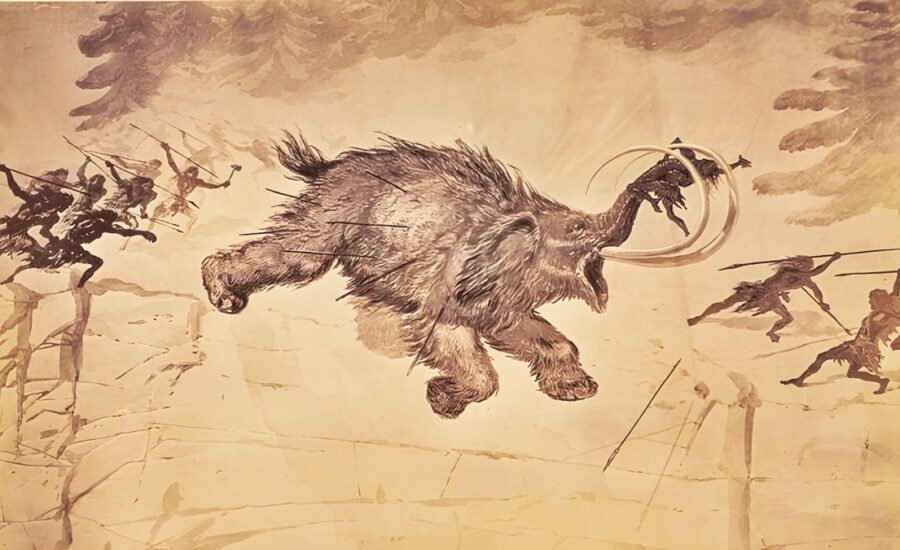
For Ice Age humans, hunting a woolly mammoth was a huge payoff.
A single animal could provide meat and fat, while its hide, bones and tusks could be used for clothing, tools, weapons and shelters.
But new research suggests prehistoric hunters were not simply killing whichever mammoth they encountered.
They appear to have preferred to hunt female mammoths, offering a glimpse into how Ice Age humans tracked and hunted these giant animals.
A study, published in Current Biology, analysed ancient DNA from 521 woolly mammoths dating back roughly 50,000 years.
The animals came from Eurasia and North America, including archaeological sites where mammoth remains had accumulated.
A BIAS AGAINST FEMALE MAMMOTHS
Among 100 mammoths from 11 archaeological sites in Poland, Austria, the Czech Republic, Germany and Russia, about 70% were female and 30% male.
That pattern was almost reversed among 421 mammoths from natural settings. There, about 66% were male and 34% female.
The contrast suggests the mammoth remains found at human sites were unlikely to be simply animals that died naturally and accumulated in the same places.
Instead, the findings point towards selective human hunting of females.
“That’s a great question, and one we’re still actively investigating,” Hannah Moots, lead author of the study, told news agency Reuters.
WHY TARGET FEMALE MAMMOTHS?
Researchers believe mammoths may have lived in social groups resembling modern elephant herds, with females and young animals travelling together while adult males were more likely to roam alone.
That could have made female-led herds easier for hunters to locate repeatedly. Female mammoths were also generally smaller than males.
An adult male could weigh up to about 6 tonnes, compared with roughly 4 tonnes for a female, potentially making females somewhat easier to hunt.
Hunters may also have taken advantage of natural features such as mud, bogs and cliffs to slow or trap mammoths before attacking them.
WHAT DOES IT REVEAL ABOUT ICE AGE-HUMANS?
One important site is Krakow Spadzista in southern Poland, where more than 100 mammoths have been found alongside stone tools and evidence of butchery.
The site dates to roughly 25,000–30,000 years ago.
The findings suggest Ice Age hunter-gatherers were making deliberate choices about which animals to pursue, rather than hunting mammoths at random.
Mammoths disappeared from mainland Eurasia and North America around 10,000–12,000 years ago, although the precise roles played by climate change and human activity remain debated.
The new study does not settle that question. It does, however, offer a clearer picture of how strategically prehistoric humans hunted one of the Ice Age’s most formidable animals.
– Ends