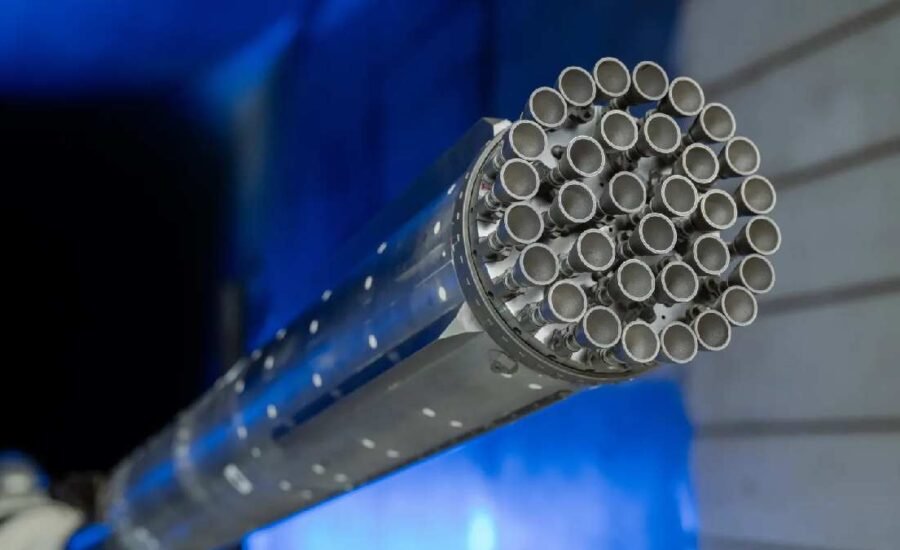
NASA has wrapped up a fresh round of wind tunnel testing on SpaceX’s Super Heavy Version 3 rocket booster as both agencies prepare for the Artemis III lunar mission. The tests took place at NASA’s Ames Research Center in California’s Silicon Valley in late 2025. Engineers used the sessions to study the extreme aerodynamic forces the upgraded booster will face during re-entry, when it returns to the launch site for refurbishment and reuse. The current testing follows an earlier round of testing NASA Ames carried out on Super Heavy in 2024.
Version 3 of Super Heavy
Version 3 of Super Heavy carries major design changes, including new Raptor 3 engines, three larger grid fins instead of four, and an integrated hot stage replacing the old interstage. Engineers wanted a clearer picture of both steady and unsteady aerodynamic forces on re-entry. Jayanta Panda, an unsteady aerodynamics expert at NASA Ames, explained that steady forces occur when air flows smoothly over the rocket, while unsteady forces come from air buffeting the vehicle unpredictably, causing vibrations.
NASA and SpaceX used a 1.2 percent scale model of Super Heavy V3 in Ames’ transonic and supersonic wind tunnels, testing speeds from Mach 0.2 up to Mach 2.5.
NASA and its partners are preparing for Artemis III by completing new wind tunnel tests on @SpaceX’s Super Heavy Version 3 rocket booster. The tests at @NASAAmes focused on better understanding what the rocket will experience during re-entry.
MORE >> https://t.co/u2gDPJlPzP pic.twitter.com/7tLf8Z9B2Q
— NASA Marshall (@NASA_Marshall) August 2, 2026
Starship Human Landing System
SpaceX is building the Starship Human Landing System, or HLS, under a NASA contract to ferry astronauts from lunar orbit down to the Moon’s surface and back. Version 3 of Starship and Super Heavy is expected to serve for the Artemis III mission in 2027, with a crewed landing planned for 2028. Manish Mehta, discipline lead engineer for the HLS Plume and Aero Environments team at NASA’s Marshall Space Flight Center, said the agency drew on decades of wind tunnel work with the space shuttle, SLS rocket, and Orion spacecraft to set up and analyze the tests. He noted that similar testing had earlier led to strakes being added to SLS for Artemis II.
Read more here.
See Also: Artemis III Astronauts Announced By NASA
Cover: NASA