
OpenAI has begun rolling out changes to ChatGPT that widen access for those on its free tier and rework the models underpinning the service for paying subscribers, with the company framing the update around factual reliability and a less cluttered response style.
Among the biggest changes for the largest share of users is the removal of message limits. Free and Go users will get unlimited text chats, a shift that takes effect next week. Limits remain in place for file uploads, images, voice, image generation and other tools, which continue to be metered separately. The company has also noted that the unlimited allowance is subject to abuse guardrails.
Alongside that, the default model for free users is moving to GPT-5.6 Luna this week, and a new Think button will let users hand harder questions to the model with more time to work through them.
Fewer factual errors, according to internal testing
OpenAI has put numbers to the improvement it claims. In an internal evaluation using financial, medical and legal prompts that required factual detail, responses containing at least one factual error were about 62 per cent less common with GPT-5.6 Luna and 68 per cent less common with GPT-5.6 Sol than with GPT-5.5 Instant, the previous default. The company attributes the gain to the models making better use of the sources they retrieve, particularly on answers that turn on dates, figures, rules or assumptions.
The evaluation is OpenAI’s own and has not been independently verified.
What changes for Plus and Pro subscribers
Plus and Pro users get an updated GPT-5.6 Sol in ChatGPT’s Chat experience, available from today. OpenAI describes it as tuned for the range of everyday work people bring to the service — quick questions, web research, advice, planning, writing and decisions.
The stated priorities are tighter formatting, answers that scale their level of detail to the question rather than padding it out, and a willingness to offer a correction where simple agreement would not be useful. The company says the same model now drives both instant responses and deeper reasoning for these users, which is intended to remove the tonal jolt that came with switching between the two.
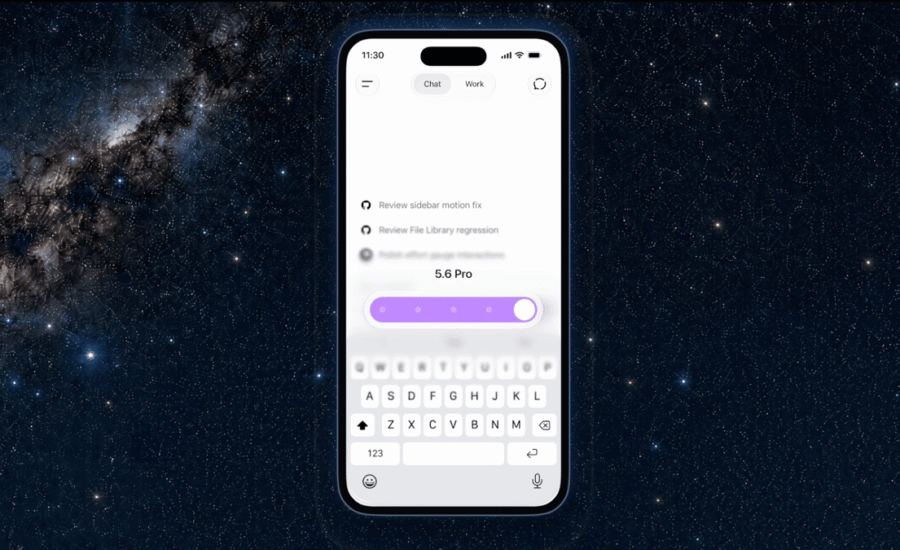
Paid subscribers also get a slider, available on web, mobile and desktop, for setting how much thought goes into a given answer — kept low for routine questions, raised for planning, research, writing, coding or anything requiring more deliberation.
This version of GPT-5.6 Sol is confined to the Chat experience. The version powering Work and Codex is unchanged by this release.
Protections for users under 18
OpenAI has outlined additional measures for users it believes to be under 18, detailed in its system card. The model has been trained to avoid romantic roleplay, age-restricted challenges and presenting itself as a substitute for real-world relationships. Age-appropriate boundaries have been applied around sexual content, eating disorders and body-image risks, age-restricted goods, dangerous activities and graphic violence. Where a teenager may need support, the model is meant to encourage them to reach out to trusted people.
The company says this training has been reinforced with system-level protections and new evaluations covering how its models perform for under-18 users, an area it describes as continuing work.
OpenAI puts weekly usage of ChatGPT at one billion people. The company casts the update as a step towards what it calls more abundant intelligence — making recent models available more widely and allowing free users to continue a conversation without running into a wall.