

The recent surge in crude oil prices and the resultant Rupee depreciation and current account deficit have once again exposed India’s economy to energy shocks. With nearly 90% of its crude oil requirements met through imports worth ₹13 lakh crore, India’s economy remains highly exposed to volatility in crude oil prices.
Reducing this dependence has therefore become a strategic priority, making domestic oil and gas exploration more important than ever. This becomes even more important because India’s deepwater oil and gas reserves have remained largely untapped for years. The reason was simple.
Drilling in ultra-deep waters is not only expensive, but there is no guarantee that a well will produce oil or gas. A single exploratory well can cost ₹800-1,000 crore, making companies cautious about investing in frontier basins. The government now wants to change that through the Samudra Manthan Programme.
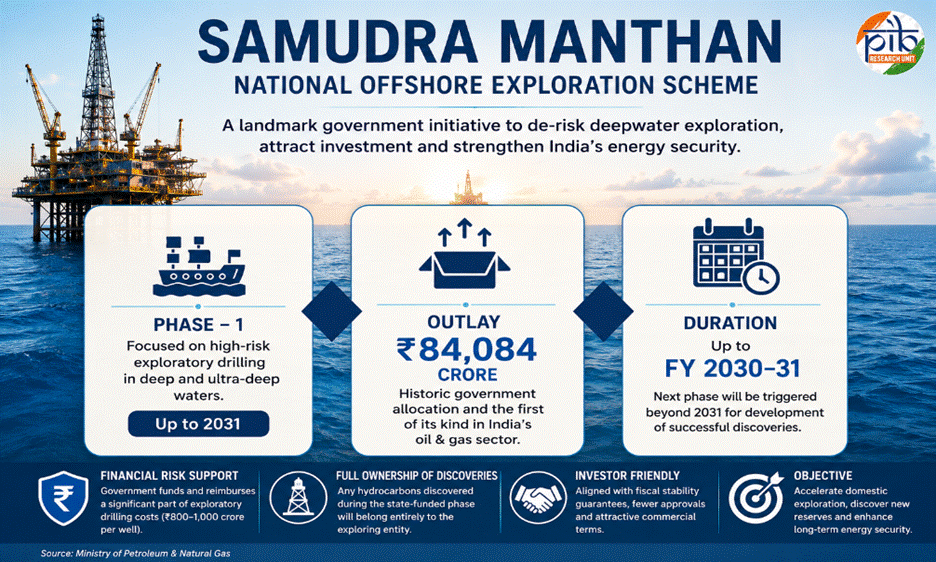
Backed by a ₹84,084 crore budget until 2031, the policy is designed to reduce the financial risk of offshore exploration. Under the scheme, the government will partially bear the cost of drilling, allowing oil and gas companies to work on high-risk projects with less upfront exposure.
The ₹84,084 crore comprises ₹28,534 crore for offshore data acquisition, offshore exploration, and infrastructure-led production (₹55,200 crore), and monitoring and support activities (₹350 crore). The project could also benefit multiple companies across the value chain.
Bridging the Macro Risk to Micro Contracts
The goal is to accelerate domestic oil and gas discoveries and strengthen the country’s energy security. The government estimates that the country’s eastern and western offshore basins are estimated to hold over 5,600 million metric tonnes (MMT) of hydrocarbon potential. This makes unlocking these reserves a key priority.
There’s another reason why exploration matters. Existing oil fields experience a natural decline of about 6-7% each year. This makes new discoveries essential to maintain current production. Against this background, this article lists three potential beneficiaries of this policy.
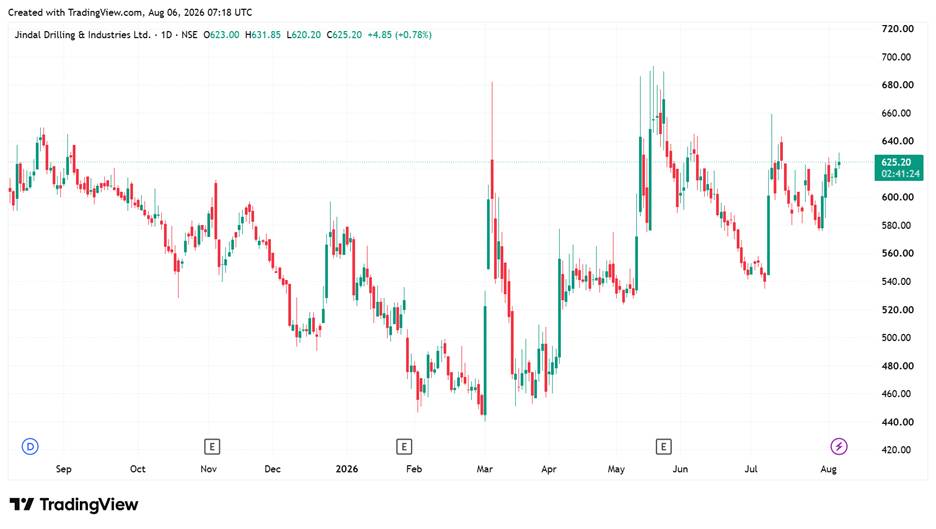
#1 Jindal Drilling & Industries: The ‘Net-Debt’ Free Player in India’s Offshore Bet
Jindal Drilling & Industries is a leading offshore drilling services contractor in India’s oil and gas sector. The company provides offshore drilling solutions to companies engaged in oil and gas exploration. This segment constitutes 100% of the company’s revenue.
ONGC Dependency and the Barrier to Entry
Jindal Drilling operates exclusively in Indian offshore waters, primarily serving state-owned oil companies. Its largest customer is the Oil and Natural Gas Corporation (ONGC), which already accounts for 99.8% of the company’s total revenue.
The company also provides specialised technical services directly to the upstream sector, including directional drilling services and mud logging services. The company manages a fleet of 6 offshore jack-up rigs, 8 directional drilling sets and 6 mud logging sets.
These fleets are designed for Indian offshore conditions and are a barrier to entry. Management states that very few international rigs meet the exact technical specifications required by India. This makes it harder and costly for foreign players to modify their idle rigs to meet India’s requirements. This protects Jindal from entry of international competitors in domestic tenders.
Join now
Riding the ₹84,084 Crore Samudra Manthan Catalyst.
This end-to-end presence makes Jindal Drilling one of the main beneficiaries of the deep-sea policy. The government push to increase domestic offshore production is favourable for Jindal Drilling. Management has stated that offshore drilling plays a key role in import substitution and foreign exchange savings.
The company has highlighted offshore discoveries in regions like the Andaman basin as having significant potential to unlock major, long-term drilling opportunities. Management stated that there are no tenders for the Andaman basin in the near-term. However, a major deepwater de-risking push could act as the regulatory catalyst needed to commercialise these prospects.
FY26 Financials: Margin Expansion Amidst Steady Revenues
Financially, the company’s revenue grew by 20.4% year-on-year to ₹997 crore in FY26. Operating profit surged 44.8% to ₹349 crore while margins expanded by 600 bps to 35%. However, net profit fell 2.3% to ₹211 crore due to higher depreciation cost and lower other income. The company is also net-debt free.
FY27 Fleet Repricing and the ₹45.8 Lakh Day-Rate
Looking ahead, the scheduled dehiring and repricing of half its fleet in FY27 is a key trigger. Jindal Drilling’s three leased and owned jack-up rigs, Discovery-I (contract expires May 2026), Jindal Star (July 2026), and Virtue-I (October 2026), will complete their existing contracts.
Management aims to re-contract these rigs. Jindal Drilling was actively bidding its recently refurbished owned rig, Jindal Pioneer, into a current ONGC 4-rig tender to redeploy it in India. ONGC also awarded a contract to the company for the deployment of Jindal Pioneer for three years at an effective day rate of ₹45.8 lakh.
#2 Engineers India: The Primary Vendor Benefitting from the Deepwater Push
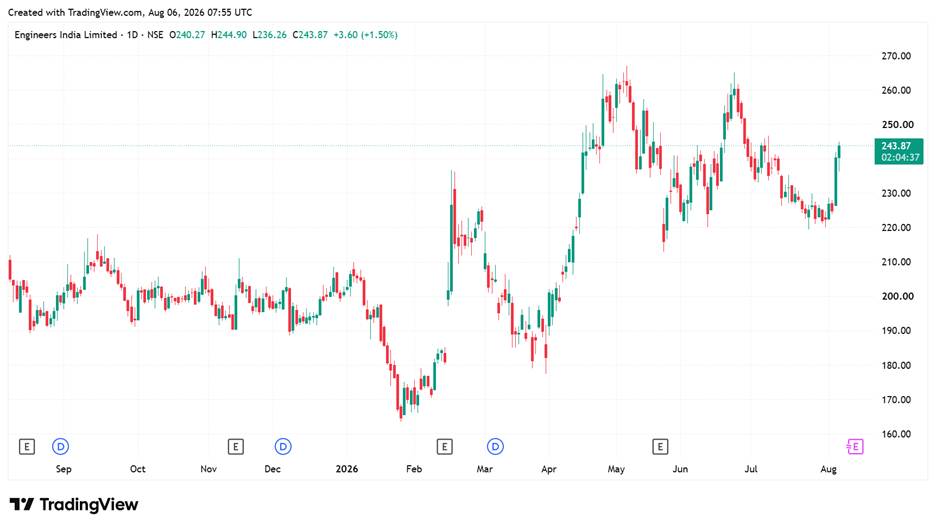
Engineers India’s (EIL) business aligns with the upstream exploration and infrastructure opportunities of the policy. It is a pioneer in India’s offshore oil and gas sector. It has successfully completed 248 offshore projects, including process platforms.
Its offshore business began in 1972, with the execution of ONGC’s Bombay High North platform in 1979, which was then the largest offshore process platform in India. These deepwater drilling projects require highly complex process design, feasibility modelling, and technical risk assessment.
EIL’s Legacy and the Shift to High-Margin Consultancy
EIL is the leader in this space for detailed feasibility reports, configuration studies, and licensor selection. It has also shifted its business model away from turnkey execution towards core, high-margin consultancy and engineering projects. Consultancy revenue grew to ₹1,782 crore in FY26, up from ₹1,678.8 crore in FY25.
ONGC Synergies and Domestic Block Monopolies
Thus, new deepwater auctions can translate directly into relatively more profitable pre-project consultancy, engineering, and Project Management Consultancy contracts for EIL. Further, EIL has a long-standing relationship with India’s upstream Public Sector Undertaking, mainly ONGC.
EIL recently secured the contract for preparing tender documents for ONGC’s Process Platform Modification and Revamping Project-1. It has been handling revamps of ONGC plants. EIL’s management states that all Indian projects are to be executed by Indian consultants.
This could make EIL one of the preferred choices for domestic engineering needs in these 18 offshore blocks. Recent project wins also demonstrate this. EIL continued to secure key offshore and upstream contracts, such as the offshore crew change facility at Santacruz, Mumbai (₹ 95 crore).
International Expansion and Downstream Pipeline Execution
EIL is widening its footprint not only domestically but also internationally. The company recently secured significant offshore and development projects, including ADNOC’s Lower Zakum development plan (Phase 1) in the UAE. Another contract is to conduct selection studies for the Umm Al Dalakh development project in the UAE.
These complex, global deepwater and offshore credentials could translate to the engineering demands of deepwater blocks in Indian waters. EIL owns downstream evacuation networks. The company has already completed 55 pipeline projects. More than 12 major pipeline projects are currently underway.
₹15,109 Crore Order Book Offers Multi-Year Visibility
Therefore, any offshore discoveries can directly translate into demand for LNG and gas terminal networks, benefiting EIL. EIL is already receiving orders for networks such as Petronet LNG’s Dahej expansion. As of March 2026, EIL’s order book of ₹15,109 crore provides revenue visibility of over 3 years as per FY26 revenue of ₹3,928 crore.
#3 ONGC: The State Giant De-Risking Deepwater Operations
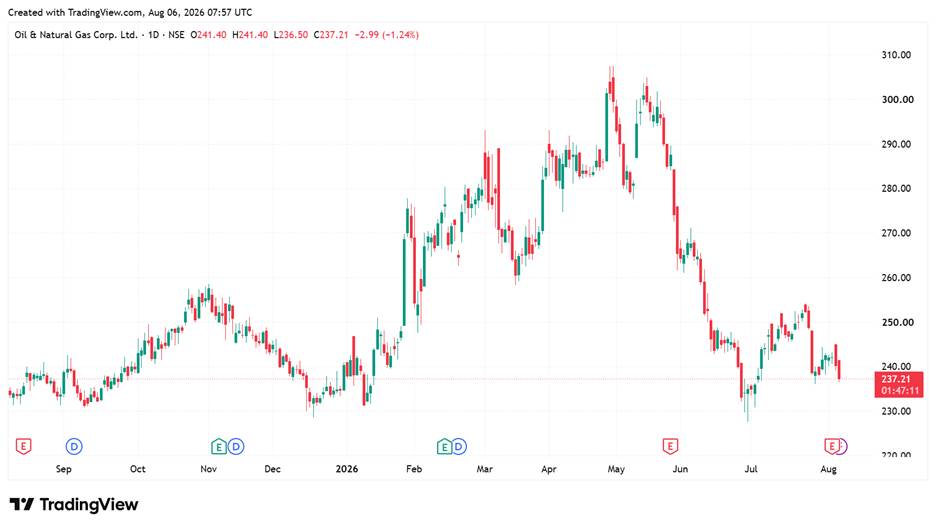
ONGC is India’s leading exploration and production company and is the primary beneficiary of this program. ONGC can drill with significantly lower financial risk because the government will fund and reimburse a major part of the exploratory costs, while the remaining portion is borne by the company. This, in turn, improves the financial viability of ONGC’s offshore projects.
It commenced drilling its first deepwater exploratory well under the program on July 25, 2026. The results of this well are expected in September. The financial support reduces exploration costs, which in turn lowers the overall break-even cost of developing any discovered fields. ONGC plans to drill 150 deepwater wells over seven years.
De-Risking Deepwater: The $75+ Baseline Math
Management states that lower break-even costs mean that many complex deepwater fields were previously considered uneconomical at $60 to $65 per barrel of crude. These have now become economically viable at expected long-term baseline oil prices of $75+ per barrel.
For ONGC, a major benefit is the full ownership of hydrocarbon reserves. ONGC management says that any hydrocarbon discovery made under the program will belong to ONGC. The development, reserve accumulation, and commercial production from these de-risked discoveries will flow entirely into ONGC’s portfolio.
This can help the company achieve its long-term growth targets. Policy support could also attract global energy majors, which were previously hesitant to commit. ONGC can partner with leading international energy firms (BP, ExxonMobil, TotalEnergies, Petrobras, and Shell).
Unlocking ‘No-Go’ Zones in OALP Round-X
These partnerships (if any) could help ONGC reduce execution risk and leverage world-class deepwater capabilities. ONGC is already a significant player in the Open Acreage Licensing Policy (OALP). The government uses OALP to auction land and sea blocks to oil companies for exploration.
However, many offshore waters were previously “no-go” zones for military, shipping, or defence security reasons. The government has now opened 99% of these restricted areas, representing 51% of the total area to be auctioned in Round-X.
With 25 blocks and 1.9 lakh square kilometres, Round-X is the tenth and largest exploration auction in India’s history. It could benefit from this, as it was awarded 15 contract areas consisting of 7 ultra-deepwater blocks, 5 shallow-water blocks, and 3 onshore blocks in Round-IX. Through Round-X, ONGC can expand its business.
Q1FY27 Earnings Surge and FY27 Production Targets
From a financial perspective, revenue rose 45% year-on-year to ₹46,460 crore in Q1FY27, as average crude oil price realisations reached US$99.5 per barrel. Consequently, net profit increased 112% to ₹17,034 crore. The company expects standalone oil and gas production to reach 39 MMT in FY27 and 40 MMT in FY28, up from 38.8 MMT in FY26.
Evaluating the Returns: High Margins vs. Asset-Heavy Risks
Engineers India’s Return on Equity (ROE) and Return on Capital Employed (ROCE) are the strongest of the three due to an asset-light business model. In contrast, ONGC’s business is capital-intensive and is exposed to commodity price volatility, resulting in comparatively lower return ratios. Jindal Drilling’s business is also asset-intensive and is linked to drilling activity.
For valuation, we have used the EV/EBITDA multiple. Engineers India is trading at a premium to both the industry and its historical 5-year median, while Jindal Drilling is valued at a discount to both. ONGC’s valuation is in line with its historical valuation, but at a discount compared to the industry.
| Peer Comparison (X) | |||||
| Particulars | EV/EBITDA Multiple | Return Ratios | |||
| Company | 5Y Median | Industry | ROE (%) | ROCE (%) | |
| Jindal Drilling | 4.1 | 5.6 | 11.2 | 12.5 | 15.4 |
| Engineers India | 13.1 | 12.2 | 9.6 | 23.8 | 30.6 |
| ONGC | 4.0 | 4.0 | 14.8 | 11.7 | 14.2 |
The success of the Samudra Manthan programme will ultimately depend on whether it leads to commercially viable discoveries. However, the policy has shifted the industry’s risk-reward equation. This has improved the outlook for offshore exploration and encouraged higher drilling activity.
This creates opportunities not only for explorers like ONGC but also for companies across the offshore engineering and drilling ecosystem. As strong contenders, these stocks are worth keeping on your watchlist.
Disclaimer
Note: Throughout this article, we have relied on data from http://www.Screener.in and the company’s investor presentation. Only in cases where the data was unavailable have we used an alternative, widely used and accepted source of information.
The purpose of this article is only to share interesting charts, data points, and thought-provoking opinions. It is NOT a recommendation. If you wish to consider an investment, you are strongly advised to consult your advisor. This article is strictly for educational purposes only.
About the Author: Madhvendra has been deeply immersed in the equity markets for over seven years, combining his passion for investing with his expertise in financial writing. With a knack for simplifying complex concepts, he enjoys sharing his honest perspectives on startups, listed Indian companies, and macroeconomic trends.
A dedicated reader and storyteller, Madhvendra thrives on uncovering insights that inspire his audience to deepen their understanding of the financial world.
Disclosure: The writer and his dependents do not hold the stocks discussed in this article.
The website managers, its employee(s), and contributors/writers/authors of articles have or may have an outstanding buy or sell position or holding in the securities, options on securities or other related investments of issuers and/or companies discussed therein. The articles’ content and data interpretation are solely the personal views of the contributors/ writers/authors. Investors must make their own investment decisions based on their specific objectives, resources, and only after consulting such independent advisors as may be necessary.