
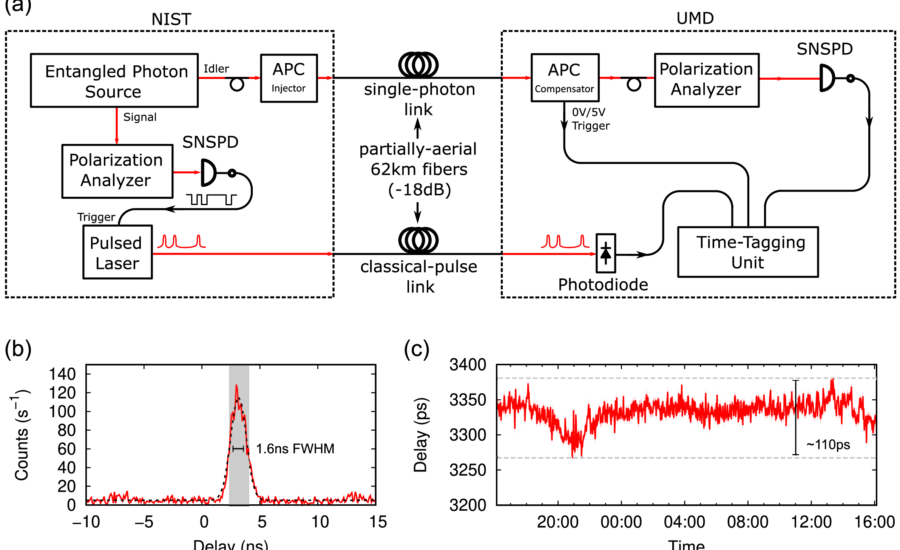
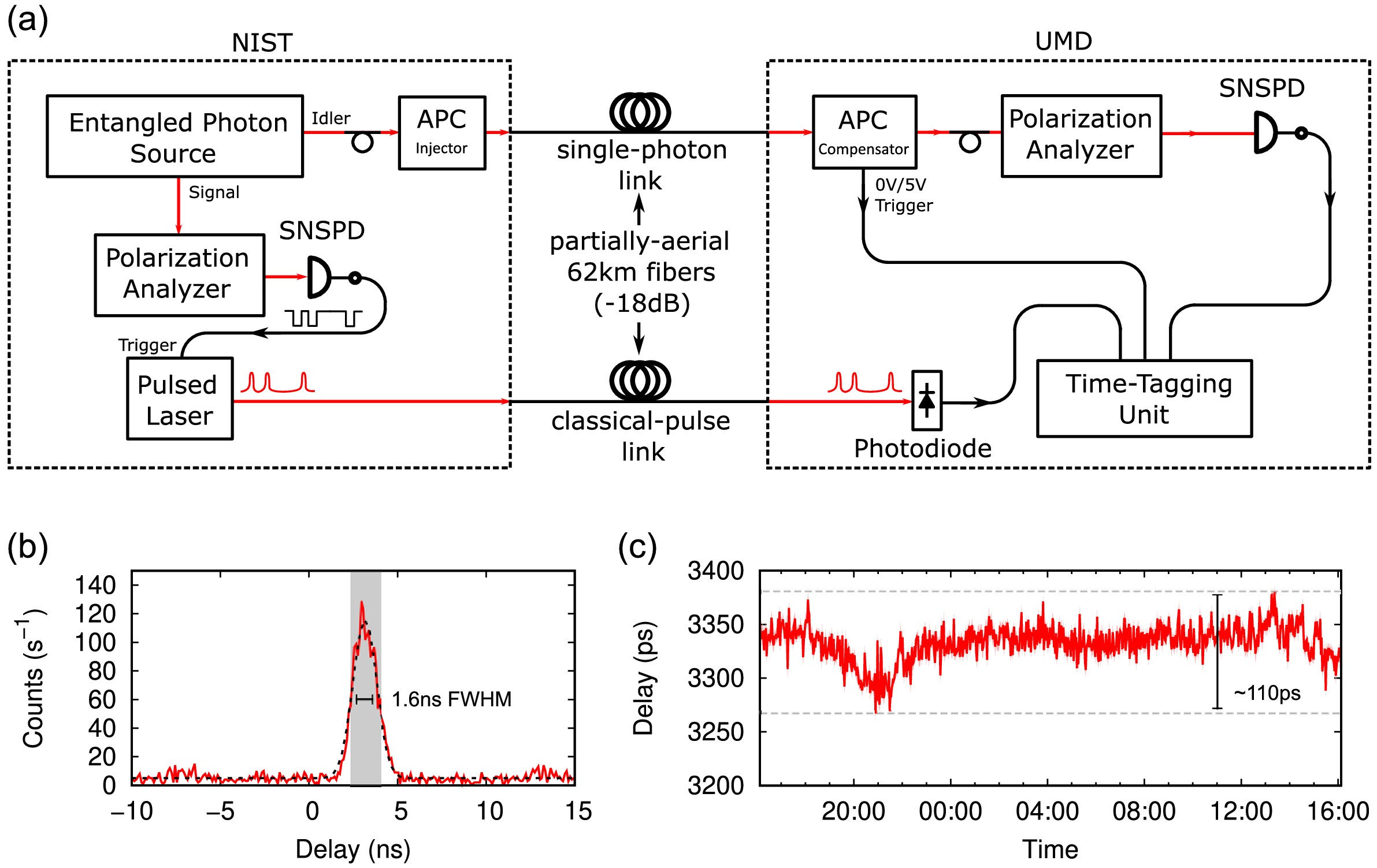
Researchers from the National Institute of Standards and Technology (NIST), the Joint Quantum Institute (JQI) at the University of Maryland, and quantum networking firm Qunnect have successfully demonstrated long-distance polarization-entangled photon distribution across a live, partially aerial fiber-optic link. Detailed in a peer-reviewed study published in the Journal of Optical Communications and Networking (JOCN, Vol. 18, Issue 8), the team transmitted entangled photons over 62 kilometers (38.5 miles) of commercial telecommunications fiber connecting NIST’s Gaithersburg campus to UMD in College Park, Maryland.
Unlike buried subterranean fiber optic lines that remain thermal and mechanically isolated, aerial fiber suspended from utility poles experiences severe polarization drift due to wind, traffic vibrations, and ambient daily temperature swings. To overcome this environmental noise, the researchers integrated automated polarization compensation (APC) devices developed by Qunnect. The system multiplexes reference light beams through the fiber to continuously map time-varying birefringence, calculating and applying inverse unitary transformations in real-time to preserve the flying photons’ quantum polarization state.
                   [ Metropolitan Quantum Entanglement Link Architecture ]
                                              │
     ┌────────────────────────────────────────┴────────────────────────────────────────┐
     ▼                                                                                 ▼
  NIST Gaithersburg Campus (Node A)                                    UMD College Park Campus (Node B)
  • Entangled Photon Pair Source (Signal & Idler).                    • Real-Time Active Polarization Correction (Qunnect).
  • Local Signal Photon Polarization Analyzer.                         • Idler Photon Receiver & Time-Tagging Unit.
  • Parallel Optical Link for Timing Sync.                             • CHSH Bell Inequality Parameter: S = 2.45 ± 0.08.
During a continuous 24-hour stress test, the setup achieved an entangled photon distribution rate of approximately 1,500 pairs per second with an operational link uptime of 92.8% (requiring only 7.2% of total link time for active polarization re-calibration). The team recorded a time-averaged Clauser–Horne–Shimony–Holt (CHSH) Bell inequality parameter of S=2.45±0.08, violating the classical physics threshold (S≤2) for over 20 consecutive hours and confirming high-fidelity entanglement preservation under adverse real-world conditions.
The trial validates that metropolitan-scale quantum networks, Quantum Key Distribution (QKD) channels, and distributed quantum computing interconnects can be deployed over existing, unshielded commercial fiber infrastructure without requiring custom underground installations.
Review the complete open-access study in the Journal of Optical Communications and Networking here, and read the official research release on NIST News here.
August 6, 2026