
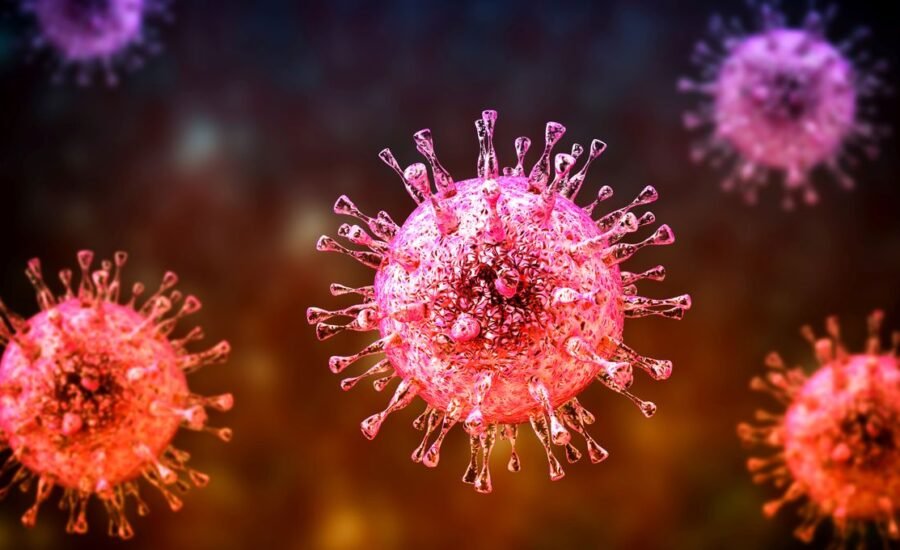
It’s an uncomfortable fact that most of us have viruses living inside us right now. Yes, even if we’re not sick. With some viruses, you catch them and then you completely recover. But other trickier customers have found ways to hang around – sometimes for a whole human lifetime.
We’re talking about things like herpesviruses, companions of the human race for thousands of years. Herpes simplex virus type 1 (HSV-1) is thought to have infected 64 percent of under-50s worldwide, and scientists are still learning about what exactly that could mean for us all.
The chickenpox virus, varicella zoster, is another herpesvirus where once you’ve had it, you’re kind of stuck with it. Lying dormant inside nerve cells, it can reactivate later as shingles or the rarer Ramsay Hunt syndrome that affected Justin Bieber a few years ago.
There’s also the Epstein-Barr virus, which causes mononucleosis (glandular fever) and more recently was confirmed as a major cause of multiple sclerosis; and cytomegalovirus, a virus so common that blood donations from people who don’t have it are highly prized for use in neonatal care.
All these unwelcome hitchhikers can reawaken in response to stress and other illnesses challenging the immune system. Anyone who experiences cold sores will be familiar with the way they reactivate whenever you’re a bit run down.
Now, a new study led by scientists at the University of Texas at Austin has found that COVID-19 can also trigger the resurgence of some of the approximately 8-12 dormant viruses each of us is carrying at any one time.
From dormancy to “dysvirosis”
“This finding suggests that COVID-19 may not always act as a single viral infection and may disrupt the body’s internal ecosystem of dormant viruses, creating a state of ‘dysvirosis,’” said lead author Dr Cole Maguire in a statement.
This was thought to be theoretically possible, especially in those with suppressed immune systems, but the new findings show it happens much more often than scientists suspected. Of the over 1,100 hospitalized COVID patients included in the study, more than half had at least one viral reactivation during their illness.
The data were collected from 20 US hospitals during the peak of the pandemic before vaccines were introduced, between May 2020 and March 2021.
As well as herpesviruses, the team documented reactivation of viruses in the family Anelloviridae.
A 2024 study described these as “mysterious” – one member of the family, torque teno virus, is thought to infect 80-90 percent of the human population. While these viruses don’t seem to directly cause disease, they have been implicated in exacerbating a whole suite of illnesses.
The virus reactivations in the COVID patients weren’t just noteworthy side effects of their infection. According to the team’s data, they may have impacted how sick the patients got and what complications they experienced, although this can’t yet be confirmed.
For example, detection of cytomegalovirus in the nose was associated with collapsed lung, while HSV-1 in the nose was associated with blood clots.
The findings, they team explain, suggest that viral reactivation could contribute to worse outcomes from COVID-19 in otherwise healthy people who may not be considered at high risk.
Important implications
It’s not yet clear how vaccination and the evolution of later COVID variants might impact viral reactivation.
Other studies have suggested a potential link between Epstein-Barr virus and long COVID, but as a 2025 review concluded, the “exact relationship” is “still not completely deciphered.” More research on all of these open questions will be needed.
Speaking to Science, immunologist Danny Altmann, who was not directly involved in the new study, commented that the comprehensive nature and sample size were strengths, as well as the fact the team included viruses that had previously been overlooked in COVID-19 research.
“Our findings have important implications for patient care,” said principal investigator Dr Esther Melamed.
“Tests already exist for several of the chronic viruses studied, and some viruses in the herpes family can be treated with existing antiviral drugs. The next step is determining whether identifying and treating reactivated viruses can improve outcomes for patients with acute COVID-19 and long COVID.”
The study is published in Nature.