
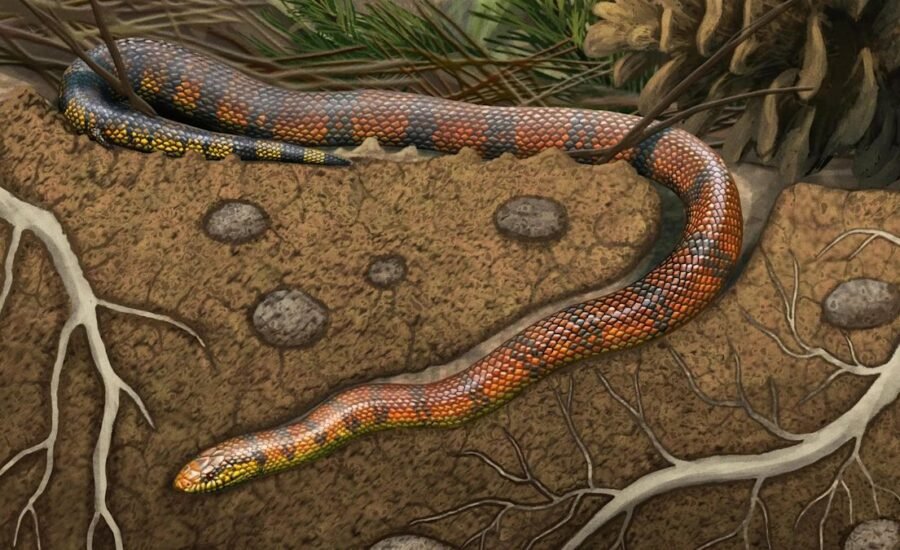
A rare snake fossil from Brazil is offering researchers a new angle on one of evolution’s enduring questions: how snakes abandoned limbs and came to rely on slithering.
According to Discover Magazine, the 80-million-year-old specimen indicates that the shift from leg-powered to limbless movement may not have happened along one straightforward evolutionary track.
What happened?
The fossil, uncovered in São Paulo state, belongs to a newly identified species called Tametara mirim, the outlet noted.
What makes the specimen remarkable is not only its age but also its condition. Researchers say the bones were preserved together in the same arrangement they had in life, something especially unusual for early snakes, Discovery Magazine said.
Fossils from the earliest stages of snake evolution are extremely rare. The research, published in Nature, noted that fewer than 10 articulated snake fossils from the Mesozoic era are known.
Study of the skull showed unusually thick, compact bone, a feature researchers associate with animals that move through soil headfirst.
Micro-CT scans of the brain cavity added another clue, showing reduced visual and forebrain regions consistent with a species adapted to life underground. A comparison with another early snake, Dinilysia, pointed in a very different direction, the researchers said.
In that species, skull and brain anatomy aligned more with life above ground than below it, adding to evidence that ancient snakes were already occupying distinct habitats, as Discovery Magazine noted.
Why does it matter?
Scientists have debated whether snakes first evolved for life in water, on land, or underground. Instead, this fossil suggests early snake lineages may have spread into different environments fairly quickly, rather than all adapting in the same way.
That means snake origins may be better understood as multiple species responding to different ecological pressures at roughly the same time, not as one evolutionary sequence.
Snakes occupy a wide range of habitats, from underground burrows to tropical coastal waters. The finding adds context for studying the ecological roles living snakes play in healthy ecosystems, including controlling pest populations and supporting food webs.
The finding also points to the value of protecting fossil sites, natural history collections, and biodiversity research.
Such discoveries can help scientists understand how animals respond to environmental change, offering knowledge that can inform efforts to protect wildlife today.
What’s being done?
Scientists use advanced imaging tools such as micro-CT scanning to study fragile fossils without damaging them. That allows researchers to closely examine skull structures, sensory systems, and other details older methods could miss.
The study shows why continued fossil exploration is so important. Each new specimen can fill major gaps in the evolutionary record and offer a clearer picture of how reptiles adapted to different landscapes over millions of years.
Fossil discoveries answer questions about prehistoric life and build knowledge that helps researchers understand resilience, adaptation, and biodiversity.
As Discover Magazine noted, the researchers said early branches of the group seem to have taken separate routes, with some suited to burrowing, some to life on the ground, and others later entering marine environments.
Get TCD’s free newsletters for easy tips, smart advice, and a chance to earn $5,000 toward home upgrades. To see more stories like this one, change your Google preferences here.