tRNA in vitro manufacturing
Oligonucleotides containing tRNA beneath a T7 promoter and adopted by an HDV ribozyme61 had been synthesized by IDT as high-fidelity DNA microchip oligo swimming pools from 254–275 nucleotides in size, and dsDNA was amplified in a single PCR response for every pool. These tRNA swimming pools included 48 distinctive E. coli isoacceptor tRNAs with all mixtures of base 75, all mixtures of bases 74 and 75 (degeneracy launched with machine mixing), and all M. alvus and M. mazei isoacceptor tRNAs. IVT reactions had been carried out at 37 °C utilizing the amplified tRNA dsDNA as template utilizing NEB HiScribe T7 Excessive Yield RNA Synthesis Package, with addition of ATP, CTP, GTP, UTP, response buffer, 200 ng dsDNA template and T7 RNA polymerase. After reverse transcription, polynucleotide kinase therapy was carried out to dephosphorylate the tRNA 3′ terminus62. tRNA produced by IVT was purified and size-selected utilizing SPRIselect beads. The tRNA was refolded by heating to 80 °C for five min and sluggish cooling to room temperature. At 50 °C, MgCl2 was added to a closing focus of 10 mM.
For amplification of particular person tRNAs from a tRNA pool, a singular primer was designed for every tRNA overlaying the T7 promoter and 5′ distinctive sequence of the tRNA. The identical reverse primer was used for all tRNAs as for the pooled amplification. Alternatively, particular person tRNA sequences had been synthesized and amplified.
tRNA aminoacylation in cell-free lysates
A complete of 40–120 µg of IVT tRNA libraries had been incubated in 200 μl NEBExpress Cell-free E. coli Protein Synthesis System (New England Biolabs), or a {custom} cell lysate translation system we ready (see beneath), and incubated for two h at 37 °C. Alternatively, 40–120 µg of IVT tRNA libraries had been incubated within the NEB PURExpress Δ(aa, tRNA) equipment and incubated for two h at 37 °C.
tRNA extraction
Cell pellets had been suspended in 1 ml TRIzol (Thermo Fisher) and frozen at −80 °C. 1-Bromo-3-chloropropane (1/10 quantity) was added, and the samples had been vortexed and centrifuged at 15,000 × g for 15 min at 4 °C. The aqueous section was transferred to a brand new tube containing 400 μl of 70% ethanol. Quick RNAs had been then remoted utilizing a modified RNeasy MinElute Cleanup Package protocol (Qiagen) to size-select for RNAs <200 nt in size. Samples had been centrifuged by means of MinElute spin column at 12,000 × g for five min at room temperature. The flow-through was added to 450 μl of 100% ethanol and centrifuged in a brand new MinElute spin column at 12,000 × g for 1 min at room temperature. The column was washed 3 times with 80% ethanol in 50 mM sodium acetate and dried with open caps at 12,000 × g for five min. Samples had been eluted in 50 mM sodium acetate and 1 mM EDTA.
Periodate oxidation and β-elimination
Periodate oxidation was carried out with 10 μg whole RNA remoted above in 10 mM sodium acetate and 50 mM NaIO4. The response was incubated at 22 °C for 30 min and quenched with 100 mM d-glucose for five min. The samples had been size-selected utilizing SPRIselect beads (Beckman Coulter) and eluted in RNase-free water. β-Elimination and deacylation had been carried out in 60 mM sodium tetraborate at 45 °C for 90 min. RNA was purified and size-selected utilizing SPRIselect beads. The three′ phosphoryl group was eliminated utilizing New England Biolabs T4 Polynucleotide Kinase equipment following the protocol of the producer. Dephosphorylated RNA was purified utilizing SPRIselect beads.
tRNA library preparation and sequencing
tRNAs had been ligated to a 3′ pre-adenylated adapter oligo utilizing New England Biolabs T4 RNA Ligase 2, truncated KQ equipment to ligate adenylated 5′ finish of a DNA oligo to the three′ OH on RNA samples. The response was carried out in keeping with the protocol of the producer for two h at 25 °C and quenched with 0.5 M EDTA and subsequently size-selected with SPRIselect. Primer-dependent reverse transcription response was carried out utilizing Maxima H Minus Reverse Transcriptase63. A complete of fifty ng of three′-adapter-ligated samples had been incubated with 6 pM RT primer and 20 mM dNTP combination at 75 °C for five min to denature the primer and had been added to Maxima equipment parts in keeping with the protocol of the producer. After incubation, alkaline hydrolysis was carried out by means of the addition of NaOH and incubation at 95 °C for 3 min, and the answer was neutralized with HCl. The samples had been purified utilizing SPRIselect. The 5′ adapter was ligated utilizing New England Biolabs Thermostable 5′ App DNA/RNA Ligase in keeping with the protocol of the producer, and the adapter-ligated samples had been size-selected with SPRIselect. The barcodes had been added to the three′ and 5′ ends of cDNA by means of single-step PCR with KAPA Hifi HotStart ReadyMix utilizing primers, together with the Illumina P5 and P7 areas, and barcodes tailored from Illumina TruSeq. Libraries had been purified utilizing SPRIselect and quantified utilizing QuBit. Libraries had been ready for sequencing utilizing the Illumina MiSeq protocol and sequenced on an Illumina MiSeq or NovaSeq instrument.
Robotic process for tSCAN
We carried out the identical process as above, with all pipetting and magnetic bead purification steps absolutely automated utilizing the OT-2 platform. We used an Opentrons OT-2 outfitted with two Magnetic Modules (GEN2), a P300 8-Channel Pipette (GEN2), a P20 Single-Channel Pipette (GEN2) and two Temperature Modules with 96-well aluminium temperature blocks. We used 96-well plates and 12-well reservoirs for enter of samples and reagents.
We used a Jupyter pocket book of OT-2 to regulate all protocols. For every consumable in every deck place, we initially calibrated the x, y and z positions and saved these objects for reuse in all procedures. We additionally calibrated the x, y and z positions of the 8-Channel inside the wells for aspiration and resuspension steps. For all purifications, we specified the variety of columns to be purified in the beginning of the protocol, and the multichannel pipette was used to hold out the process. All buffers used through the process had been supplied in 12-well reservoirs with portions calculated by the protocol at time of initialization. All response steps had been inherited from a mixing script that separated pattern knowledge illustration from machine management. Three.xlsx spreadsheets had been supplied containing layouts of two supply plates in addition to reactions. A CSV file was mechanically generated that specified all operations the instrument would carry out. The machine management protocol would then management the {hardware} and execute all steps.
Evaluation of tRNA aminoacylation from NGS knowledge
The .fastq recordsdata obtained from sequencing had been analysed with {custom} Python scripts. After high quality filtering, reads had been aligned with MMseq to a library of all E. coli tRNAs. Subsequent, the aligned knowledge had been looked for every tRNA sequence and adapter sequence together with every mixture of terminal 3′ nucleotides. All reads had been quantified for the presence or absence of terminal adenosine as charged or uncharged tRNAs, respectively. All charged and uncharged percentages had been quantified for every isoacceptor tRNA with all 3′ trinucleotide mixtures and output as .csv recordsdata.
In-lysate dedication of tRNA aminoacylation utilizing isotopically labelled ATP with tSCAN-M
Every tRNA species being assayed for aminoacylation was in-vitro-transcribed as described above, besides that isotopically labelled ATP (Adenosine-15N5 5′-triphosphate, Adenosine-13C10,15N5 5′-triphosphate or Adenosine-13C10 5′-triphosphate) changed the ATP equipped within the HiScribe equipment. The tRNA was purified and refolded as earlier than.
In every cell-free response, 1–2 μg of in-vitro-transcribed tRNA being assayed for aminoacylation was added into a ten μl quantity of NEBExpress Cell-free E. coli Protein Synthesis System (New England Biolabs) and incubated at 37 °C for two h. Then 10 μl of RNase A digestion answer was added, consisting of 200 mM sodium acetate (pH 5.2) and 1.5 U μl−1 RNAse A and incubated for 20 min at room temperature. The protein was precipitated by addition of 1% formic acid, and the reactions had been then frozen at −80 °C for 30 min to 1 day. After precipitating protein at −80 °C for 30 min, the insoluble materials was eliminated by centrifugation at 16,000 × g for 15 min at 4 °C. The soluble fraction was then transferred to autosampler vials, saved on ice till instantly earlier than high-resolution LC–MS evaluation and returned to ice instantly afterwards.
aaRS protein manufacturing and purification
E. coli LeuRS, ProRS and ValRS had been subjected to PCR amplification from the genome of E. coli K12 MG1655 and cloned with His-tag right into a ColE1 spine with a bla resistance marker and remodeled into E. coli BL21(DE3) expression pressure. The aaRSs had been overexpressed in E. coli cells with an optical density (OD) of 0.6. Protein manufacturing was induced by including 0.5 mM isopropyl-b-d-1-thiogalactopyranoside (Millipore Sigma), and the cells had been moved to a 33 °C incubator and grown at 250 rpm for two.5 h. The cells had been harvested at 6,000 × g for 15 min at 4 °C, washed with 1× PBS buffer, and saved at −80 °C. The frozen cell pellet was thawed in lysis buffer (100 mM HEPES pH 7.2, 500 mM NaCl, 5 mM BME). The cell paste was suspended in 15 ml of lysis buffer (50 mM Tris (pH 7.5), 300 mM NaCl, 20 mM imidazole) and lysed by sonication. The crude extract was centrifuged at 30,000 × g for 30 min at 4 °C. The soluble fraction was loaded onto a column containing 2 ml of Ni-NTA resin (Qiagen) beforehand equilibrated with 20 ml lysis buffer. The column was washed with 20 ml lysis buffer, and the sure protein was then eluted with 2 ml of fifty mM Tris (pH 7.5), 300 mM NaCl and 300 mM imidazole. The purified proteins had been dialysed with 10 mM Tris (pH 7.5), 0.5 M NaCl, 1 mM DTT and 50% glycerol, and saved at −80 °C for additional research.
In vitro aminoacylation exercise assay
A 20 μl aminoacylation response contained the next parts: 50 mM Tris-HCl (pH 7.2), 10 mM MgCl2, 10 mM ATP, 2 mM amino acids, 500 nM aaRS and 20 μg tRNA. Aminoacylation reactions had been incubated at 1 h at 37 °C. The reactions had been stopped by the including 20 μl digestion answer consisting of 200 mM sodium acetate (pH 5.2) and 1.5 U μl−1 RNase A, and incubated for 20 min at room temperature. The protein was precipitated by addition of 1% formic acid, and the reactions had been then frozen at −80 °C for 30 min to 1 day. After precipitating protein at −80 °C for 30 min, the insoluble materials was eliminated by centrifugation at 16,000 × g for 15 min at 4 °C. The soluble fraction was then transferred to autosampler vials, saved on ice till instantly earlier than high-resolution LC–MS evaluation and returned to ice instantly afterwards.
Mass spectrometry evaluation of tRNA aminoacylation
Quantitative mass spectrometry knowledge had been collected utilizing an Agilent 6530 Quadrupole Time-of-Flight (QTOF) MS with an electrospray ionization (ESI) supply, coupled to an Agilent Infinity 1290 ultrahigh-performance liquid chromatography (UHPLC) system with an Agilent Poroshell 120 EC-C18 2.7 μm, 2.1 ×50 mm column. The solvents used had been water and 0.1% formic acid (solvent A) and acetonitrile and 0.1% formic acid (solvent B). Mass spectra had been gathered utilizing Twin Agilent Jet Stream (AJS) ESI in optimistic mode. The mass vary was set from 100 m/z to 1,700 m/z with a scan velocity of three scans per second. The capillary and nozzle voltages had been set at 3,500 V and 1,000 V, respectively. The supply parameters had been set with a fuel temperature of 325 °C and a stream price of 12 l min−1, nebulizer at 35 psi and sheath fuel temperature at 350 °C at a stream price of 11 l min−1. MS knowledge had been acquired with MassHunter Workstation Knowledge Acquisition (v.B.06.01, Agilent Applied sciences) and analysed utilizing MassHunter Qualitative Evaluation (v.10.0, Agilent Applied sciences). All amino acid adenylate plenty had been monitored, and the EICs had been plotted for every ion of curiosity.
Manufacturing of {custom} E. coli cell-free translation system
We cloned a plasmid containing the ribosomal 23S rRNA with G2251C and G2553C mutations and remodeled it into BL21(DE3) competent cells to supply a lysate with CGA ribosomes. As a management, we cloned a plasmid containing the WT ribosomal 23S rRNA and remodeled it into BL21(DE3). For each plasmids, we used a ColE1 spine with a design as beforehand reported17 to have a duplicate variety of 50–100 inside every cell and improve the amount of CGA ribosomes within the lysate (in contrast with the seven copies of native ribosomes within the E. coli genome).
BL21(DE3) competent cells containing ribosome plasmids had been grown in 1 l of 2xYT medium (16 g l−1 tryptone, 10 g l−1 yeast extract, 5 g l−1 NaCl, 7 g l−1 Okay2HPO4, 3 g l−1 KH2PO4, pH 7.2) supplemented with 100 µg ml−1 of carbenicillin and incubated at 37 °C at 250 rpm. At an OD600 of 0.6, cultures had been inoculated with 1 mM IPTG and grown to an OD of three.0. The cells had been then centrifuged for 15 min at 5,000 × g and 4 °C. The pellets had been washed 3 times with ice-cold S30 buffer (10 mM tris-acetate pH 8.2, 14 mM magnesium acetate, 60 mM potassium acetate, 2 mM dithiothreitol) and frozen at −80 °C.
The frozen pellets had been thawed and resuspended in 0.8 ml g−1 of pellet mass and sonicated in a QSonica sonicator at 50% amplitude in an ice-water tub with a cycle of 45 s on and 59 s off, with a complete of about 600 J delivered per ml of pattern. DTT (3 ml) was added per ml of the pattern instantly after sonication. The lysate was centrifuged at 18,000 × g at 4 °C for 15 min, and the supernatant underwent a run-off response with incubation at 37 °C and 250 rpm for 1 h. The samples had been then centrifuged once more at 10,000 × g and 4 °C for 10 min, and the supernatant was aliquoted and frozen at −80 °C.
Peptide manufacturing in cell-free translation methods
In vitro translation reactions had been arrange with NEBExpress Cell-free E. coli Protein Synthesis System (New England Biolabs) or custom-produced E. coli cell-free translation methods. Briefly, the reactions had been arrange consisting of 12 µl S30 extract, 25 µl of the NEBxpress synthesis buffer, 5 µg of linear DNA, 1 µl RNase inhibitor, 1 µl T7 polymerase, 1 µl GamS inhibitor and water to 50 µl. Parallel reactions had been additionally set as much as improve yields of peptide manufacturing after which pooled earlier than purification. Linear DNA was amplified with T7 promoter and terminator from a double-stranded DNA template and purified with AMPure XP magnetic beads (Thermo). The reactions had been incubated for 18 h at 30 °C. The interpretation reactions had been affinity-purified utilizing Dynabeads His-Tag Isolation and Pulldown beads (Thermo). Samples for WT ribosome crosstalk experiments had been washed in 10 mM imidazole in 1× PBS and eluted with 500 mM imidazole in 1× PBS. The purified samples had been then size-filtered utilizing 10 kDa filters (Pall) and run on a Q Exactive Orbitrap mass spectrometer (see beneath). The opposite samples had been incubated on the Dynabeads His-Tag Isolation and Pulldown beads and straight digested on beads earlier than proteomic evaluation (see beneath).
Compressed genetic code era and AGENTEX workflow
As talked about beforehand, we used an Opentrons OT-2 outfitted with two Magnetic Modules (GEN2), a P300 8-Channel Pipette (GEN2), a P20 Single-Channel Pipette (GEN2) and two Temperature Modules with 96-well aluminium temperature blocks. We used 96-well plates and 12-well reservoirs for enter of samples and reagents.
All protocols had been run utilizing the Jupyter pocket book of OT-2. The protocol was divided into dsDNA manufacturing, DNA purification, tRNA manufacturing, tRNA purification, polypeptide manufacturing and polypeptide purification steps (polypeptide purification was optionally available and used for LC–MS/MS evaluation however not for luminescence experiments). For all purifications, we specified the variety of columns to be purified in the beginning of the protocol, and the multichannel pipette was used to hold out the process.
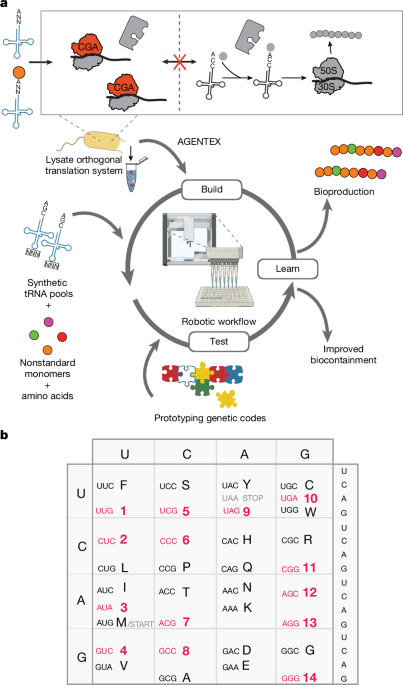
The tRNA pool sequences had been mechanically generated relying on the required variety of codons for use for translation. The peptide DNA sequence was additionally generated with compressed genetic code from a supplied amino acid sequence. All DNA sequences had been ordered as chip-synthesized oligonucleotides and amplified and purified by machine protocols. The entire tRNAs in every tRNA pool had been transcribed in a single response, and all swimming pools had been purified in parallel. When an orthogonal aaRS, as in pazFRS used for M. jannaschii tRNAtyrCUA, was required, its dsDNA was additionally included within the translation response combination. All response steps (dsDNA manufacturing, tRNA manufacturing, cell-free translation response) had been inherited from a mixing script that separated pattern knowledge illustration from machine management. Three .xlsx spreadsheets had been supplied containing layouts of two supply plates in addition to reactions. A .csv file was mechanically generated that specified all operations the instrument would carry out. The machine management protocol would then management the {hardware} and execute all steps.
Proteomic evaluation of peptides produced in cell-free translation methods
Quantitative evaluation was carried out by a Q Exactive Orbitrap mass spectrometer (Thermo) outfitted with an Evosep (Odense) nano-pump. The samples had been run on 30 SPD (samples per day) technique by Evosep. Stream-through that was size-filtered by 10 kDa filters was additional digested in 50 mM TEAB buffer with trypsin for 3 h. The ensuing digests had been loaded straight onto Evotips (Evosep). The peptides had been eluted from Evotips straight to fifteen cm PepSep C18 (Bruker) column for chromatographic separation. The Q Exactive instrument was run in WWA mode (extensive window isolation) with MS data-dependent acquisition. The information had been searched by Thermo Proteome Discoverer 3.1.1.93 with Chimerys search engine. The information had been searched in opposition to the final E. coli K12 database from Uniprot and a custom-built library database that included all predicted amino acid modifications. We allowed variable modification on Ala (+4 Da) in instances wherein isotopically labelled alanine was included within the cell-free translation system. All quantitation of the presence of such heavy amino acids was accomplished primarily based on MS spectra peak volumes that had been mechanically extracted by software program from uncooked knowledge. The outcomes had been saved at 0.1% FDR stage on each peptide and protein stage by Percolator64.
For evaluation of AGENTEX crosstalk, quantitative evaluation of pulldown samples from magnetic beads was carried out with ZenoTOF7600+ (SCIEX) coupled with Evosep (Odense) nanoHPLC system. The samples had been digested straight from the magnetic beads in 50 mM TEAB buffer at 37 °C over 3 h. The digested peptides had been loaded straight into Evosep ideas for evaluation. The peptides had been eluted from Evotips straight to fifteen cm PepSep C18 (Bruker) column for chromatographic separation. The instrument was operating in DIA mode with a 400–800 Da and computerized window isolation with 20 ms accumulation time for MS/MS acquisition. Searches had been accomplished with the PEAKS 13 database (BSI). All searches had been accomplished with 1 % FDR at protein and peptide ranges. The information had been searched in opposition to the final E. coli K12 database from Uniprot and a custom-built library database that included all predicted amino acid modifications.
Reporting abstract
Additional data on analysis design is obtainable within the Nature Portfolio Reporting Summary linked to this text.